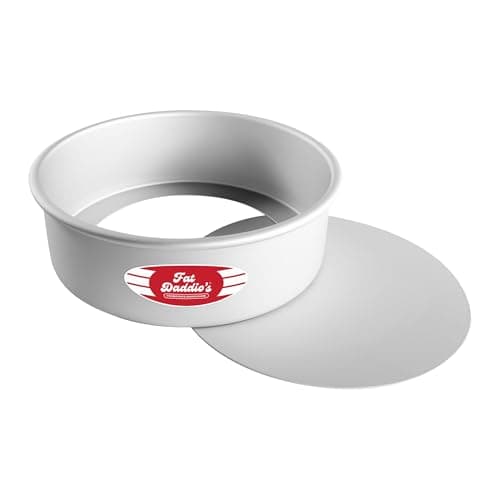
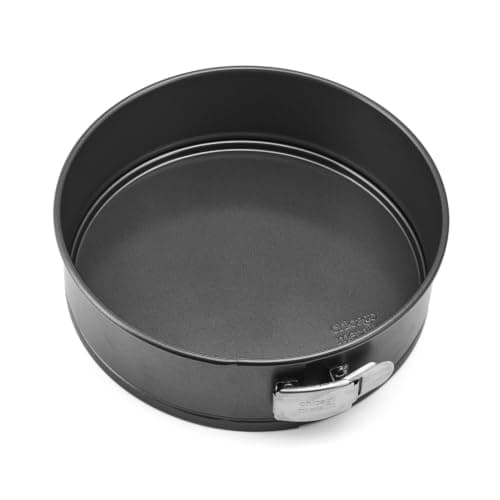
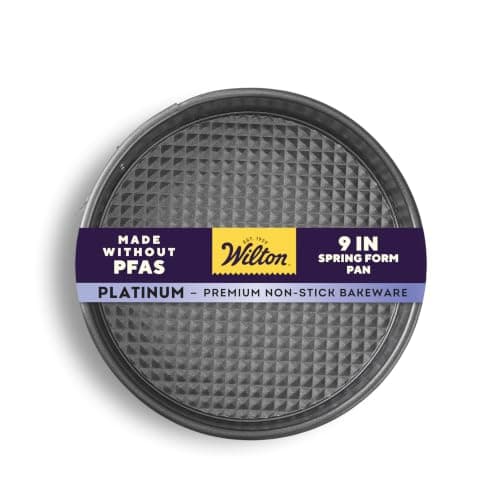
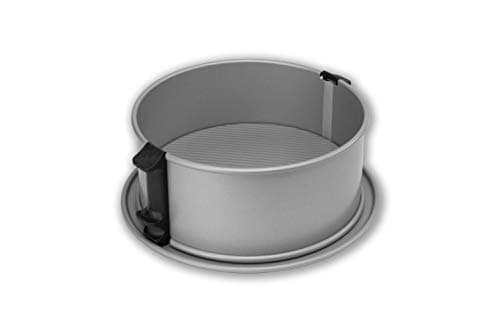
Buy the USA Pan leak-proof springform. It is the only pan on this page that treats leaking as an engineering problem rather than your problem: USA Pan publishes an o-ring seated in a groove on the base, silicone vertical seals fitted into the rolled edges of the sidewall, and a sidewall that latches onto an oversized base plate — three seals where a conventional springform has none. Aluminized steel, Americoat nonstick, a published 450°F ceiling and a lifetime limited warranty. Take the Fat Daddio's PCC-93 instead if you want nothing on the pan to wear out: it is a push pan, not a springform, so there is no hinge or latch at all, the walls are uncoated anodized aluminum, and it gives you a full 3 inches of depth. The Chicago Metallic 9 x 3 is the cheapest genuinely tall pan here, with a published 450°F rating and a buckle latch. The Wilton Platinum is the budget pick, and the only one of the four published as dishwasher safe.
Why springform pans leak, and why that is a design fact rather than a defect
A springform pan is two parts: a ring with a hinge and a clamp, and a flat disc that drops into it. There is nothing bonding the two. The ring tightens around the base and the fit is close, but a close fit is not a seal, and cheesecake batter is thin enough to find any gap — a batter of cream cheese, eggs and sugar is closer in viscosity to a thick custard than to a cake batter. Put that pan in a water bath, which is what most cheesecake recipes ask for, and you now have water pressing in from outside as well as batter pressing out from inside.
That is the whole reason this category exists in the shape it does, and it is why the pans divide into three genuinely different answers:
1. Engineer the seal. USA Pan is the pan here that does it: a rubber o-ring in a machined groove, silicone seals in the sidewall edges, and an oversized base the wall latches down onto rather than balancing on the edge of. This is the only approach on the page that attacks the mechanism rather than compensating for it, and it is the reason it tops this list.
2. Remove the hinge entirely.A push pan — the Fat Daddio's PCC-93 — is a seamless one-piece ring with a loose base you push up from underneath. No hinge, no clamp, no mechanism to loosen with age, and a sidewall with no vertical seam for batter to track down. It is still not leakproof, because the base-to-wall junction is a junction, and it removes the part of a springform that most often fails after a few years.
3. Accept it and wrap the pan. The Chicago Metallic and Wilton picks are conventional hinge-and-base pans, which is also what nearly every cheesecake recipe on the internet assumes you own. The workaround is foil: two wide sheets of heavy-duty foil crossed under the pan and crimped up the sides above the water line, or a purpose-made silicone sling. It works, it is fiddly, and it is the reason the premium pan costs what it does.
Depth is the second spec, and it is the one recipes care about
Nine inches is the standard diameter and almost every cheesecake recipe is written for it. The variable is depth, and the published figures here run from 2.625 to 3 inches:
- USA Pan: 9 x 9 x 2.625 in baking surface (published).
- Wilton Platinum: 9 x 2.75 in (published).
- Chicago Metallic and Fat Daddio's: a full 3 in.
Three-eighths of an inch does not sound like a decision until you bake a New York-style cheesecake, which is a tall, dense, 2.5-to-3-pound filling that is supposed to come out as a cliff rather than a slab. In a 2.625-inch pan that filling reaches the rim, and a cheesecake that touches the rim cannot get the gentle dome it needs without spilling. Lighter, lower cheesecakes, tortes, ice-cream cakes and most European-style bakes fit a 2.625-inch pan comfortably.
So the depth question resolves cleanly: if New York cheesecake is why you are buying, buy one of the 3-inch pans. If you want the best-engineered pan and bake across a range, the USA Pan's seals are worth more than the extra 3/8 inch. Our best cake pans page makes the same argument about layer-cake depth, and it is the same arithmetic: batter volume scales with depth, so a deeper pan is a different pan and not just a bigger one.
Surface: coated, or anodized and bare
Three of these pans are coated steel and one is uncoated anodized aluminum, and the trade is exactly the one we lay out across the uncoated bakeware lane.
Coated(USA Pan's Americoat, Chicago Metallic's nonstick, Wilton's DURALAST) means the set edge of a cheesecake releases from the ring without running a knife around it, which on a delicate custard genuinely matters. The coating is a consumable: it caps the pan at a published 450°F, it does not like metal tools, and the makers recommend hand washing however the dishwasher label reads.
Anodized and uncoated (Fat Daddio's) means the aluminum's own surface has been hardened electrochemically. There is nothing to peel, flake or wear off, Fat Daddio's rates the anodized line to 550°F — the highest figure on this page by 100 degrees — and the pan is effectively permanent. The cost is that it is not a release surface: you grease the ring and line the base with a parchment round every single bake, exactly as you would with the anodized cake pans in our Fat Daddio's cake pan review.
Published specifications of the four picks
| Pan | Depth | Seal design | Surface | Oven ceiling |
|---|
| USA Pan leak-proof (1086SF) | 2.625 in | O-ring + silicone edge seals, oversized base | Americoat nonstick silicone | 450°F |
| Fat Daddio's PCC-93 | 3 in | Push pan — no hinge or latch | Anodized aluminum, uncoated | 550°F (line) |
| Chicago Metallic 9 x 3 | 3 in | Conventional hinge + buckle latch | Nonstick carbon steel | 450°F |
| Wilton Platinum | 2.75 in | Conventional hinge + clip | DURALAST silicone-infused coating | 450°F |
One gap worth naming: no maker or retailer publishes a gauge or thickness figure for the Chicago Metallic pan, so we cannot compare how heavy its steel is against the USA Pan's. Its 3-inch depth and its published 450°F rating and limited lifetime warranty are what we rank it on. Where a figure does not exist we say so rather than borrowing one from a sibling pan — see how we pick.
How to choose and use a springform pan
Wrap the pan unless the pan says you do not have to
For any conventional hinge-and-base springform in a water bath, the routine is two overlapping sheets of heavy-duty foil crossed under the pan and crimped up the outside, finishing above the eventual water line, with as few creases below it as you can manage. Press the foil to the metal rather than leaving a loose skirt — water wicks into gaps. A silicone cheesecake sling does the same job more tidily and is the better buy if you bake cheesecake often with a pan you already own.
The alternative that avoids the whole business: skip the bath and use a pan of hot water on the rack below the cheesecake. You lose some of the gentle, even set a true bain-marie gives, you keep the humidity that stops the top cracking, and nothing can leak into anything.
Check that the base sits flush, and check the ring is round
Two things to inspect on arrival and once a year afterwards. Put the base in the ring, clamp it, and look at the seam from the side: the base should sit level in its channel all the way round with no visible step. Then set the open ring on a flat counter and look for daylight under it. A ring that has warped — from a dishwasher, from being stacked under heavy pans, from thin steel and years of heat cycling — will never seal again however much foil you use, and no amount of clamping makes a non-circular ring circular. This is the practical argument for the thicker-walled pans: Wilton's anti-warp wall claim and USA Pan's heavy aluminized steel are both addressing exactly this.
Line the base, every time
A parchment round on the base is the cheapest insurance in this category. It guarantees the cake lifts off the disc cleanly, it means a knife never has to touch the base, and on the uncoated Fat Daddio's pan it is not optional. Cut it by standing the base on the parchment and tracing round it, or fold a square into eighths and cut an arc — the same method as in how to grease and line a loaf pan.
Releasing: run the knife before you open the clamp
The order matters. Chill the cheesecake fully — a warm cheesecake tears, and most recipes want four hours or overnight. Then run a thin knife or small offset spatula around the inside of the ring, warmed under a hot tap and dried, before you release the clamp. Opening the clamp first means the ring moves while the cake is still stuck to it, which is how you get a torn edge on a cake you waited a day for.
A springform is more useful than just cheesecake
Worth knowing before you decide a cheesecake pan is a single-purpose purchase: a 9-inch springform is the standard pan for deep-dish and Chicago-style pizza, for ice-cream cakes and semifreddo (freeze in the pan, release, serve), for tortes and flourless chocolate cakes that are too fragile to invert out of a solid pan, for layered savory bakes, and for setting a no-bake dessert on a biscuit base. Any batter you can bake in a solid round pan can be baked in a springform — the removable side simply means you never have to turn the cake upside down to get it out.
What we did not feature, and why
Glass and ceramic springforms do not meaningfully exist; the mechanism needs metal's stiffness. If you want glass, you want a solid dish and a dessert you serve from it, which is the trade covered in our glass vs metal comparison.
Silicone-walled springforms release easily and insulate badly, and a flexible ring is the opposite of what a pan whose job is to hold a seal needs.
No-name “leakproof” springforms are the biggest category on Amazon by listing count and are absent here on purpose. Several publish no material, no temperature rating and no warranty while using the word leakproof in the title. We rank on published specifications, and a claim in a product title is not one.