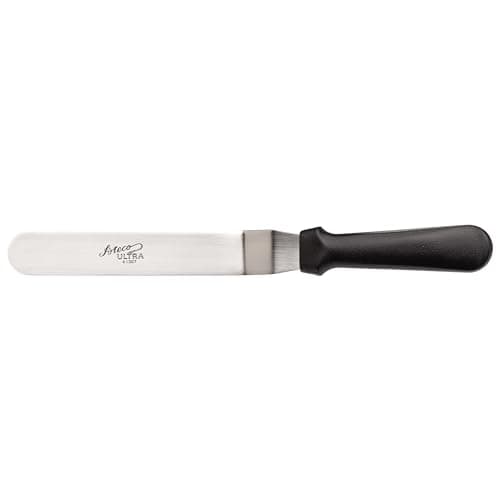
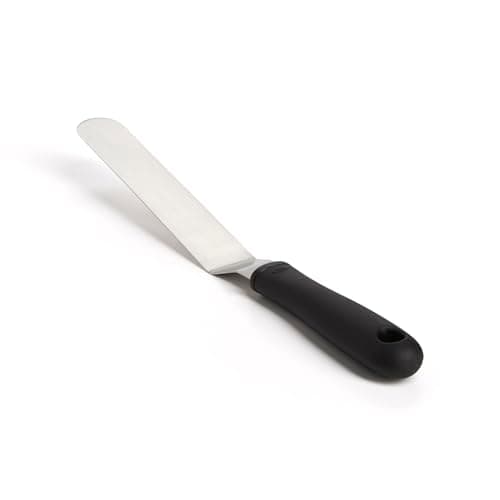
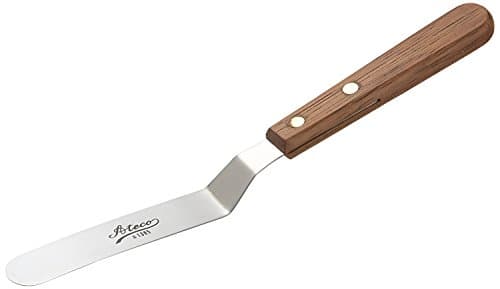
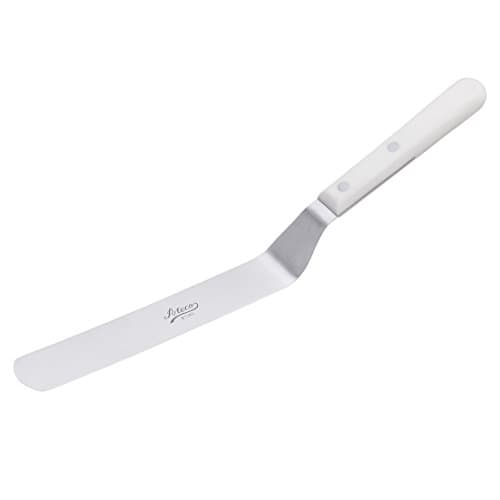
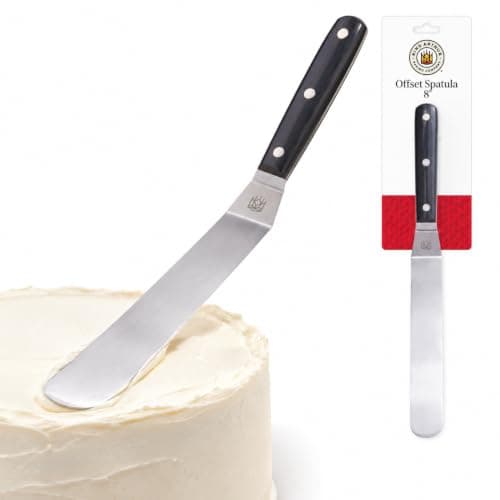
Buy the King Arthur Baking Company 8-inch offset spatula. Eight inches is the length that crosses the top of a 9-inch layer in two passes rather than five, and King Arthur publishes what almost nobody else in this category does: Japanese stainless steel, a BPA- and PFAS-free handle, 12.52 inches overall with an 8-inch blade, and a dishwasher rating. Take the Ateco Ultra 7.75-inchinstead to spend roughly half as much for a blade a quarter-inch shorter — the specs are thinner, the tool is not. The OXO Good Grips Bent Icing Spatula has the most comfortable handle here and publishes no blade dimension at all. The Ateco 1385 is a 3/4 x 4.5-inch detail blade for cupcakes and corners, and the 9.75-inch Ateco is the one to buy when the thing you are frosting is a sheet cake.
The criteria: length is the spec, and the bend is the mechanism
An offset spatula is a flat blade set below the line of its handle, so that the blade can lie flat against a surface while your hand stays above and clear of it. That is the whole idea, and it is worth saying plainly because the name describes the geometry rather than the job. A straight icing spatula puts your knuckles in the same plane as the blade; inside the rim of a brownie pan, or against the top of a cake you are trying to level, that is the difference between a flat surface and a dragged one.
So the bend is not a comfort feature. It is clearance. Everything else about choosing one follows from the length, in this order:
1. Blade length, matched to what you are spreading. This is the decision, and it is the one most people get wrong by buying a set. A blade should ideally cross the work in one or two passes, because every pass you add is another chance to leave a ridge. A 9-inch round cake wants roughly 7 to 9 inches of blade. A cupcake wants 4 or 5. A quarter-sheet cake wants 9 or 10. A blade much longer than the work is unsteerable; a blade much shorter turns one smooth sweep into six overlapping ones.
2. Flex, which is a trade and not a quality.A flexible blade conforms to what it is pressed against, which is exactly what you want for spreading frosting, ganache or batter into an even layer. A stiff blade keeps its own shape, which is what you want for lifting — sliding under a cookie, a brownie, a tart base. No blade does both well. King Arthur sells the 8-inch as extra flexible, which is right for frosting and means it will bow under a loaded brownie. Ateco publishes its blades as tapered ground, which is a manufacturing description with a real consequence: the flex is distributed evenly along the blade rather than concentrated at the tip.
3. Blade width, which nobody thinks about until it is wrong.A 1.25-inch blade is a spreading tool. A 3/4-inch blade reaches into places the wide one cannot — between cupcake liners, into the corner of a square pan, under the edge of a cookie sandwich. Width is why a second, small spatula is a sensible purchase and a matching set of three usually is not.
4. Handle material, and whether it can go in the dishwasher. Three patterns exist here: riveted wood (warm, traditional, must be dried by hand), hard polypropylene (what commercial kitchens specify, because it absorbs nothing), and soft overmold (the most comfortable, and a wear part). The dishwasher ratings follow: Ateco publishes its plastic-handled blades as dishwasher safe and publishes no such rating for the wood-handled 1385, and both King Arthur and OXO publish theirs as dishwasher safe.
5. Whether the maker publishes anything at all.This category is mostly unbranded three-piece sets with no published steel, no blade thickness and no dishwasher rating, sold on a photograph. We rank what is published, and where a figure does not exist we say so rather than borrowing one from a sibling product — see how we pick.
Published specifications of the five picks
| Spatula | Blade | Handle | Dishwasher | Best at |
|---|
| King Arthur 8 in | 8 in, Japanese stainless | BPA/PFAS-free plastic | Yes | Layer cakes |
| Ateco Ultra 7.75 in | 7.75 x 1.25 in, taper ground | Polypropylene | Yes | Value |
| OXO Bent Icing Spatula | Not published | Soft non-slip | Yes | Comfort |
| Ateco 1385 | 3/4 x 4.5 in, taper ground | Wood, two rivets | Not published | Detail |
| Ateco 9.75 in | 1.25 x 9.75 in, tapered | Plastic, stainless rivets | Yes | Sheet cakes |
Two gaps worth naming rather than filling in. OXO publishes no blade length, width or thicknessfor the Bent Icing Spatula anywhere in its listing, which makes it the one pick here you cannot size on paper before it arrives — we have not estimated it from a photograph. And none of the five publishes a blade thickness, which is the figure that would let you compare stiffness directly; King Arthur describes its blade as extra flexible and Ateco describes its blades as taper ground, and those descriptions are the best available evidence rather than a measurement.
Why 8 inches, and why a set of three is usually a mistake
The appeal of a three-piece set is obvious and the arithmetic is against it. Sets are typically 6, 8 and 10 inches, and in practice almost everybody uses one of the three. The 8 does the cakes; the 10 is awkward on a round and only earns its keep on a sheet; the 6 is too wide to be a detail tool and too short to be a cake tool, so it sits in the drawer.
The better buy is a long blade for the work and a narrow blade for the detail — two tools that do genuinely different things. That is why our top two picks are both in the 7.75-to-8-inch band and the fourth pick is a 3/4-inch-wide blade less than half that length. A 1.25-inch-wide 6-inch blade is the one size that is not a job.
On a 9-inch round, an 8-inch blade reaches past the center from either side, so the top gets smoothed in two overlapping passes with one ridge to blend. Go down to 6 inches and the same top takes four or five passes and there are three or four ridges, each of which has to be worked out. That is the entire case for length, and it is visible in the finish rather than theoretical.
Flexible or stiff: pick the job before the tool
This is the one place where buying the wrong spatula produces real frustration, because flex is not a quality level. It is a specialization.
A flexible bladepresses into frosting and follows the surface under it. Loaded against the side of a cake it bends slightly and stays in contact across its whole length, which is what lays down an even coat. It is also what you want for pushing batter into the corners of a pan, for spreading ganache to the edge, and for lifting the last of a filling out of a bowl. King Arthur's 8-inch is sold as extra flexible and the OXO as flexible; both are frosting tools first.
A stiff bladekeeps its plane. Slide it under a brownie and the brownie comes up level instead of folding; get it under a cookie that has spread and stuck, and the cookie releases in one piece. Nothing on this page is a genuinely rigid lifter — that is a different tool, usually sold as a cookie or tart spatula — but the Ateco blades are the stiffer of the group, because taper grinding puts more metal nearer the handle.
If you want one blade to do both jobs acceptably, the 7.75-inch Ateco Ultra is the compromise we would make: enough flex to spread, enough spine to lift a bar if you are careful about where you put it.
What the offset actually buys you, beyond cake
Worth knowing before you decide this is a decorating-only tool. The clearance that the bend provides is useful anywhere a flat blade has to work inside a rim: leveling batter in a cake pan so it bakes flat instead of domed, spreading brownie or bar batter into the corners of a square pan, smoothing the top of a loaf of batter bread, easing a cheesecake away from the ring of a springform pan, lifting and turning decorated cookies, spreading tempered chocolate thin for bark, and sliding under a tart base to move it off the pan bottom.
It is also the correct tool for the single most useful trick in layer-cake assembly: a long offset blade, laid flat on top of the cake and drawn toward you while the cake turns, levels a dome without a cake leveler and without a serrated knife. On a turntable — see the best cake turntables— that same motion is how the top gets genuinely flat.
None of which makes it a tool you will use weekly if you do not frost things. It is cheap enough that it does not have to be.
How to choose and use an offset spatula
Buy for the biggest thing you frost, then add a small one
The decision is one question: what is the largest surface you regularly spread something across? If it is an 8 or 9-inch round, buy a blade in the 7.75-to-8-inch band and you are done. If it is a 9 x 13 pan or a quarter-sheet cake, buy the 9.75-inch. If it is cupcakes and cookies, buy the 4.5-inch and nothing else.
Then, if you decorate often, add the other end of the range rather than the middle. Two spatulas that do different jobs beat three that overlap, and a 4.5-inch detail blade plus an 8-inch working blade covers essentially everything a home baker frosts.
The one technique that makes a flat top
Put more frosting on than you need, in a mound in the middle. Lay the blade flat — flat, not angled — across the top with the tip past the far edge, and pull it toward you in one continuous motion while rotating the cake a quarter turn. Do not press. The blade rides on the frosting, and the offset keeps your hand above the cake so you can see what you are doing. Repeat from a new angle, and wipe the blade between passes.
The mistakes are all the same mistake: too little frosting, so the blade touches crumb and drags it through the finish; and pressing down, which makes the flexible blade bow and leaves a shallow trough. More frosting and less pressure fixes almost everything.
Warm the blade for the last pass
Dip the blade in hot water and dry it, then make one final light pass. The warm metal melts the outermost film of buttercream and leaves a surface with no tool marks in it at all. It is the oldest trick in cake decorating and it costs nothing. Dry the blade properly between dips, because water dragged into buttercream shows.
Use it to level batter, not just frosting
A domed cake is mostly an oven-and-recipe problem, but some of it is that the batter went in uneven. Pour, then take an offset blade and spread the batter very slightly higher at the rim than in the center. The middle rises fastest; starting it lower gets you closer to flat, which means less to level and less cake in the bin. This matters most in the deeper pans covered in 8-inch vs 9-inch cake pan.
Cleaning, by handle
Plastic and polypropylene handles (the Ateco Ultra, the 9.75-inch Ateco, King Arthur, OXO): all four are published dishwasher safe. The blades are stainless and the handles are sealed, so there is nothing to protect.
Wood handles (the Ateco 1385): hand wash, dry immediately, and do not leave it standing in a sink. Ateco publishes no dishwasher rating for the wood-handled blades, and a riveted wood handle that is repeatedly soaked will swell, dull and eventually loosen around the rivets. This is the same rule as every wooden-handled baking tool.
Buttercream in the offset itself is the part people miss. The crook of the bend is a corner, and frosting packs into it. Run a thumb or a brush through the angle rather than just wiping the flat of the blade.
What we did not feature, and why
Unbranded three-piece spatula setsare the largest group in this category by listing count — usually 6, 8 and 10 inches for less than a single branded blade — and they are absent here on purpose. Most publish no steel grade, no blade thickness and no dishwasher rating, and several reuse the same photograph across unrelated storefronts. Our argument on this page is that the published blade dimensions are the product; a number in a title with nothing behind it is not a specification. If you want three sizes cheaply, that is a legitimate purchase and we cannot rank it against figures that do not exist.
Straight icing spatulas are a different tool and a reasonable thing to own instead. A straight blade is better for the sides of a tall cake, because the handle does not get in the way of a vertical pass, and it is what most people reach for alongside a bench scraper. They are not offsets and they do not solve the knuckle-clearance problem inside a pan rim.
Silicone spatulas and bowl scrapers come up in the same searches and do a different job: they are for getting batter out of a bowl, not for spreading a surface flat. Our picks for sticky-batter handling sit in is a dough whisk worth it.
Spatulas sold inside decorating kits— bundled with piping tips, a turntable and a scraper — price the blades as if they were free, and in those kits they generally are: thin, stamped, unmarked steel. Buy the stand separately and buy the blades separately.