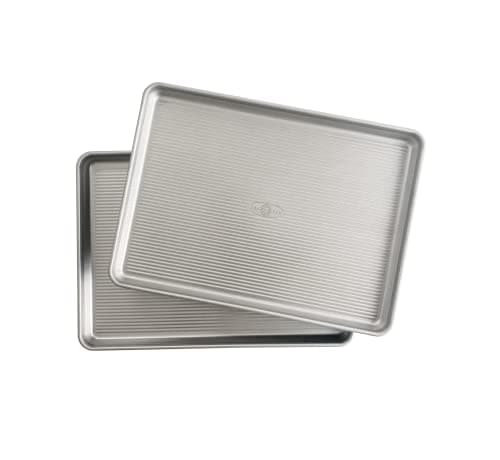
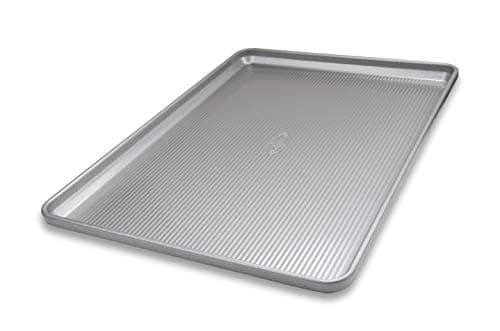
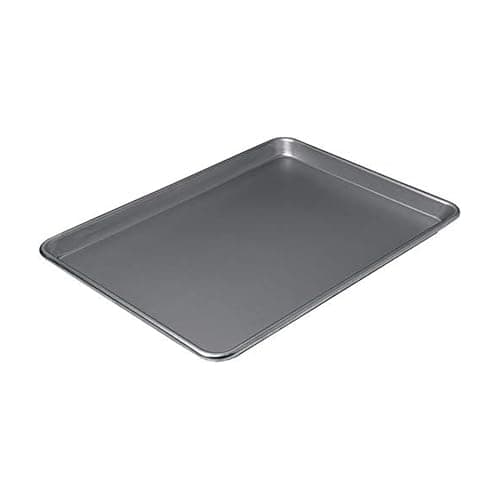
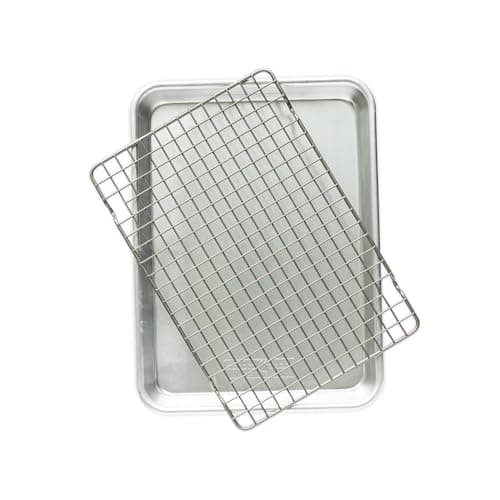
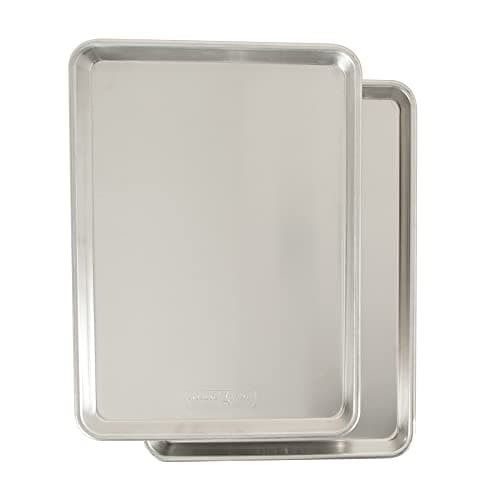
Buy the Nordic Ware Naturals half sheet two-pack. Cookies are the bake that exposes a sheet pan, because the only thing standing between a chewy cookie and a burnt one is how the pan delivers heat to the underside of the dough — and light, bare aluminum does that more gently and more evenly than any coated or dark pan you can buy. Add the encapsulated galvanized steel rim, which is the specific construction detail that stops a pan buckling in a hot oven and tipping your dough into one corner, and the fact that it comes two to a box with a lifetime warranty, and this is the easy answer. Buy the USA Pan half sheet two-pack instead if you will not line a pan and want a release coating made without PTFE. Buy the USA Pan Heavy Duty if your current pans have already warped on you. Buy the Chicago Metallic Professional as a cheap third pan for long batches, and the Nordic Ware quarter sheet if four cookies or a toaster oven is the real job.
Before the ranking, the single most useful thing on this page: you need two sheet pans, not one. Cookie dough put on a pan that is still hot from the last batch spreads before it sets, so batch three comes out flatter and more done around the edge than batch one did. Two pans alternating — one in the oven, one cooling on a rack — removes that variable entirely. It is the cheapest improvement available to anyone who bakes cookies, and it is why two of our five picks are sold in pairs.
What actually makes a cookie sheet good
Color, and therefore browning. A dark pan absorbs radiant heat and dumps it into the base of the cookie; a light pan reflects more of it. That is the whole mechanism behind the most common complaint in cookie baking, which is bottoms that are done before the middle is. Light bare aluminum is the reference surface. If your current pans are dark and your cookies burn underneath, you have already found your problem.
Gauge, and therefore evenness. A heavier pan evens out your oven's hot spots because it takes longer to change temperature; a thin pan transmits them straight through. This is also what decides whether a pan warps.
The rim. Nordic Ware's Naturals line encapsulates a galvanized steel wire in the rolled rim, and USA Pan reinforces its rims the same way. It is not cosmetic: the rim is what resists the differential expansion that makes a cheap pan jump and buckle with a bang when you slide it into a hot oven. See how to keep baking sheets from warping for why that happens.
A rim at all, in fact. Every pan here is a rimmed sheet pan rather than a rimless cookie sheet, which is the right default — a rim holds a sliding tray of dough, catches butter from a spreading cookie, and makes the pan usable for roasting too. The one thing a rim costs you is the ability to slide a sheet of cookies off sideways, which parchment solves anyway.
Published specifications of the five picks
| Pan | Surface | Published size | Oven ceiling | Pans |
|---|
| Nordic Ware Naturals half sheet | Bare aluminum | 17.9 x 12.9 in; 17.1 x 12.1 in surface | Not published as a limit | Two |
| USA Pan half sheet | Americoat, PTFE-free | 17.25 x 12.25 in surface | 450°F | Two |
| USA Pan Heavy Duty half sheet | Americoat, PTFE-free | Half-sheet footprint, heavier gauge | 450°F | One |
| Chicago Metallic Professional | Nonstick coating | 17 x 12.25 in | Not published | One |
| Nordic Ware Naturals quarter sheet | Bare aluminum, grid incl. | Quarter-sheet footprint | Not published as a limit | One |
Those are the manufacturers' own published figures, cited in Sources at the foot of this page, and two rows deserve a note. “Not published as a limit” on the bare aluminum pans means there is no coating to blister, so Nordic Ware does not publish a ceiling — that is not the same as a verified unlimited rating and we will not present it as one. “Not published” on the Chicago Metallic means we could not find a figure at all, so treat high-heat use of that pan as unverified. Our scores are judgments from documented research on published specifications and aggregated owner reports, not measurements — how we pick says so plainly.
Getting cookies right once you have the pan
Line it, and line it with parchment
Parchment is the most under-rated tool in cookie baking. It guarantees release on any surface including bare aluminum, it stops the pan's own color from mattering as much, it lets you portion a whole batch onto a sheet of paper and slide it onto a cool pan, and it makes cleanup a matter of throwing it away. A silicone mat does the same job and insulates slightly more, which can leave you paler bottoms — useful if you were burning them, unhelpful if you want color. Neither is a substitute for a decent pan, but both make a decent pan more forgiving. See how to grease and line a pan for the technique.
Get the dough off the pan when the recipe says
A hot sheet pan keeps cooking cookies after they leave the oven, which is the second most common cause of over-baked cookies after an over-hot pan. Move them to a wire rack at the time the recipe says rather than when they look done — how to use a cooling rack covers the timing and why airflow underneath matters.
Weigh the flour
Cookie dough is more sensitive to flour weight than almost anything else you bake, because the ratio of flour to butter and sugar is what decides whether a cookie spreads thin or stays domed. A cup of flour can vary by 20 percent depending on how it was scooped, which is enough to turn the same recipe into two different cookies. A scale fixes it permanently — see how to measure flour by weight and our ranked kitchen scales.
Chill the dough if it spreads
Cold butter spreads more slowly, so chilled dough holds its shape while the structure sets. If your cookies come out thin and lacy and you wanted thick and chewy, the pan is probably not the problem; the dough temperature is. Thirty minutes in the fridge, on the parchment, is usually enough.
Which of the five, by situation
- Buying your first pans: the Nordic Ware two-pack. Best browning, no coating to wear out, lifetime warranty, two pans.
- You refuse to use parchment: the USA Pan half sheet two-pack. A coated surface made without PTFE, PFOA or BPA, in a pair, with a 450°F ceiling that is fine for every cookie recipe there is.
- Your pans have warped before: the USA Pan Heavy Duty. Thicker gauge is the single best defence, and the extra mass also evens out oven hot spots.
- You bake very long batches: add the Chicago Metallic Professional as a third pan. It is the lightest pan here and the coating is a consumable, but as the pan that keeps a rotation going it is hard to argue with the price.
- Four cookies, or a toaster oven: the Nordic Ware quarter sheet. Same construction as our top pick at half the footprint, and the included grid doubles as a small rack.
Where this sits in a baking kitchen
Sheet pans are the highest-use item in most kitchens and among the cheapest to get right, so they are an easy early purchase — our baking essentials starter kit puts them near the front for that reason. If you want the whole sheet-pan field rather than the cookie-specific cut, see the best baking sheets. If the coating question is what you are stuck on, that is aluminum vs nonstick baking sheets, and the two brand head-to-heads are Nordic Ware vs USA Pan and Caraway vs Nordic Ware. And if the dough itself is the bottleneck rather than the pan, our best stand mixers for cookies and best hand mixers for cookie dough are the pages to read.