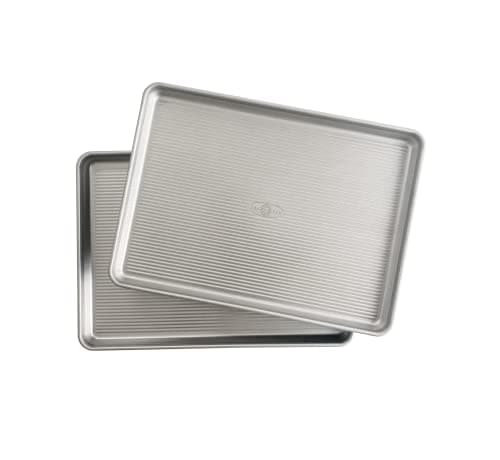
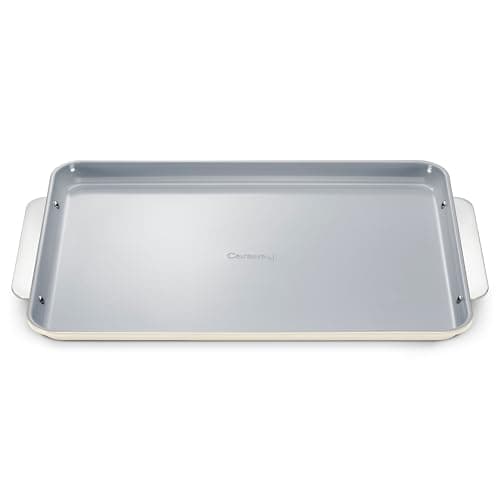
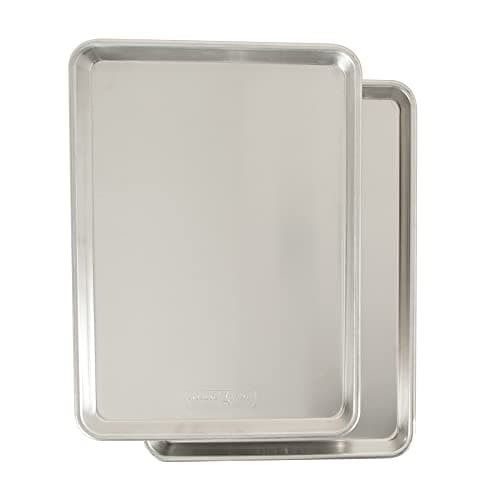
Bare aluminum is the better pan; nonstick is the more convenient one. Light, uncoated aluminum conducts heat quickly and reflects radiant heat, so it browns cookies and pastry more evenly than a coated pan; it has no coating to scratch, blister or lose its slickness, so it bakes the same at year ten as at week one; and because there is no coating to protect, no one publishes a temperature ceiling you could exceed. A coated pan buys you one thing in exchange: release without parchment. That is a real convenience and for some people it decides the purchase — but understand that you are buying a wear item, and that the coating is between the heat and your bake.
So the useful question is not “which is better.” It is: will you line the pan? If the answer is yes, buy bare aluminum and spend the difference on parchment. If the answer is honestly no, buy coated and accept that you will replace it.
What bare aluminum actually does
Aluminum is among the most thermally conductive metals in a kitchen, which means it comes up to temperature fast and distributes heat sideways through the pan rather than letting hot spots sit. Its color matters just as much: a light surface reflects a good share of the radiant heat coming off the oven walls and elements instead of absorbing it and pushing it into the base of your bake. Put those together and you have the surface that scorches cookie bottoms least, which is why it is the pan professional kitchens buy by the dozen.
The costs are real and worth stating. Bare aluminum is not a release surface — sticky, sugary batters grab it, and parchment or a silicone mat is effectively mandatory. Nordic Ware advises against the dishwasher, because detergent and heat discolor bare aluminum permanently. And it mottles and darkens with age: it will never look new again, though it bakes the same.
What a coating actually does
A nonstick coating is a thin layer of something slick — PTFE on most cheap pans, silicone-based on USA Pan's Americoat, ceramic on Caraway's — bonded to the metal underneath. It releases sticky bakes without a liner, and it makes cleanup easier. Three things follow from it that the box does not say.
It is a consumable. Coatings scratch, scour off and lose slickness. Ceramic coatings generally go sooner than PTFE ones. A coated pan has a service life; a bare one mostly does not.
It caps the temperature. This is the part that catches people out. USA Pan's coated sheets publish a 450°F ceiling, which is below the 475–500°F a lot of roasting and pizza recipes call for. Caraway publishes 550°F, the highest we rank. Exceeding a published rating is not a risk we will tell you to take, so if you roast hard, a 450°F pan is simply the wrong pan.
It sits between the heat and the bake. A coating cannot improve heat transfer into dough; at best it is neutral. That is why we score bare aluminum highest on browning.
The chemistry question, answered honestly
A lot of people arrive at this comparison because of what is in the coating rather than how it bakes, and that is a legitimate reason to shop. The complete answer is bare metal: a Nordic Ware Naturals pan has no coating at all, so there is nothing to ask about. The middle path is USA Pan's Americoat, a silicone-based surface the company lists as made without PTFE, PFOA or BPA. The premium path is Caraway, which lists its ceramic coating free of PTFE, PFOA, PFAS, lead, hexavalent chromium, phthalates, cadmium and mercury. All three of those are the manufacturers' own published claims, cited below; we are reporting what they publish, not testing it.
The published ceilings, side by side
| Pan | Surface | Published oven ceiling | Coating claims |
|---|
| Nordic Ware Naturals half sheet | Bare aluminum | Not published as a limit | No coating at all |
| USA Pan half sheet | Americoat, silicone-based | 450°F | Made without PTFE, PFOA, BPA |
| Caraway baking sheet | Ceramic over aluminized steel | 550°F | Listed PTFE-, PFOA- and PFAS-free |
All figures are the manufacturers' own, cited in Sources. The “not published as a limit” row means exactly that — an absence of a published ceiling, not a verified unlimited one. We will not convert a gap in the documentation into a claim; see how we pick.
Which to buy, by what you cook
Cookies, pastry, sheet cakes
Bare aluminum, lined with parchment. This is the bake where browning evenness is the whole game and release is a solved problem. Our best baking sheets for cookies ranks the field on exactly this.
Hard roasting and sheet-pan pizza
Above 450°F the coated USA Pans are out on their own published rating. Your options are the Caraway at 550°F or bare aluminum, and bare aluminum is also the cheaper and more durable of the two. Roasting is the one job where you actively want some stick — the browned fond on the pan is flavour.
Sticky, sugary bakes you will not line
Coated, and preferably in a pair so you are not washing one pan between batches. Caramel, toffee and anything with melted sugar is the case where a coating genuinely earns its place — though parchment on a bare pan still beats it for cleanup.
Everything, on one budget
Bare aluminum two-pack plus a roll of parchment. It is the cheapest route to two good pans, it covers every temperature, and nothing about it wears out. If you want a coated pan as well, buy it second and treat it as the specialist.
Two things that matter more than the coating
Gauge and rim construction
A heavy pan with an encapsulated steel rim will outperform a light coated pan at every job, coating or not, because it evens out oven hot spots and it does not buckle. If your pans have jumped and warped in a hot oven, that is a gauge-and-rim problem and no coating addresses it — see how to keep baking sheets from warping.
Owning two
A cool pan and a hot pan bake differently, so one good pan is worse than two adequate ones for anything that goes in batches. Both of the two-packs we rank fix this in one purchase. And if the pan you need is actually smaller — a toaster oven, a tray of nuts — see what size baking sheet do I need.
Where this sits
The same bare-versus-coated argument runs through the rest of the bakeware on this site, and it does not always land the same way. On loaf pans an uncoated bakery pan is the durability pick but asks you to grease every bake — see how to choose a loaf pan and the best loaf pans. On bread vessels the question becomes enamel versus bare iron, where the trade is seasoning and a temperature ceiling rather than release — see enameled vs bare cast iron for bread. The brand head-to-heads for sheet pans are Nordic Ware vs USA Pan and Caraway vs Nordic Ware.