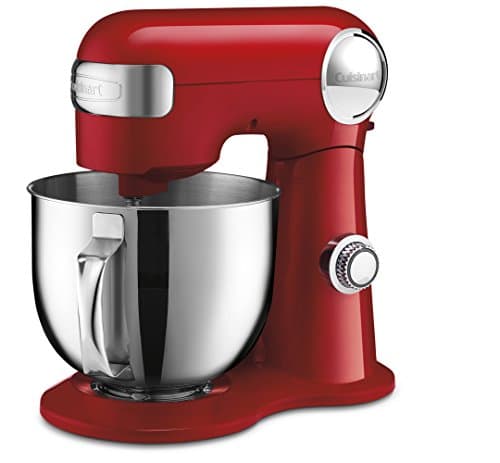
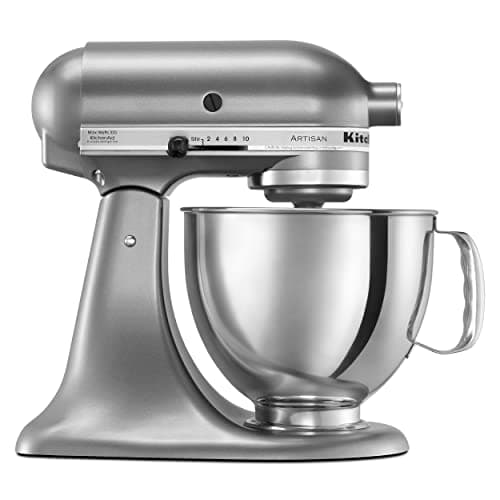
This is the comparison for anyone who's looked at the price of a KitchenAid Artisan, seen a Cuisinart Precision Master with a bigger bowl for less money, and wondered what exactly the extra KitchenAid dollars buy. It's a fair question, and the honest answer is specific: you're paying for an ecosystem and resale value, not for raw mixing capacity.
On the numbers that describe mixing, the Cuisinart Precision Masterwins. It has a larger 5.5-quart bowl versus the Artisan's 5, a higher rated motor, twelve speeds with a useful slow start, and it ships with a splash guard on top of the beater, whisk and dough hook. If you just want the most bowl and motor per dollar for creaming, whipping and kneading a loaf or two, it's the value pick, and it usually undercuts the Artisan on price too.
Where the KitchenAid Artisan pulls ahead is everything aroundthe mixing. Its front PowerHub is the deepest attachment ecosystem in the category — pasta rollers, grinders, spiralizers, ice-cream bowls — and nothing Cuisinart offers comes close. KitchenAids also hold resale value and parts availability better than any rival, and the cast build feels a step more refined. That's the trade in one line: the Cuisinart is more mixer today; the KitchenAid is a better platform over years. Our full Cuisinart review and Artisan review go deeper on each.
The short answer
Quick picks
| # | Product | Best for | Score | Price |
|---|
| 01 | KitchenAid Artisan 5-Qt Tilt-Head (KSM150)The default for a reason: 5-qt tilt-head, a mature attachment ecosystem, and enough motor for a couple of loaves a week. Not the mixer for daily heavy dough — but that's a small slice of home bakers. | Most home bakers | | $449.00·Amazon |
| 02 | Cuisinart Precision Master 5.5-Qt (SM-50)The value tilt-head. A larger 5.5-qt bowl and a stronger rated motor than the Artisan, usually for less money. The trade is a thinner accessory ecosystem and slightly rougher fit and finish. | Best value tilt-head | | $216.65·Amazon |
#ad · Live prices from the Amazon Product API, as of Sep 19, 2026. Where we have no verified live price we show none — a gap beats a number that has rotted.
In detail
The picks, in full
Most home bakers
KitchenAid Artisan 5-Qt Tilt-Head (KSM150)
325 W rated5-qt bowl10 speedsTilt-headPowerHub port
The default for a reason: 5-qt tilt-head, a mature attachment ecosystem, and enough motor for a couple of loaves a week. Not the mixer for daily heavy dough — but that's a small slice of home bakers.
- Motor / dough
- 8
- Capacity
- 8
- Build & durability
- 8.5
- Ease of use
- 9
- Value
- 8.5
Pros
- +Huge attachment ecosystem (grinder, pasta, ice cream) via the front PowerHub
- +5-qt bowl handles roughly a double batch of cookie dough or 2 loaves of bread dough
- +Holds resale value and parts availability better than any rival brand
Cons
- −Tilt-head flex shows on very stiff, low-hydration dough
- −325 W rated motor is mid-pack — it will bog if you knead dense dough daily
Don't buy this if…
…you knead stiff bagel or heavy rye dough every day — a bowl-lift or a Bosch has the motor headroom you'll keep asking for.
Best value tilt-head
Cuisinart Precision Master 5.5-Qt (SM-50)
500 W rated5.5-qt bowl12 speedsTilt-headSplash guard
The value tilt-head. A larger 5.5-qt bowl and a stronger rated motor than the Artisan, usually for less money. The trade is a thinner accessory ecosystem and slightly rougher fit and finish.
- Motor / dough
- 8
- Capacity
- 8.5
- Build & durability
- 7.5
- Ease of use
- 8.5
- Value
- 9
Pros
- +Bigger bowl and higher rated wattage than the same-price KitchenAid
- +12 speeds with a genuinely useful low start speed
- +Comes with dough hook, flat beater and whisk in the box
Cons
- −Far fewer first-party attachments than KitchenAid
- −Resale value and long-term parts support trail KitchenAid
- −Head latch feels less refined
Don't buy this if…
…you want to grow into pasta rollers, grinders and the wider attachment world — that's KitchenAid's home turf.
Buy the KitchenAid if… / buy the Cuisinart if…
Buy the KitchenAid Artisan if…
You want the attachment ecosystem, the strongest resale value, or the more premium feel — or you simply expect to keep the machine for a decade and want the deepest parts and service network behind it. If there's any chance you'll add a pasta roller or grinder, the KitchenAid is the platform to build on.
Buy the Cuisinart Precision Master if…
You want the most mixing capacity per dollar and you don't care about attachments. The bigger bowl and higher rated motor are real advantages for pure mixing and kneading, and getting the whisk and dough hook in the box adds value. For a straightforward home baker who just wants a capable machine, it's the smart-money buy — and the value champion of our budget roundup.
How to weigh the wattage gap
The Cuisinart's higher rated wattage reads as a knockout on a spec sheet, but rated watts and real kneading torque are not the same thing — gearing and drive design matter as much. Count it as a genuine point for mixing headroom, not proof it out-kneads a KitchenAid on every dough. Our wattage guide unpacks why.
The deciding question
Ask yourself one thing: will you ever buy an attachment? If yes, the KitchenAid's premium is buying something you'll use, and its resale value softens the cost later. If no, the Cuisinart gives you more mixer for less, and the KitchenAid tax buys you nothing you'll touch.
How we picked
We don't run a testing lab
We read the manuals, compiled the published specifications, did the wattage-to-dough math and weighed aggregated owner reviews, then scored each product against a published rubric. The scores are judgments from documented research — they are not measurements we took, because we do not have a lab and we're not going to pretend we do. Every spec is the manufacturer's published figure, cited in Sources.
Questions
Frequently asked
Is a KitchenAid or Cuisinart stand mixer better?+
It depends what you value. The Cuisinart Precision Master gives you a bigger bowl and higher rated motor for less money; the KitchenAid Artisan buys the deepest attachment ecosystem, stronger resale value and a more refined build. Choose the Cuisinart for value, the KitchenAid for the platform.
Does the Cuisinart really have a bigger bowl and stronger motor than the KitchenAid?+
Yes — on paper the Precision Master lists a 5.5-quart bowl (vs the Artisan's 5) and a higher rated wattage. Rated watts aren't the same as kneading torque, but for pure mixing capacity per dollar the Cuisinart out-specs a same-price KitchenAid.
Why is the KitchenAid more expensive if the Cuisinart out-specs it?+
You're paying for the attachment ecosystem, resale value and long-term parts support, not raw mixing numbers. If you'll never buy an attachment, that premium buys little; if you will, it's buying something real. See the
Artisan review for the full picture.
Receipts
Sources
We don't run a testing lab, and we don't pretend to. Specs are the manufacturer's published figures, cited above; scores are our judgments from that research. Where we couldn't verify something, we say so on the page rather than quietly leaving it out. Read our full method.