Use parchment paper for most of what you bake, and keep one silicone mat for sticky work. Parchment is thin, so the pan's heat reaches the base of a cookie almost unimpeded — you get the crisp, browned bottom that is the point of a good cookie. It can also be cut to shape, folded into a sling to lift a loaf out of a pan, used as a parchment transfer for Dutch-oven bread, and binned. A silicone mat is the better tool when the bake is sugary enough to weld itself to a surface, and when the same recipe runs often enough that disposable liners become a real cost. Its trade is insulation: a mat sits between the pan and the dough, so bases brown more gently — which is a defect for a chocolate-chip cookie and a feature for a macaron.
The comparison, by what each one actually does
| Parchment paper | Silicone baking mat |
|---|
| Browning the base | Better — thin, minimal insulation | Gentler — the mat insulates |
| Release on sticky, sugary bakes | Good | Best |
| Reusable | A few times at most | Hundreds of bakes |
| Cut to size, folded, used as a sling | Yes | No — fixed size and shape |
| High-heat roasting | Typically rated to around 425-450°F | Check the maker's rating — usually lower than you expect |
| Under a broiler | No | No |
| Spreading cookie dough | Spreads a little more | Grips, so less spread |
| Cost per bake | Pennies, forever | Effectively nothing after the first few dozen bakes |
| Storage | A roll in a drawer | Rolls, but wants to spring flat |
The temperature figures are the general published ratings for each product category, and they vary by brand — the practical instruction is to read the box, because a mat used past its rating degrades and parchment used past its rating scorches and can char at the edges.
Why a mat changes the bake, not just the cleanup
The mechanism is simple: silicone is an insulator and a sheet of parchment is barely anything at all. A cookie on parchment sits roughly on the pan; a cookie on a mat sits on a layer of rubber. Heat still gets through, but slower and more evenly, which means the base sets later and browns less.
That is a real and visible difference, and whether it is good or bad depends entirely on the recipe. For a chewy chocolate-chip cookie with a crisp base, parchment is the better liner. For a delicate shortbread or a tuile that scorches before the center cooks, the mat's gentleness is exactly what you want. For macarons it is close to mandatory — the grip stops the feet spreading and the even heat is what gives them a smooth top.
A mat also physically grips dough, which changes how cookies spread. Same dough, same oven: a cookie on a mat spreads less and stays taller. If your cookies are coming out flat and thin, swapping to a mat is one of the cheapest fixes available. The best baking sheets for cookies covers the other half of that equation, which is the pan underneath.
What parchment does that a mat cannot
It can be cut.A parchment circle for the base of a cake pan, a strip the length of a loaf pan, a round sized to the base of a Dutch oven — none of that is possible with a fixed mat. For round and loaf pans, parchment is simply the tool.
It makes a sling. A strip running the long way with two ends hanging over the rim gives you handles to lift a loaf or a traybake straight out of the pan without levering at a hot crust. This is the single best use of parchment and it is why an uncoated loaf pan is no harder to live with than a coated one — see how to grease and line a loaf pan.
It transfers bread into a hot pot. Proof a loaf on a parchment round, then use the paper to lower it into a preheated Dutch oven. It keeps your hands away from a 475°F rim and lands the loaf centered. Combo cooker vs Dutch oven covers why that step is the hardest part of Dutch-oven bread.
It goes straight in the bin. With the sugar, the burnt cheese and the fat. There is no washing step, which on a busy bake is worth more than the cost of the sheet.
The pans these go on
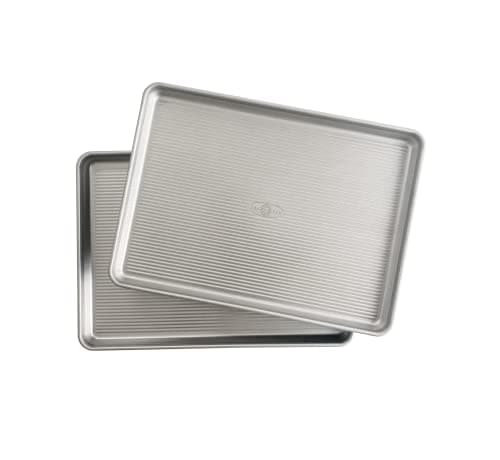
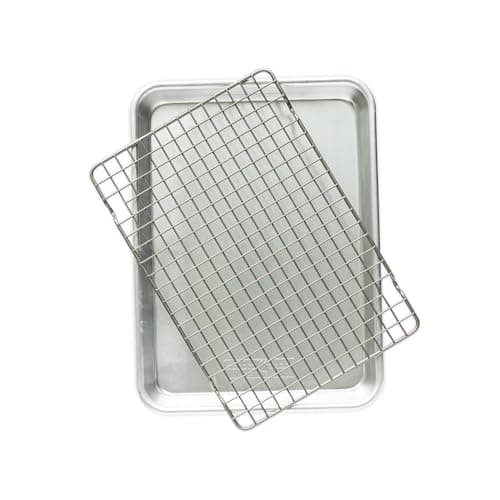
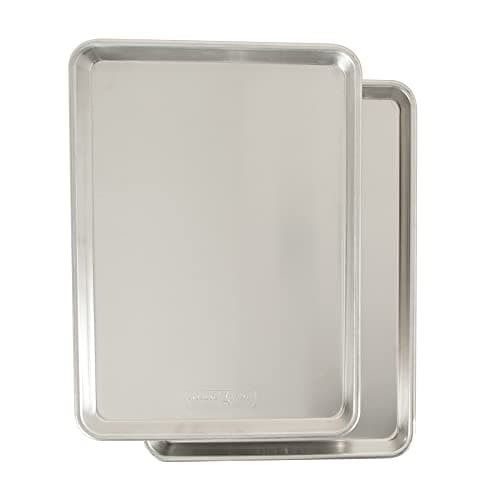
A liner is only half of the surface decision, and the pan matters more. Bare aluminum — the Nordic Ware Naturals half sheet 2-pack — effectively requires a liner, because raw aluminum is not a release surface; it is also the pan that browns best, so parchment on bare aluminum is the classic combination for cookies. The coated USA Pan half sheet releases without a liner for many bakes, which makes it the pick if you resent using parchment at all; note the 450°F published ceiling. The Nordic Ware quarter sheetis the small-batch pan and comes with an oven-safe grid, and at that size a half-sheet mat will not fit anyway — parchment cut to size is the only liner that works.
Which to reach for, by job
Chocolate-chip and most drop cookies: parchment, for a browned base. Switch to a mat if your cookies spread too much.
Macarons, meringues, tuiles, shortbread: mat. Grip and gentle, even heat are the point.
Anything with caramel, toffee or a sugar glaze: mat. This is the job where silicone is clearly better, and where parchment can bond to the sugar.
Roasting vegetables at 425°F and above:parchment, or nothing. Check your mat's rating — most are lower than roasting temperatures, and a degraded mat is a binned mat.
Lining a cake or loaf pan: parchment, cut to shape. A mat cannot do this.
Lowering bread into a Dutch oven: parchment, as a transfer sling.
Under a broiler: neither. Bare pan.
Three things that go wrong
- Using a mat past its temperature rating. It does not fail dramatically; it slowly gets tacky, stains and starts to smell. Read the number on the packaging and treat it as a hard limit.
- Parchment hanging over the rim at high heat. The overhanging edge has no food on it to keep it cool and it will brown, curl and in a hot oven char. Cut it to the pan or fold the edges in.
- Confusing parchment with wax paper.Wax paper is not oven-safe — the coating melts and smokes. They sit next to each other in the shop and look similar. Check the box.
Caring for a silicone mat so it lasts
Wash it in warm soapy water by hand, lay it flat or roll it loosely — never fold it, because a crease becomes permanent and then a weak line. If it is holding onto grease, a paste of baking soda and a little water rubbed in and left for a few minutes lifts the film that soap leaves behind. Do not cut on it, do not use it as a trivet for anything hotter than its rating, and retire it when the surface goes tacky rather than trying to rescue it.
Sized correctly it should sit flat inside the pan with no overlap climbing the walls. A half-sheet mat in a quarter-sheet pan is a common mistake and it buckles the liner right where the food is.
What neither one fixes
A liner cannot correct a pan that is too dark or too thin. If cookie bottoms burn while the tops stay pale, the problem is a dark, cheap pan absorbing too much radiant heat, and no amount of parchment or silicone will fully compensate — a light-colored, reinforced pan will. Best baking sheets and the best bakeware without a nonstick coating both cover why the metal underneath decides more than the layer on top of it, and how to use a cooling rack covers the step after the pan comes out.