If you weigh your ingredients — and for baking you really should — the choice between a digital scale and an analogspring scale isn't close. A digital scale reads to the gram, zeroes out between ingredients, and switches units at a button press; an analog spring scale does none of those things well. There's still a narrow place for a spring scale, and we'll be honest about it, but for accurate baking the digital scale wins before you weigh your first cup of flour.
Start with resolution, because it's the whole game in baking. A good digital baking scale reads in 1-gram (or 0.1-ounce) steps, which is fine enough to catch the difference between 120 grams of flour and 140 grams — a gap big enough to turn a tender cake dense or a bread dough slack. An analog spring scale reads off a needle sweeping a dial, and you're lucky to resolve it to the nearest ounce or 25 grams; the needle also drifts as the spring ages, so today's reading and next year's won't match. For weighing produce or a rough portion that imprecision is harmless. For a recipe where 20 grams of flour changes the result, it isn't. Weighing rather than scooping is the single biggest consistency upgrade in baking — our measure-flour-by-weight guide walks through why — and a digital readout is what makes that precision usable.
The tare (zero) buttonis the feature that turns a scale from a gadget into a baking tool, and it's the clearest line between the two types. Tare lets you set the scale back to zero with a bowl already on it, so you can add flour, hit zero, add sugar, hit zero, add butter — building a whole recipe in one bowl with nothing to wash between ingredients and no mental math. Every digital scale worth buying has it. A spring scale can't truly tare; the best it offers is a dial you twist to reset the needle to zero with the empty bowl on, which is coarse and has to be redone by hand for each ingredient. Once you've baked with a tare button, weighing without one feels like counting on your fingers.
Unit switching is the quieter convenience that only the digital side offers. Recipes come in grams, ounces and pounds depending on where they're written, and a digital scale flips between them — often five units or more — at a button press, so a European bread recipe in grams and an American one in ounces both work on the same tool. A spring scale is printed with one set of units on its dial and that's what you get. If you bake from a mix of sources, that flexibility saves conversions and the errors that come with them.
So where does an analog spring scale still earn a place? In three honest spots. It needs no batteries, so it's always ready and never dies mid-recipe. It's cheap and rugged, with nothing electronic to fail. And for rough weighing— a handful of vegetables, portioning meat, a camping or off-grid kitchen — nearest-ounce accuracy is plenty. If you never bake by weight and just want a knockabout scale for the pantry, a spring scale is a reasonable, cheap tool. But for baking, none of those strengths outweigh the missing tare and the coarse resolution. Our do-you-need-a-scale guide makes the broader case for weighing at all.
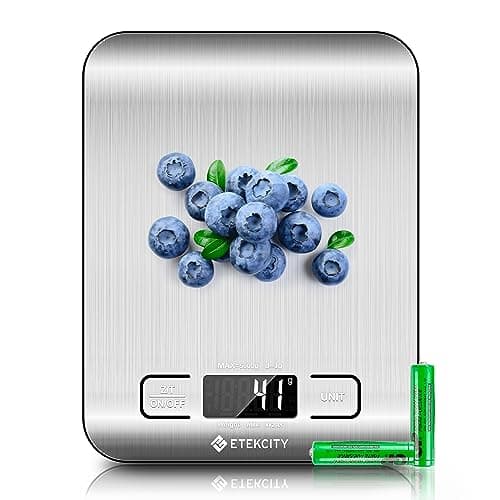
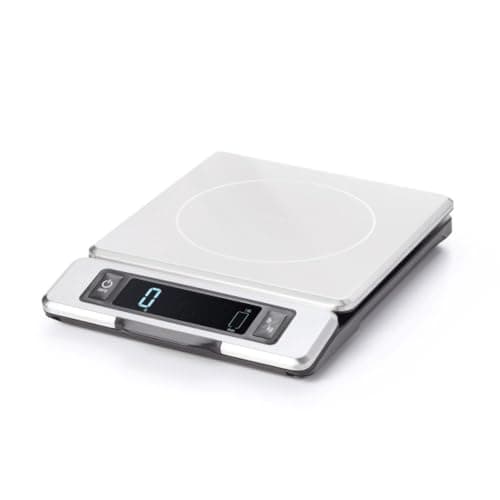
That leaves the real decision for most bakers: which digital scale? Our two picks bracket the market. The OXO Good Grips 11-lb scaleis the one to buy if you want the best everyday experience — it's the pricier of the two but still affordable. The Etekcity 11-lb digital scale is the budget answer that costs about as much as a bag of flour and still does the two things that matter. The rule: both weigh accurately to the gram and both tare, so buy the OXO for the nicer display and build, or the Etekcity to start baking by weight for the least money.
Which digital kitchen scale should you actually buy?
Buy the OXO Good Grips 11-lb scale if…
You want the scale you'll reach for without a second thought. Its standout feature is a pull-out displaythat slides forward on a little arm, so the numbers stay readable even with a wide mixing bowl parked on top — the exact situation where a fixed display disappears from view. It reads in fine 0.1-ounce / 1-gram steps up to an 11-pound capacity, tares cleanly for multi-ingredient weighing, and wipes down thanks to a stainless top. For a baker who weighs most bakes, the small premium buys a genuinely better daily tool, which is why it anchors our OXO food scale review as the most-recommended baking upgrade.
Who it's notfor: someone on the tightest budget, or anyone who wants a rechargeable scale — it runs on a battery, not a built-in cell. If the money is the hard constraint, the Etekcity does the core job for less.
Buy the Etekcity 11-lb digital scale if…
You want to start baking by weight for the price of a bag of flour. It reads to 1 gram, has the tare buttonthat actually matters, switches between five units, and ships with the AAA batteries in the box — the two must-have features of a baking scale with none of the excuses. You give up the OXO's pull-out display and a little polish, but the accuracy that changes your baking is all here. For a beginner or a second scale for a drawer, it's the honest value pick, and the reason it leads the budget end of our kitchen scales hub.
Who it's notfor: anyone weighing tiny quantities where a tenth of a gram matters (dialing in espresso, say), or anyone who dislikes a display that hides under a big bowl. It has no 0.1-gram fine mode and its auto-off is eager enough to switch off mid-recipe. If either bothers you, the OXO's pull-out readout is worth the step up.
Where an analog spring scale still earns a spot
Be fair to the old technology. A spring scale needs no batteries, costs little, and has nothing electronic to break, so it's a sensible knockabout tool for rough weighing — portioning produce, a camping kitchen, a garage or workshop. If you never bake by weight, that's a legitimate reason to keep a cheap spring scale in the pantry. What it can't do is the precise, tare-driven weighing that baking rewards: the needle is coarse, it drifts as the spring ages, and there's no true zero between ingredients. Treat a spring scale as a rough kitchen helper, not a baking instrument, and you'll be using it for what it's good at.
How to read the precision numbers
Two specs decide whether a digital scale suits baking: resolution and capacity. Resolution is the smallest step it reads — 1 gram or 0.1 ounce is the sweet spot for baking, fine enough to weigh flour and sugar accurately without being so twitchy it never settles. Capacity is the most it can hold; an 11-pound / 5-kilogram limit, which both our picks share, comfortably takes a big bowl plus a full recipe of ingredients. You only need sub-gram resolution for very small quantities like coffee or spices, and chasing it on a baking scale usually costs more and settles slower. For most home baking, 1-gram resolution and an 11-pound capacity is the target, and both these scales hit it. If you want to see how two scales at the same spec differ in the hand, our OXO vs Etekcity comparison puts them head to head.
The deciding question
Ask what you want the scale to do. If it's to bake accurately — consistent cakes, reliable bread, no more scooping — a digital scale is the only sensible choice, and the decision is just OXO for the better display or Etekcity for the lower price. If it's only to roughly weigh food now and then and never bake by weight, a cheap spring scale will do that. But since weighing is the biggest single upgrade a home baker can make, most people are really choosing between two digital scales, not between digital and analog at all.