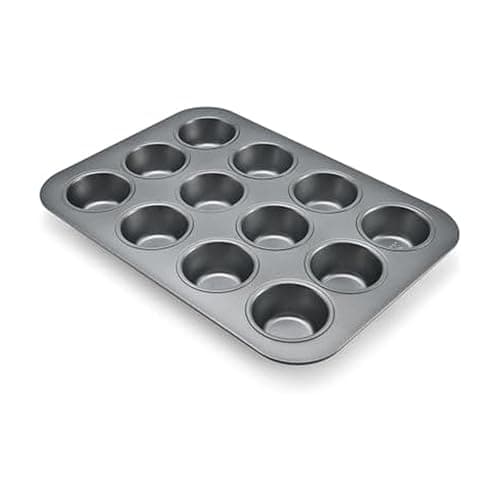
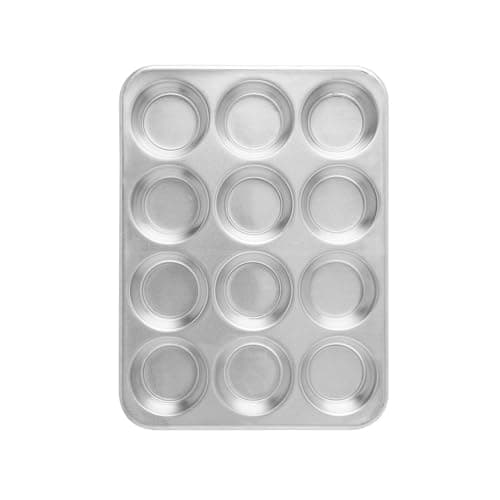
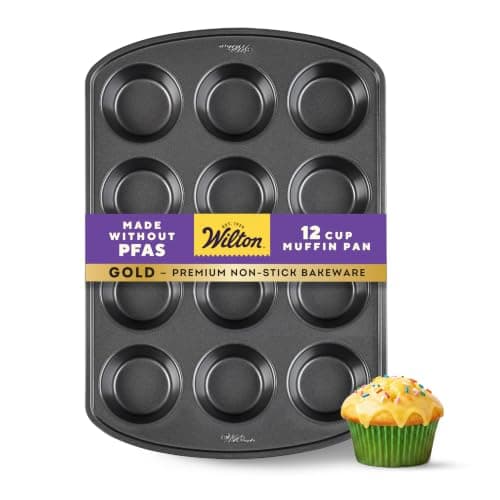
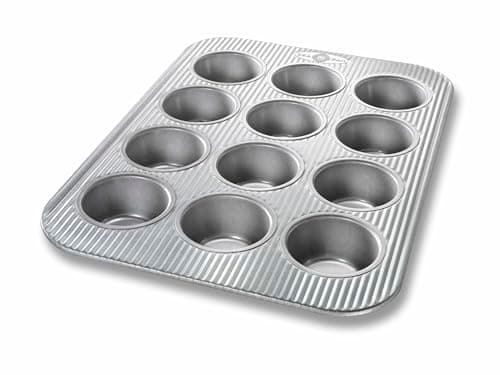
Buy the USA Pan 12-well muffin pan. It is heavy aluminized steel with USA Pan's Americoat silicone nonstick, it publishes a 450°F ceiling and a limited lifetime warranty, and it publishes the number that actually matters: a 2.75-inch well, which is the size every standard American muffin recipe and every standard paper liner is built around. The Chicago Metallic Commercial II is the best coated pan per dollar and has the commercial 12-cup footprint, with the honest caveat that the maker publishes no oven-temperature figure for it. The Nordic Ware Natural Aluminum Commercial pan is the uncoated pick: bare aluminum, nothing on it to wear out, and a published 500°F rating that is the highest here by 50 degrees. The Wilton Goldis the cheapest pan on the page that publishes real specs, and its wells are 2 inches rather than 2.75 — which is a reason to buy it knowingly, not a reason to avoid it.
The well diameter is the spec that decides this, and nobody checks it
A muffin pan is sold as a “12-cup” pan and that tells you the hole count, not the hole size. There are two common sizes in the standard category, and they are 25 percent apart in diameter: the commercial standard well is 2.75 inches across, and the budget-retail well is 2 inches. USA Pan publishes 2.75 x 2.06 x 1.38 inches per cup. Wilton publishes 2 inches in diameter by 1.25 inches deep. Both pans are called standard 12-cup muffin pans, and they bake visibly different muffins from the same bowl of batter.
This matters in three practical ways. First, yield: a recipe written for 2.75-inch wells gives you twelve muffins in a commercial pan and twelve smaller muffins plus leftover batter in a 2-inch pan. Second, bake time: a smaller, shallower well sets faster, so a recipe timed for the standard pan will overbake in a narrow one if you follow the clock rather than a skewer. Third — and this is the one that annoys people — paper liners. The standard muffin liner sold in American supermarkets has a 2-inch base and roughly a 1.25-inch wall, sized for the 2.75-inch pan. In a 2-inch-well pan the same liner has to be squashed in, and it comes out pleated and short.
So before anything else: look up the published well diameter of the pan you are about to buy, and match it to the liners in your drawer. Both sizes are legitimate. Buying one by accident is not.
Then the coating question, which the liner answers for you
The second decision is coated or uncoated, and the useful way to settle it is to ask what you actually do on a Saturday morning.
If you always use paper liners, buy the uncoated pan. A liner is a release surface. The nonstick coating on the pan underneath it never touches the batter and does nothing but wear out. That makes the Nordic Ware bare-aluminum pan the rational buy for liner users: there is no coating to scratch, nothing to flake, nothing to degrade, and Nordic Ware publishes a lifetime warranty and a 500°F ceiling precisely because there is no coating to put a limit on. The same logic runs through our best bakeware without a nonstick coating page, where three of four picks carry a lifetime warranty for exactly this reason.
If you bake muffins straight into the pan, buy the coated pan.Greasing twelve wells by hand is tedious, and an uncoated well will keep part of the muffin whatever you do with a brush. A good coating — USA Pan's Americoat, Chicago Metallic's dual nonstick, Wilton's PFAS-free scratch-resistant finish — releases a muffin with a light greasing and a twist. The cost is that it is a consumable: a coated pan is something you own for years, not forever, and cooking spray shortens that considerably because the propellant and lecithin bake into a varnish the coating cannot shed. USA Pan says plainly that it does not recommend cooking spray on its pans.
If you bake savory things in the pan, read the ceiling. Popovers and Yorkshire puddings start at 425–450°F; roasted egg cups and mini quiches sit around 375°F. The published ceilings here are 500°F for the uncoated Nordic Ware, 450°F for USA Pan and for Wilton, and nothing at all for the Chicago Metallic, which is why we treat that one as a conventional-baking pan only. A 450°F pan is outside its rating the moment a popover recipe says 450 and then tells you to preheat the pan. See how we pick for what we do when a maker publishes no number: we say so, and we do not borrow a figure from a sibling pan.
Material and color change the bake more than the price does
Three materials turn up in this category, and they are genuinely different tools.
Bare aluminum(Nordic Ware) is raw light metal. It conducts heat very fast and reflects radiant heat rather than absorbing it, so it browns gently and evenly — a muffin crown sets without the base going dark first. It is also soft, which is why Nordic Ware wraps the rim around a steel wire: the encapsulated rim is what stops a light pan buckling when it goes from a 400°F oven to a wet sink. It will stain and discolor, permanently, and that is cosmetic.
Aluminized steel(USA Pan, Chicago Metallic) is steel with an aluminum-silicon coating bonded to it. You get steel's stiffness — a pan that does not flex when you lift it full — with much of aluminum's conductivity. It is the commercial bakery standard for exactly that reason, and it is why both of these pans are heavier in the hand than their price suggests.
Formed steel with a dark coating (Wilton) is the supermarket construction. Thin steel heats and cools quickly, and a dark surface absorbs radiant heat, so bases brown faster than crowns. If you have ever had muffins with dark, slightly tough bottoms and pale tops, the pan was probably dark and thin and the rack was probably low. Move the rack to the middle or slightly above, and take fifteen degrees off.
Published specifications of the four picks
| Pan | Published well size | Material | Oven ceiling | Warranty |
|---|
| USA Pan 12-well (1200MF) | 2.75 x 2.06 x 1.38 in | Aluminized steel, Americoat | 450°F | Lifetime limited |
| Chicago Metallic Commercial II | 15.8 x 11.3 x 1.5 in pan (well size not published) | Aluminized steel, dual nonstick | Not published | Lifetime (Commercial II line) |
| Nordic Ware Natural Aluminum Commercial | 12 cavities (diameter not published) | Uncoated aluminum, steel rim | 500°F | Lifetime |
| Wilton Gold | 2 in dia x 1.25 in deep | Formed steel, PFAS-free coating | 450°F | Limited lifetime |
Two of these pans do not publish a well diameter, which is worth stating rather than glossing over. Chicago Metallic publishes the pan's outside dimensions — 15.8 x 11.3 inches, which is the commercial 12-cup footprint the trade pans use — and foodservice listings of the same maker's bakery pans give 2.75-inch cups, but we have not found a published figure for this retail item and so we have not put one in the table. Nordic Ware publishes capacity and warranty but not a cavity diameter for this pan. If the exact well size is critical to you, the USA Pan and Wilton figures are the two we can cite.
How to choose a muffin pan
Buy twelve wells, and buy two pans if you bake in batches
Twelve is the standard because nearly every muffin and cupcake recipe is scaled to twelve standard wells — about a third of a cup of batter each. Six-cup pans exist for small households and are a false economy if you ever double a recipe. The genuinely useful second purchase is a second identical pan rather than a different size: two pans of the same model bake at the same rate in the same oven, so a 24-muffin batch goes in and comes out together. Two pans of different lines brown differently and leave you rotating trays and guessing.
Jumbo and mini pans are different tools, not upgrades
A jumbo pan (roughly 3.5-inch wells) and a mini pan (roughly 1.75 inches) are not substitutes for a standard pan, because the recipe you own was written for a specific well volume. Jumbo wells need a longer bake at a lower temperature or the outside sets before the middle does. Mini wells bake in about half the time and dry out if you look away. Buy a standard pan first, use it for a year, and add a second size only when you know which direction you keep wishing for.
Check the rim, and lift the pan if you can
Two construction details separate a pan that stays flat from one that rocks on the rack after a year. The first is the rim: an encapsulated steel wire rolled into the edge, which is what the Nordic Ware pan uses, stiffens the whole pan and resists the differential expansion that buckles light metal. The second is simply mass. A heavier pan in the same material is a thicker pan, and thickness is what resists warping and evens out the oven's hot spots. Our how to keep baking sheets from warping page covers the mechanism in detail, and every word of it applies to a muffin pan.
Dishwasher: assume no, and check
Of these four pans, exactly one is published as dishwasher safe — the Wilton, and even there the maker advises against detergent tablets. USA Pan states “do not place in dishwasher.” Nordic Ware states hand wash only for uncoated aluminum, because dishwasher detergent reacts with bare aluminum and leaves it permanently dulled and darkened. Chicago Metallic recommends hand washing to extend coating life. If you want a pan you can put in the machine, that narrows your options to one here and you should buy it on purpose.
What we did not feature, and why
Silicone muffin pans are absent deliberately. Silicone does not conduct heat into the batter the way metal does, so muffins brown less at the sides and base and the pan has to be supported on a sheet to stay flat. They release beautifully and they are the wrong tool if you want a crown and a browned edge — the same trade we lay out in silicone vs metal loaf pans.
Ceramic-coated pansare a real category — they typically publish higher ceilings than PTFE-family coatings — and we have not featured one here because the ceramic muffin pans currently listed either come from brands that publish no citable specification or sit at prices the three picks above beat on published numbers. If that changes, this page changes.
Stoneware and cast-iron muffin pans are specialist items for cornbread and popovers, where you want the pan preheated and the batter to hit hot metal. They are heavy, slow to come up to temperature, and genuinely better at that one job. They are not a general-purpose muffin pan, and nobody should buy their first one.