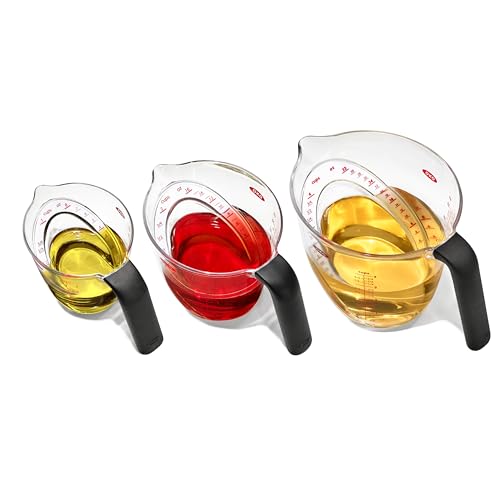
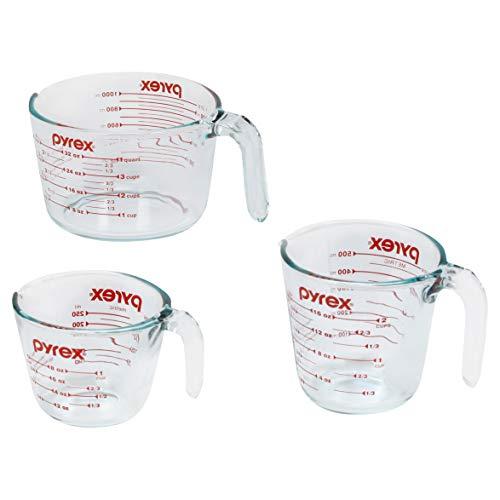
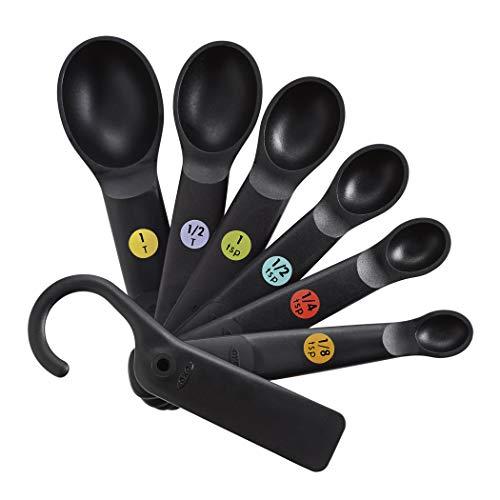
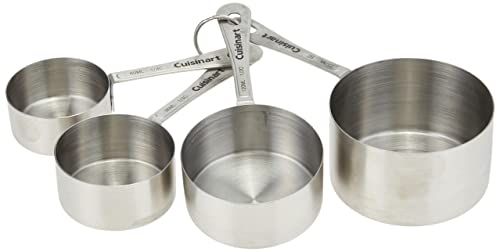
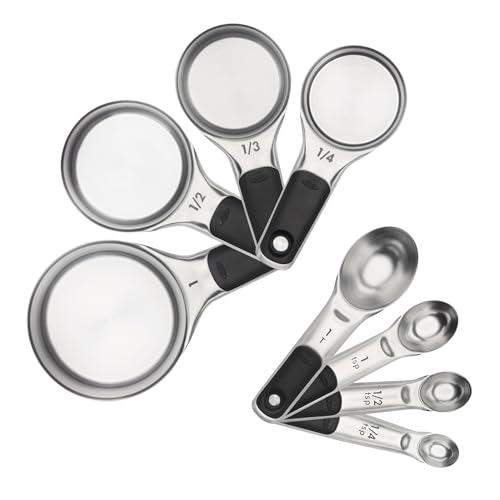
Buy the OXO Good Grips Stainless Steel Measuring Cups and Spoons, 8-Piece Set. Its markings are permanently etched rather than printed, which is the one specification that decides how long a measuring set stays useful, and it covers the eight sizes almost every American recipe is written against: 1/4, 1/3, 1/2 and 1 cup, plus 1/4 teaspoon, 1/2 teaspoon, 1 teaspoon and 1 tablespoon. Magnetic handles nest the set without a ring, so taking the 1/3 cup out does not mean unthreading three other cups. It is also the most expensive pick here. If you measure a lot of liquid, add the OXO angled 3-piece set, which is the one genuine design innovation in this category — you read it looking down into the cup instead of crouching to get level with it. If you would rather have one vessel that measures and melts, buy the Pyrex 3-pack instead. The OXO 7-piece spoons are the budget pick and the only set here with a 1/8 teaspoon. And then read the flour section below, because there is one ingredient where none of these five can give you what you want.
The criteria: these tools do not go inaccurate, they go unreadable
A stamped metal cup holds the volume it held the day it was made. Nothing in it wears, bends out of calibration or drifts. So what actually goes wrong with measuring sets, and the thing to buy against, is more mundane and much more common.
1. How the markings are applied.This is the spec. A printed or painted “1/3” on the handle of a cup survives a certain number of dishwasher cycles and then begins to ghost, and a set of four near-identical stainless cups with no legible markings is a set of four guesses. Etched (the OXO eight-piece) and laser-etched(the Cuisinart) markings are cut into the metal and outlast the tool. Printed markings on plastic — the OXO angled cups, the OXO spoons — are the weak point of two picks we still recommend, because they are better than their stainless rivals at other things. Pyrex's exterior printing is the usual reason an otherwise immortal glass cup gets retired.
2. Dry cup or liquid cup, and why they are not the same object. A set of nested cups and a spouted jug measure the same volumes and are used in opposite ways. Dry cupsare filled to the brim and leveled off with a straight edge, which is why they have no spout and no headroom — the rim is the measurement. You cannot level a dry ingredient in a jug, because the marking is halfway up the side and there is nothing to scrape against. Liquid cupshave headroom above the top marking so liquid does not slosh out, a spout to pour from, and a marking read against the surface of the liquid. Trying to measure a cup of milk in a dry cup means filling it to a meniscus level with the rim and then carrying it; trying to measure a cup of flour in a jug means shaking it flat and squinting. Own both. That is not an upsell — it is why two of the five picks here are jugs and three are not.
3. Where you read the marking from.A conventional glass jug is read at eye level, because looking down at an angle puts the marking and the liquid surface in different planes and you misread by a surprising margin at small volumes. OXO's angled cups solve this by printing the scale on an angled interior ledge so the marking and the liquid line up when seen from above. It is the one idea in this category that genuinely changed a tool, and it is the reason that pick is ranked second despite being plastic.
4. Which sizes are in the set. Nearly every set gives 1/4, 1/3, 1/2 and 1 cup, and 1/4, 1/2, 1 teaspoon and a tablespoon. The gaps worth noticing are a 1/8 teaspoon— only the OXO seven-piece spoons here — and 2/3 and 3/4 cup, which no set here has. The 1/8 teaspoon matters more than it looks: that is the band where salt, baking soda and strong spices live, and it is the band where eyeballing goes wrong fastest, because halving a 1/4 teaspoon by eye is a 20 to 30 percent error on an ingredient whose job is chemical.
5. Whether it survives heat and a dishwasher.Stainless and glass are dishwasher-proof indefinitely. Only the Pyrex set publishes preheated-oven, microwave and freezer ratings, which is what makes a glass jug the vessel you melt butter and scald milk in as well as the one you measure them with — one object instead of three.
The one ingredient where a cup will lose: flour
This is the honest part of the page, and it is the reason we would rather you read this section than buy a nicer set.
A cup is a volume. Flour is a compressible powder, so the amount of it that fits in a fixed volume depends entirely on how it got there. King Arthur publishes 1 cup of all-purpose flour as 4 1/4 ounces, or 120 grams, and that figure assumes a specific technique: fluff the flour, spoon it lightly into the cup, level it off. Dip the cup straight into the bag and you compact the flour as you scoop it. A published test that weighed cups of flour across brands and methods measured a range from 124 grams to 144 gramsdepending on the flour and the scooping method — and the widest reading came from dipping.
Twenty-four grams does not sound like much. In a loaf calling for three cups it is roughly half a cup of extra flour, which moves the dough's hydration by several percentage points. That is the difference between a slack, extensible bread dough and a stiff one that fights you, and it is the single most common reason a bread recipe “doesn't work.” In a cake it is the difference between tender and dry. The recipe was not wrong; the measurement was not repeatable.
There are only two real answers. The first is to weigh flour, which removes the variable completely and is why every serious bread recipe published in the last decade gives grams — our kitchen scales page ranks the scales for that, and how to measure flour by weight covers the method. The second, if you are not going to buy a scale, is to be consistent: always fluff, spoon and level, never dip, and your results will at least be repeatable even if they are not 120 grams. There is a full method for that on how to measure flour without a scale.
What a cup is genuinely good at is everything else. Water, milk, oil and other incompressible liquids measure accurately by volume because a liquid cannot be packed. Sugar is free-flowing enough that a leveled cup is close to repeatable. Teaspoons of salt, soda and baking powder are fine at a leveled teaspoon. The honest shape of this purchase is: buy good cups and spoons for all of that, and weigh your flour.
A cup is not even one number
Worth knowing because it explains an apparent contradiction people run into when converting recipes. A US customary cup is 8 US fluid ounces, which is 236.588 milliliters. The cup used on US nutrition labels, defined by the FDA for food labeling, is a round 240 milliliters. An Australian metric cup is 250 milliliters. A Japanese cup is 200.
So a measuring jug marked in both cups and milliliters has to pick one convention, and the ones that print 240 mL against 1 cup are not wrong — they are using the labeling definition. The spread between 236.6 and 250 is about five percent, which is invisible in a soup and visible in a custard or a batter. If you are following a recipe written in another country's cups, converting to grams and milliliters is not pedantry, it is the only way to get the recipe the author wrote. Our guide to measuring liquids for baking goes further into this.
Stainless, plastic or glass?
All three are here on purpose, because they fail and succeed at different things.
Stainlessis the right answer for dry cups and spoons. It can be etched, it does not stain or hold odors, it survives a dishwasher forever, and it is rigid — which matters when you are scraping a straight edge across the rim to level flour. Its limits: no microwave, and a bare metal handle is unpleasant if the contents are hot.
Plasticis the right answer when the shape is the feature. OXO's angled interior ledge is a molded form that stainless cannot easily reproduce, and the seven-piece spoon set's flat-bottomed spoons and built-in leveler are moldings too. The cost is printed markings and no heat. Good plastic measuring tools are a legitimate purchase with a shorter life.
Glassis the right answer when you want the measuring vessel to also be cookware. Pyrex publishes preheated-oven, microwave, freezer and dishwasher ratings on these, which is why a 2-cup glass jug ends up being where you melt the butter, bloom the yeast, warm the milk and then measure the next thing — one object, one wash. It breaks, it is heavy when full, and you read it at eye level.
What this buys you that a scale does not
We have argued hard elsewhere on this site for weighing — see do you need a kitchen scale for baking — so it is worth being clear about where cups and spoons still win outright.
Small quantities. Most home scales have a 1-gram resolution, and a quarter teaspoon of baking soda is well under a gram. You cannot weigh it meaningfully. Spoons are the correct tool for everything below about 5 grams, which is most of the chemistry in a cake.
Liquids in a hurry. A cup of water weighs 236 grams and a cup of oil weighs roughly 210, so weighing liquids means knowing a density for every one of them. A jug does not care. For water, milk, oil and stock, volume is simply the faster correct answer.
Recipes written in cups. An enormous amount of good American baking exists only in volume, including most family recipes, and converting on the fly is how you introduce errors rather than remove them.
No batteries, no tare, no wait. A scale that has gone to sleep mid-recipe with flour on the platform is its own small tragedy. Nothing here needs power, and using a scale well has a learning curve that cups do not.
How to choose and use measuring cups and spoons
Buy etched if you can, and buy the size spread you actually use
If you are buying one set to keep, buy etched or laser-etched stainless: that single feature decides whether the set is still usable in ten years. If you already own spoons, buy cups alone and save real money — the Cuisinart four-cup set is a third of the eight-piece's price for the same etched-marking advantage. If you already own cups, the OXO seven-piece spoons cost less than lunch and add the 1/8 teaspoon almost nothing else has.
Fluff, spoon, level - and never dip
The method matters more than the cup. Stir the flour in its container to loosen it, spoon it lightly into the cup until it mounds over the rim, then sweep the excess off level with a straight edge — the back of a knife or the flat of a bench scraper. Do not tap the cup, do not shake it flat, and above all do not scoop straight from the bag: dipping compacts the flour and is what produces the 144-gram cup.
Level dry ingredients, read liquid ones
Dry cups and spoons are leveled; liquid jugs are read. Level a measuring spoon of baking powder the same way you level flour — a heaped teaspoon of baking powder can be half again the intended quantity, and baking powder is the ingredient where that shows up as a metallic taste and a collapsed crumb. For jugs, set the jug on the counter rather than holding it, and read at eye level unless the cup is designed to be read from above.
Measure sticky things by displacement or by weight
Honey, molasses, corn syrup and peanut butter leave a meaningful fraction of themselves in the cup, so a “cup” of honey measured and poured is less than a cup delivered. Two fixes: oil or spray the cup first so the contents slide out, or weigh them, which is the one place a scale beats a jug even for a liquid.
Pack brown sugar, do not pack anything else
Brown sugar is the deliberate exception to the no-packing rule: American recipes assume firmly packedbrown sugar unless they say otherwise, so press it into the cup with the back of a spoon until it holds the cup's shape when turned out. Cocoa and powdered sugar go the other way — they clump, so sift them before measuring if the recipe says sifted, and expect a sifted cup to weigh noticeably less than an unsifted one. Our guide to sifting covers when that actually matters.
Do not use a liquid jug for flour or a dry cup for liquid
Both are common and both introduce error in the same direction — too much. You cannot level flour in a jug, so you end up eyeballing a line partway up the side, and eyeballing runs heavy. You cannot carry a dry cup filled to the brim with milk without spilling it, so people under-fill and then top up by eye.
Keep the set together
The most common way a measuring set stops being a set is that one cup lives in the sugar canister and another is in the dishwasher. Magnetic handles (the OXO sets) or a ring (the Cuisinart) exist for this reason, and the magnets are genuinely the better solution because you can take one piece without disassembling the stack. Whichever you buy, store it as one object.
What we did not feature, and why
Adjustable or sliding measuring cups. A barrel with a plunger and a scale printed on the side, marketed for sticky ingredients. The idea is sound and the execution usually is not: the scale is printed, the seal picks up residue, and the volume you get depends on how hard you pushed. For sticky ingredients, oiling a normal cup or weighing is more reliable and cheaper.
Unbranded stainless sets with no stated marking method. The biggest group in this category by listing count, often very cheap, usually photographed identically across several storefronts. Many do not say whether the markings are etched or printed, and since that is the spec this page ranks on, they cannot be compared with a set that states it. A cheap etched set is a good buy; a cheap set that will not tell you is a coin toss.
Digital measuring cups and scoops with a built-in display.These are a scale in an awkward shape — small platform, small capacity, a battery, and a resolution no better than a cheap flat scale. If you want to weigh, buy a scale; our kitchen scales page ranks them, and the entry-level ones cost less than these.
Nested sets that include 2/3 and 3/4 cup. They exist and they are convenient, and we have not ranked one here because none of the sets we could verify as currently purchasable published enough about its markings to rank honestly. Two scoops of a 1/3 cup is a 2/3 cup, and if the set you want has the extra sizes and states that its markings are etched, buy it.