A loaf pan is the cheapest link in the whole bread chain and one of the few that you cannot compensate for later. The flour, the yeast, the mixer and the oven all get discussed endlessly; the pan gets grabbed off a shelf for eight dollars and then quietly decides how tall the loaf rises, how dark the sides go, and whether the thing comes out in one piece. Two bakers can follow the same recipe to the gram and pull out visibly different bread because one used a thin, dark, oversized pan and the other used a heavy, light-colored one in the size the recipe was written for. That is the whole reason this page exists.
There is no single best loaf pan, and any list that gives you one is skipping the actual decision. The pan that makes a beautiful domed sandwich loaf is the wrong pan for banana bread; the pan that produces perfect square slices for toast is useless if you never wanted square slices; the dish that goes from oven to fridge with a lid on it will never give you a crisp crust. So the six picks below are sorted by job, not by a single ranking of quality, and each one is honest about the job it is bad at.
How we picked
Our scores are judgments made from documented research — published manufacturer specifications, published baking guidance, and aggregated owner reports — not lab measurements. We do not run a lab, and how we pick says so in those words. For loaf pans specifically, five things decided the list.
Size fidelity comes first. The two common sizes, 8.5 x 4.5 inches and 9 x 5 inches, differ by about 15% in capacity according to King Arthur Baking, and that gap is the difference between a loaf that domes above the rim and one that spreads sideways and barely crests it. A pan that is honest about which of those two it actually is matters more than any other single feature, so we favored pans whose published baking dimensions are unambiguous.
Material, because it sets how the crust browns. Heavy aluminized steel and bare aluminum conduct heat quickly and brown gently and evenly. Dark, thin nonstick steel absorbs more radiant heat and browns harder and faster. Glass is slow to heat and slow to let go of that heat, which is why the standing advice for glass is to drop the oven by 25°F. None of those is wrong; they are just different tools, and we picked one of each rather than pretending one material wins.
Coated or uncoated is a real fork in the road. A nonstick surface is a convenience and a wear item — it will eventually scratch, dull or blister, and then the pan is done. An uncoated pan asks you to grease or line it every single bake and, in exchange, has nothing that can fail. Both answers are defensible, so there is a pick for each.
Build details decide whether it warps. The pans here use folded corners and a rolled rim wrapped around a steel wire, which is the difference between a pan that stays flat through years of hot ovens and one that starts rocking on the counter after a season. Finally, price and warranty: loaf pans are inexpensive enough that a lifetime warranty and a made-in-USA build are realistic asks rather than luxuries. We link every pick through to the live Amazon price rather than quoting a number here, because bakeware discounts move constantly.
The picks, and who each is for
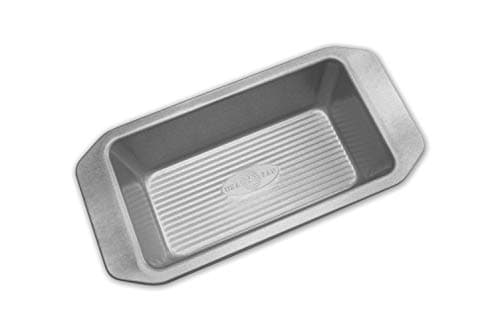
USA Pan 1-lb loaf pan — the everyday winner. This is the pan to buy if you are buying one pan. Its baking surface is a true 8.5 x 4.5 inches, which is the size the majority of yeasted sandwich-bread recipes are written around, so the dough climbs the walls and domes instead of sprawling. The body is heavy aluminized steel with USA Pan's fluted profile and a steel wire rolled into the rim, and the Americoat nonstick surface is made without PTFE, PFOA or BPA. The honest catches: it is rated to 450°F, so it is not the pan for a screaming-hot artisan bake; USA Pan recommends hand-washing, so the dishwasher is off the table if you want the coating to last; and the fluted surface prints faint ridge lines down the sides of the finished loaf, which is cosmetic but noticeable. If your recipes call for 9 x 5, buy the Nordic Ware below instead — batter sized for the bigger pan will spill out of this one.
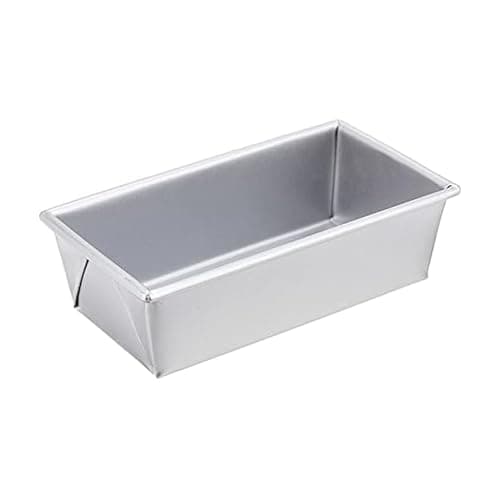
Chicago Metallic Commercial II uncoated — for people who don't trust coatings. Same 8.5 x 4.5 footprint, same heavy aluminized steel, and no coating at all. There is nothing on this pan to scratch, blister or wear off, it carries the Commercial II line's lifetime warranty, and it is usually the cheapest pan on this page. The price you pay is procedural: you grease, flour or line it every single time, without exception, and sticky high-sugar batters will grab it harder than they would a nonstick pan. It also darkens with use and will never look new again, which bothers some people more than it should. Our guide to greasing and lining a loaf pan makes that routine quick enough that it stops being a chore.
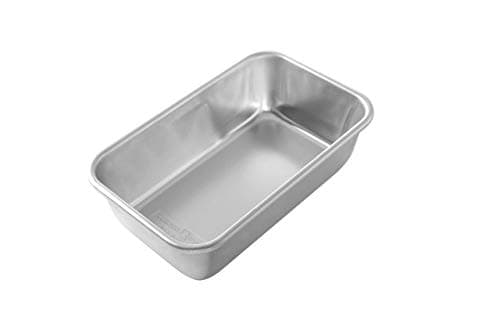
Nordic Ware Naturals 1.5-lb — the quick-bread pan. Banana bread, zucchini bread, pumpkin loaves and pound cake are almost always written for a 9 x 5, and this pan's interior of roughly 9.1 x 5.3 inches is that pan. It is pure uncoated aluminum with an encapsulated galvanized steel rim, made in the USA, and light-colored aluminum is exactly what a long, sugary bake wants — it browns gently rather than setting a hard, dark edge before the middle is done. The catches: Nordic Ware advises against the dishwasher because detergent and heat discolor bare aluminum, it needs greasing like any uncoated pan, and it is genuinely too big for a three-cup-of-flour yeast recipe, which will rise sideways in it instead of up.
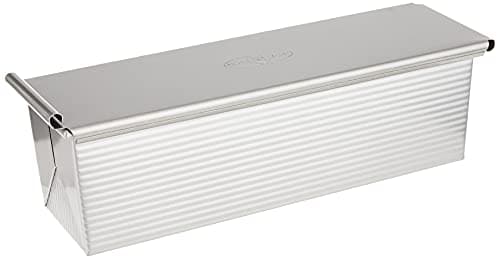
USA Pan Pullman 13 x 4 with lid — for square sandwich bread. The Pullman is a different tool rather than a better loaf pan: the sliding lid caps the dough so it bakes into a flat-topped rectangle, which is how you get pain de mie and slices that are the same size top to bottom. It is the heaviest, sturdiest pan here and the only one that changes the shape of the bread rather than just holding it. It is also the most expensive, hand-wash only, and completely wasted on you if you bake banana bread. Our full USA Pan Pullman review covers it in detail, including the fact that a 13 x 4 pan needs a recipe scaled to it.
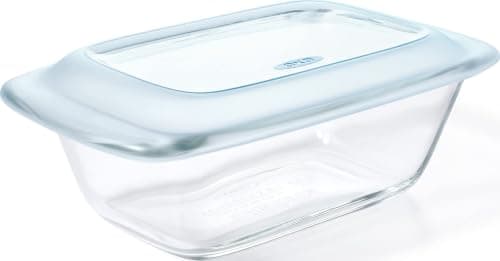
OXO Good Grips glass loaf pan with lid — bake it, cover it, put it away. Thermal-shock-resistant borosilicate glass with real handles and a slosh-proof lid, so a meatloaf or a banana bread can go freezer to oven to fridge in a single dish, and it is dishwasher- and microwave-safe on top of that. You can also watch the bottom crust brown through the side, which is a genuine advantage for anyone who has ever pulled out a pale-bottomed loaf. But glass is the wrong pan for crusty yeast bread: it heats slowly, holds that heat, browns the sides more gently than metal, and King Arthur Baking's standing advice is to reduce the oven by 25°F when you use it. OXO also says not to put it under a broiler, and it is heavy enough that a hard knock against the sink ends it. Our OXO glass loaf pan review covers it in full, including the bakes it is genuinely the best pan for.
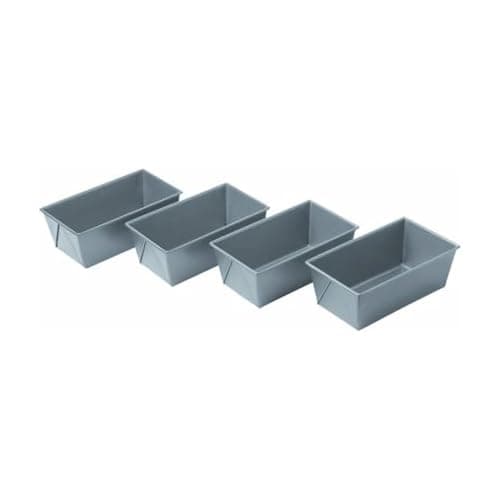
Chicago Metallic mini loaf pans, set of four — for gift loaves. These are four separate half-pound pans rather than one linked tray, and that detail is the whole point: you can bake two instead of four, rotate them in a small oven, or hand one to a neighbor still sitting in its pan. Construction is the same heavy aluminized steel with wire-rod rims as the full-size Commercial II, with a nonstick coating that suits the sticky, sugary batters people usually bake in miniature. The cons are the obvious ones: the coating is a wear item, four pans take more cupboard space than one, and you have to re-time every recipe because mini loaves finish well before a full loaf would.
Two narrower pages pick up where this ranking stops. If the loaves you bake are yeasted sandwich bread specifically, the field reorders around the 8.5 x 4.5-inch interior — the best loaf pans for sandwich bread ranks on that one spec and explains why it decides the loaf. And if you are weighing the OXO glass pan against a metal one for banana bread or meatloaf, glass vs metal loaf pangives that decision the whole page it needs, including the 25°F rule.
How to choose a loaf pan
If you take one thing from this page, take this: buy the pan your recipes are written for first, and worry about material second. Almost every disappointing loaf that gets blamed on yeast or technique is really a pan-size mismatch. Our longer guide to choosing a loaf pan goes deeper on materials and finishes; what follows is the decision in the order it actually matters.
Size first, and it is not a small difference
The two sizes you will see everywhere are 8.5 x 4.5 inches and 9 x 5 inches. That half-inch in each direction sounds trivial and is not: King Arthur Baking puts the capacity difference at about 15%. Put dough sized for the smaller pan into the bigger one and it still rises perfectly well — it just rises sideways, producing a wide, flat loaf that barely clears the rim instead of a domed one. Go the other way and the batter crests the pan and spills onto the oven floor.
The useful rule of thumb, again from King Arthur, is to read the flour: a recipe built on about three cups of flour wants the 8.5 x 4.5 pan, and one built on about four cups wants the 9 x 5. In practice, yeasted sandwich breads mostly live in the smaller pan and quick breads mostly live in the larger one, which is exactly why the top two picks here are 8.5 x 4.5 and the third is a 9 x 5. If you bake both kinds of bread, owning one of each is a more useful upgrade than owning one expensive pan. And if you also bake in a machine, the sizing language is different again — our bread machine loaf sizes explained untangles the 1-lb, 1.5-lb and 2-lb settings.
Material sets how the crust browns
Once the size is right, material is what changes the loaf. Aluminized steel — steel bonded with aluminum — is the baker's default because it conducts heat quickly and evenly, holds its shape, and delivers a golden crust rather than a scorched one. Bare aluminum, like the Nordic Ware, behaves similarly: light-colored, quick to heat, gentle in the way it browns. Dark nonstick steel, which is what most cheap supermarket pans are, absorbs more radiant heat and browns harder and faster; if you already own one and your loaves come out dark at the edges, that is why, and dropping the oven 25°F usually fixes it.
Glass is the outlier. It is slow to take up heat and slow to give it back, so the edges keep cooking after you pull it out and the sides brown less than metal would. King Arthur's advice is a 25°F reduction whenever you bake in glass. That makes glass a poor choice for a crusty yeast loaf and a very good one for anything you want to cover and refrigerate. Silicone is the one material we did not pick at all, and deliberately: it is a poor heat conductor, so it browns the sides and bottom weakly, and a floppy pan needs a baking sheet under it anyway. Our silicone vs metal loaf pans comparison makes the full case; the short version is that release convenience is not worth a pale, soft crust on bread.
Coated or uncoated: pick your trade
This is a genuine fork rather than a quality ranking. A nonstick coating releases loaves cleanly and cleans up faster, which matters most with sticky, sugary batters — the mini pans here are coated for exactly that reason. But every coating is a consumable. Scratch it with a knife, scour it, or run it through enough dishwasher cycles and it dulls, and eventually the pan is spent. That is why USA Pan tells you to hand-wash.
An uncoated pan has nothing that can fail. It will discolor, it will look older every year, and it will keep baking exactly the same bread in twenty years as it did on day one — which is why the Chicago Metallic carries a lifetime warranty and why bakeries use uncoated pans. The cost is that you must grease, flour or line it every single time, and the one time you forget, you lose the loaf. If that routine sounds like friction, buy coated; if it sounds like nothing, buy uncoated and never think about pans again.
The construction details that decide whether it warps
Loaf pans fail in two ways: the coating goes, or the pan warps. Warping is about construction, and there are two things to look for. The first is folded corners rather than welded or crimped seams, which give the metal somewhere to move as it expands. The second is a rolled rim with a steel wire inside it— every pan on this list has one, and it is the single biggest reason a pan stays flat through hundreds of hot cycles instead of developing a rock. Gauge matters too: heavier steel resists warping and evens out oven hot spots, at the cost of taking slightly longer to come up to temperature. A pan that rocks on the counter is not just annoying, it bakes unevenly, because part of the base has stopped touching the rack.
The lidded Pullman is a different tool, not an upgrade
It is worth being clear about what the Pullman does, because it looks like a fancier loaf pan and it isn't one. The sliding lid constrains the dough so it fills the box completely, giving you a flat-topped rectangular loaf with a tight, fine crumb — pain de mie, the sandwich bread of French bakeries. That is a specific result, brilliant if you want uniform square slices for sandwiches or toast, and pointless otherwise. It also demands a recipe scaled to the pan: a 13 x 4 Pullman holds far more dough than a standard loaf pan, and under-filling it gives you a short, dense brick. Buy it as a second pan when you know you want that bread, not as your first.
What actually kills a loaf pan
Three habits account for most dead pans, and all three are avoidable. The dishwasher is the biggest one: it discolors bare aluminum, and detergent plus heat shortens the life of any nonstick surface, which is why both USA Pan and Nordic Ware steer you to a sink and a sponge. Metal utensils are the second — cutting a loaf in the pan or levering it out with a knife scars a coating in one stroke. And overheating is the third: the aluminized-steel pans here are rated to 450°F, and pushing past that, or running an empty pan under a broiler, damages coatings and can warp the metal. Cool the pan before washing, use a thin silicone or nylon spatula to release a stubborn loaf, and a good pan genuinely becomes a decades-long purchase.
How many pans do you actually need?
For most home bakers the honest answer is two: one 8.5 x 4.5 for yeast bread and one 9 x 5 for quick breads. That covers virtually every loaf recipe in circulation and costs less than a single mid-range cake pan. Buy a second matching pan only if you regularly double a recipe — two identical pans bake far more consistently side by side than two different ones. Everything after that is specialist: the Pullman if you want square sandwich slices, glass if you bake to store, the minis if you give bread away at the holidays. If you are building a kitchen from scratch, our baking essentials starter kit puts pans in context against the other tools worth buying first — and the short answer there is that a scale still beats a pan upgrade for improving your bread.
If you are choosing between the two brands at the top of this list
USA Pan and Nordic Ware win most of this page between them, and the choice reads like a brand question while actually being a size question — USA Pan vs Nordic Ware loaf pans sets out which pan your recipe is written for. The same two brands fight over sheet pans too, with a different answer: Nordic Ware vs USA Pan baking sheets.
And if what you really want is a crusty free-form loaf
No loaf pan produces that, because a pan cannot trap steam. For a boule or a batard with an open crumb you want a covered cast iron vessel: start with our Lodge Essential Enamel review, which is the pot we recommend to most bread bakers, or Lodge vs Le Creusetif you are weighing the premium. A loaf pan and a Dutch oven are not competing purchases — most bread bakers end up owning both.