Macarons are the recipe that exposes a mixer's finesse rather than its muscle. Almost the whole battle is the meringue: you're whipping egg whites and sugar into a foam that has to be fine, glossy and stable enough to fold into almond flour and pipe into smooth, footed shells. That means the specs that dominate a bread-mixer ranking — wattage, dough capacity, drive design — barely matter here. What matters instead is a good wire whip that folds in small, uniform bubbles, steady low-speed control so you can build the foam gradually rather than thrashing it, and a bowl the whisk actually sweeps in full so no whites are left un-whipped at the bottom. Judged on that, the ranking looks very different from our dough roundups, and two of the three picks are tilt-heads.
Three things separate a good macaron mixer from a merely powerful one. The first is the wire whip and how finely it aerates— a fine foam built on small bubbles is what gives a macaron its smooth top and neat foot, and a coarse, fast-whipped foam is what gives you hollow, cracked shells. The second is low-speed control: meringue for macarons is best started slow and ramped gently, so a mixer with a genuinely useful low setting is worth more than one with a higher top speed. The third is full planetary bowl coverage— the whisk needs to reach the whole bowl so every bit of white is whipped evenly, and a machine that stays planted through a longer whip makes that easier. Our three picks each nail those in a slightly different way.
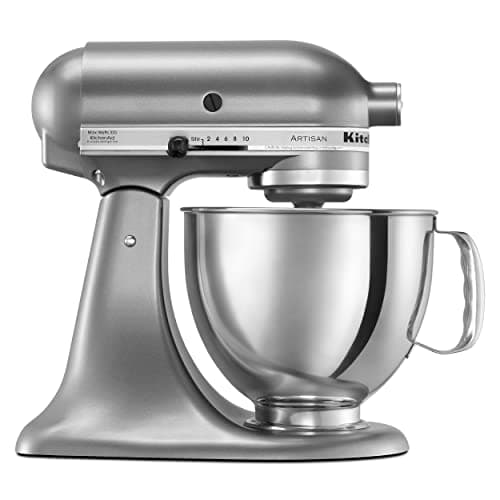
KitchenAid Artisan — the easy-control default.For macarons the Artisan is the natural first choice, and its supposed weakness — a mid-pack motor — simply doesn't matter, because whipping meringue is light work that never troubles it. What you get instead is a proven wire whip, ten well-spaced planetary speeds with a controllable low end, and the familiar planetary action that sweeps a 5-quart bowl thoroughly. It's the machine most macaron recipes are implicitly written for, and the easiest to dial in. The honest cons are the same two we always name: the rated 325-watt motor is only mid-pack, and the tilt-head can flex on very stiff dough — neither of which bites when your job is meringue. If there's a macaron-specific caution it's simply that you must set the beater height so the whisk clears the bowl base cleanly, so the whites at the bottom aren't left behind. The full Artisan review covers the rest.
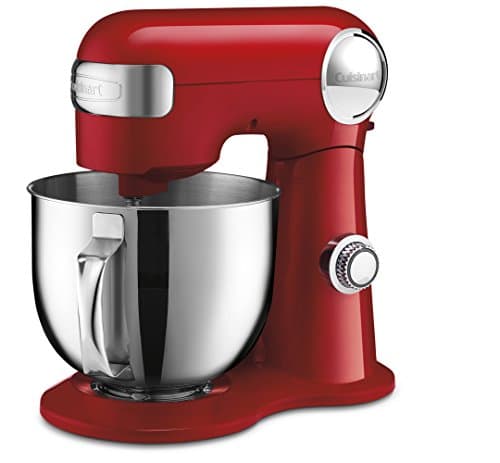
Cuisinart Precision Master — roomy bowl and real value.The Cuisinart is the value pick that happens to suit macarons nicely. Its larger 5.5-quart bowl gives the foam room to climb, its 12 speeds include a genuinely useful low start that helps you break up the whites gently, and the included splash guard keeps sugar from dusting the counter as you add it — a small convenience that matters when you're streaming sugar into building whites. It ships with a whisk, flat beater and dough hook in the box, usually for less than the same-size KitchenAid. The honest cons: it has far fewer first-party attachments than KitchenAid, its resale value and long-term parts support trail the KitchenAid line, and the head latch feels a little less refined. None of those touches its meringue ability — they're about the wider ownership experience. Read the Cuisinart Precision Master review for the detail.
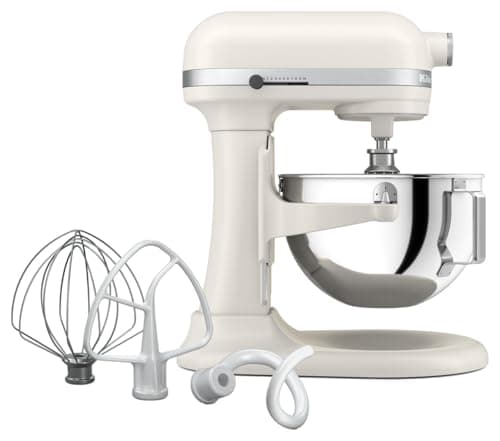
KitchenAid 5.5-quart bowl-lift — planted through the longer whips.If you make macarons in bigger batches, or you make a French meringue that you whip for several minutes, the bowl-lift is the steady hand. Its lift frame plants the head firmly over a larger 5.5-quart bowl, so it stays rock-steady through a long whip where a lighter machine might start to shimmy, and it sweeps the bowl thoroughly for even aeration. It takes the same front-hub attachments as every other KitchenAid, so it's no dead end. The honest cons are the familiar bowl-lift ones: it costs more than the tilt-head Artisan for what most bakers need, the lift design is a little less convenient for quick bowl and beater swaps — a mild annoyance when you're running batches — and it's heavier and taller, so check your under-cabinet clearance. Don't step up to it if you make macarons occasionally in normal quantities; the Artisan does that beautifully for less. The 5.5-quart bowl-lift review has the full picture.
What actually makes a stand mixer good for macarons
Macarons are a technique recipe, and the mixer's only real job is to build a perfect meringue. So the buying criteria flip from what you'd weigh for bread: you want finesse, control and even coverage, not raw power. Here is what to look for, and why.
The meringue is (almost) everything
A macaron shell is essentially stabilized meringue folded with almond flour and sugar, so the quality of that meringue decides whether you get smooth, footed shells or hollow, cracked ones. The mixer's contribution is the foam: a fine, glossy, stable meringue built on small, uniform bubbles. Every criterion below flows from that single goal. If you're new to whipping whites, our step-by-step guide to whipping egg whites in a stand mixer walks through the grease-free bowl, the speed ramp and reading soft versus stiff peaks — the exact skills a macaron leans on.
A wire whip that aerates finely
The wire whip (the balloon whisk) is the attachment that builds the foam, and what you want from it is fine aeration — lots of small bubbles rather than a few big fragile ones. All three picks come with a capable wire whip, and all three whip a French or Swiss meringue well. The finer and more uniform the foam, the smoother the finished shell and the neater the foot, which is why the technique of ramping the speed up gradually matters as much as the hardware. If you sometimes make small batches and would rather not haul out the stand mixer, you can build a macaron meringue with a hand mixer too — our meringue-with-a-hand-mixer guide covers that route honestly.
Low-speed control beats top-end power
Here is the counterintuitive part: for macarons, a controllable low speed is worth more than a big motor or a high top speed. You start the whites slow to break them up into fine bubbles, then ramp gently to medium-high to build volume — and if your recipe uses an Italian meringue you also want steady control while you stream in hot syrup. A mixer that whips violently from the start builds coarse, unstable foam. That's why the Cuisinart's useful low start speed is a genuine asset and why the Artisan's well-spaced low end suits the job. Our stand-mixer speeds guide maps which numbers on the dial count as low and medium-high so you can find the sweet spot on your machine.
Full bowl coverage and even whipping
A meringue is only as good as its most under-whipped corner, so the whisk needs to sweep the whole bowl and reach the whites sitting at the very bottom. This is where planetary action and correct beater height come in: a whisk set too high leaves a slick of un-whipped white in the base, which then loosens the whole meringue when you fold. All three picks use full planetary movement, and the bowl-lift's planted head keeps that sweep steady through a longer whip. Whichever you choose, confirm the whisk clears the bowl base by a hair — the same clearance check that keeps a batter fully mixed applies exactly here.
Why power barely matters — and when a tilt-head is plenty
It's worth being blunt: the wattage wars that dominate bread-mixer reviews are almost irrelevant to macarons. Whipping a few egg whites is light work that no capable mixer struggles with, which is why the Artisan's mid-pack motor is a non-issue and why two of our three picks are tilt-heads. You do notneed a bottom-drive workhorse or a big bowl-lift to make excellent macarons; you need control and a good whisk. The only reason to step up to the bowl-lift is batch size and long-whip stability, not power. If you also bake bread and want one machine for both jobs, weigh that separately — our best-for-cake-batter roundup looks at the same finesse-first machines from the baking-not-kneading angle.
Sizing the three to your macaron habit
Line the picks up against how much you make. The Artisan is the do-it-all default: enough bowl and the right control for normal home batches, plus the widest accessory range if your baking grows. The Cuisinart is the value route to the same result, with a slightly bigger bowl and a handy splash guard, at the cost of a thinner ecosystem and slightly rougher finish. The 5.5-quart bowl-lift is for the baker who runs bigger or more frequent batches and wants the steadiest platform for a long whip — it's the upgrade, not the starting point. Pick the one that matches your ambition rather than the one with the biggest number on the box.
The technique the mixer can't do for you
No mixer makes a macaron by itself, so a word on the parts that are on you. Start with a spotlessly grease-free bowl and whisk, because any fat stops the whites from building volume. Whip to the peak your recipe calls for — usually stiff, glossy peaks — and stop there; over-whipped meringue turns grainy and folds badly. Then comes the fold, or macaronage, which is entirely a hand skill: you deflate the batter to the right ribbon consistency by hand, not in the machine. The mixer builds the meringue; you finish the batter. Get the meringue right with the machines above and the rest is practice.
Read each pick in full before you buy
Treat this roundup as a shortlist and read the individual reviews before you spend. The Artisan review is the place to start for the default, the Cuisinart Precision Master review makes the value case, and the 5.5-quart bowl-lift review covers the steadier, bigger-batch upgrade. Each is honest about the cons a roundup can only sketch.