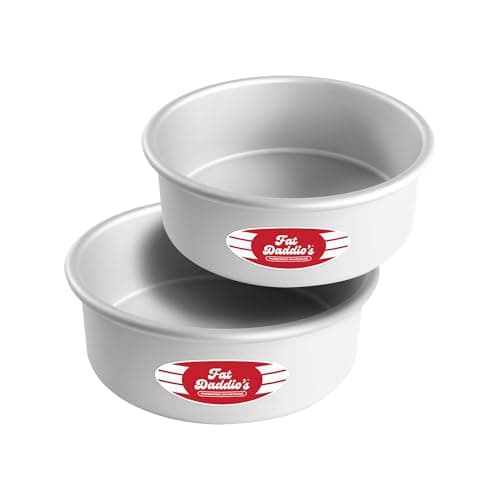
Buy the Fat Daddio's 8 by 3-inch set if you want cake pans you will never replace. They are 16-gauge anodized aluminum, seamless, with straight sides and sharp corners, published at 5 cups of capacity and rated to 550°F under a lifetime warranty — and they come as a pair, which is the minimum a layer cake needs. The reason serious cake bakers standardize on them is one specification: anodizing is a surface, not a coating, so Fat Daddio's states the pan will not peel, rust, flake or chip. The honest catch is the same fact in reverse— bare anodized aluminum is not a release surface, so you grease and line every single time, and you hand wash. If that routine sounds like work rather than a habit, a coated pan is the better buy for you.
What you are buying, by the published numbers
| Interior size | 8 x 3 in |
| Material | 16-gauge anodized aluminum |
| Capacity | 5 cups per pan |
| Oven rating | 550°F |
| In the box | Two pans |
| Construction | Seamless, straight-sided |
| Warranty | Lifetime |
| Care | Hand wash; grease and line |
Those are Fat Daddio's own published figures, cited in Sources. We have not measured a pan or run a bake test — see how we pick for exactly what our scores are and are not.
Anodized aluminum, and why cake bakers care
Anodizing is an electrochemical process that thickens and hardens aluminum's own natural oxide layer. The important consequence is that there is no separate material sitting on top of the metal. A nonstick pan is aluminum or steel plus a coating, and the coating has a life; an anodized pan is aluminum whose own surface has been made harder. Nothing can delaminate, because nothing was laminated on.
Two practical benefits follow. The pan tolerates heat a coated pan cannot — 550°F published against the 450°F typical of coated aluminized steel — and it does not degrade from use. The pans you buy today bake the same in fifteen years, which is why they are the pans in cake-decorating kitchens where a dozen pans get used weekly for years.
Aluminum itself is the other half of the story. It conducts heat quickly and evenly and it is light in color, so it browns a cake's edges gently rather than setting a dark crust before the center cooks. That is what you want in a sponge: an even, tender crumb from edge to edge. The best bakeware without a nonstick coating covers the same argument across sheet pans and loaf pans.
Why 3 inches of depth is the real reason to buy these
Most American cake pans are 2 inches deep. These are 3, and that changes what you can make. A 3-inch pan holds about 5 cups of batter against roughly 4 in an 8 by 2-inch pan, so one pan bakes a layer tall enough to torte— slice horizontally in half — which is how a four-layer cake comes out of two pans. It also gives a rising batter room, so a cake that would dome and spill over a shallow pan simply climbs.
The cost is that recipes are not written for it. A batter sized for an 8 by 2-inch pan will look thin in these and bake quicker than expected; a batter sized for a 9-inch pan fits one of these nicely and takes longer, because the center is further from the oven's heat. The arithmetic is in 8-inch vs 9-inch cake pan, and the rule that saves you either way is to fill no more than two-thirds up the wall.
The seamless, straight-sided build
This sounds like marketing and it is the detail decorators actually buy for. A pan with a rolled or seamed joint at the base leaves a faint ring in the cake, and a pan with slightly flared sides bakes a layer with a slope — which means a stacked cake that leans, and frosting doing structural work it should not be doing. One-piece construction with straight walls and a sharp base corner gives you a layer with square edges that stacks flat.
For a single-layer snack cake none of that matters. For a two- or four-layer cake with a smooth frosted finish it matters a great deal, and it is the clearest reason this set costs more per pan than the alternatives.
Who should buy them
Anyone who bakes layer cakes more than occasionally. Two matched pans, square edges, splittable layers and a surface that does not age. This is the buy-once option.
Anyone avoiding coatings. There is no coating here at all, which also means no PTFE, no PFOA and no ceramic layer to wear through.
Anyone who bakes at high heat on the same pans.The published 550°F rating is the highest of any cake pan we cover.
Who should not
Occasional bakers. If a cake happens twice a year, a coated 9-inch pan releases with less preparation for half the money. Our cake pan roundup ranks those.
Anyone who will not line a pan. This is the one real failure mode: bare anodized aluminum will hold onto a cake that was not greased and lined, and a cake stuck in a pan is a cake lost.
Anyone whose recipes are all 9-inch. These are 8-inch pans. Buy the size your recipe book assumes rather than converting every time.
Cheesecake bakers. A solid-bottomed pan cannot be inverted, so a cheesecake needs a springform or a push-up base. A deep solid pan looks like it should work and does not.
Getting a cake out of them cleanly
- Grease, parchment circle, grease again. Butter or oil the base and sides, drop in a parchment round cut to the base, then grease the paper. Done this way the release is as clean as any coated pan's — the method is the same as for a loaf pan.
- Weigh the batter between the two pans. Split by eye and one layer bakes faster, which is the actual reason layer cakes come out uneven. A scale settles it in seconds.
- Ten minutes in the pan, then out onto a rack. Any longer and the cake steams itself against hot metal. A cooling rack is the cheap tool that protects the bake.
- Hand wash, dry immediately.Fat Daddio's recommends hand washing, and anodized aluminum in a dishwasher comes out dulled. Warm water and a soft brush; no scouring pads.
- Expect a 3-inch pan to bake longer than a 2-inch one at the same diameter, and test the center rather than trusting the stated time.
The verdict
These are the cake pans to buy if cake is something you do rather than something that occasionally happens. The anodized surface means they will outlast any coated pan on the market, the 3-inch depth unlocks split layers, and the seamless straight sides are what make a stacked cake sit flat. What you accept in return is a greasing-and-lining routine on every bake and hand washing afterwards — which, for a baker who already lines pans by reflex, costs nothing at all.
If you are still choosing between materials, the best cake pans ranks these against coated and bare-aluminum alternatives with live prices, and aluminum vs nonstick makes the same argument for sheet pans.