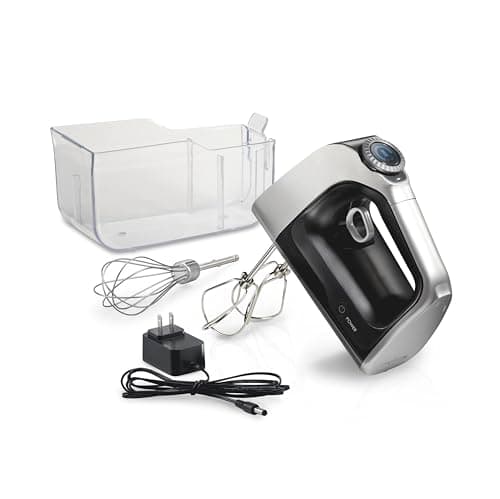
Buy the Hamilton Beach Professional 62673 if you want a cordless hand mixer and do not want to pay KitchenAid money for one. It is the cheapest cordless mixer on this site that comes from a brand with a published spec sheet and a support line, and the two numbers that matter are good: Hamilton Beach rates it for about an hour of mixing per charge, and a 10-minute top-up is enough for a batch of cookies — which takes most of the planning out of owning a battery appliance. Its defining feature is not a speed dial but infinite speed control: you squeeze the trigger further for more power, like a cordless drill. That gives finer adjustment at the low end than a five- or seven-step dial, and it is more tiring to hold steady through a long job. There are no dough hooks, so stiff cookie dough and bread are out of scope.
The published specification
| Speed control | Infinite — trigger, not a dial |
| Run time per charge | About 1 hour of mixing |
| Quick charge | 10 minutes, enough for a batch of cookies |
| In the box | Three attachments + snap-on storage case |
| Battery | Built in — rechargeable, not removable |
| Dough hooks | Not included, not available |
| Who it is for | Cordless convenience for less |
Those are Hamilton Beach's published figures, cited in Sources below. We have not timed a battery or measured torque — see how we pick for exactly what our scores are and are not.
What a trigger changes
Every corded hand mixer gives you stepped speeds: a dial or a rocker switch that moves between numbered settings. This one gives you a continuous range controlled by how hard you squeeze. It is a genuine difference in use, with a clear advantage and a clear cost.
The advantage is at the bottom end. The usual complaint about cheap hand mixers — including Hamilton Beach's own corded 6-speed — is that speed 1 is already too fast for folding dry ingredients, so you start in a cloud of flour. With a trigger you can creep in at a genuinely low speed and bring it up as the mixture comes together. That is effectively what KitchenAid's Soft Start does automatically, achieved manually.
The cost is repeatability and fatigue. Returning to exactly the same speed twice is guesswork, which matters for a recipe that says “beat on medium for three minutes.” And holding a trigger at a constant pressure through an eight-minute meringue is tiring in a way a dial is not. If you want stepped, repeatable settings, this is the wrong mixer and a corded nine-speed is the right one — see hand mixer speeds explained.
The battery, honestly
An hour of mixing per charge is a lot. Almost no home recipe asks for more than ten minutes of continuous mixing, so in practice the question is never “will it last this bake” but “did I remember to charge it.” That is where the 10-minute quick charge genuinely matters: a mixer with a flat battery and a ten-minute wait is a mild inconvenience, while one with a two-hour wait is a corded mixer you have to apologize for.
The real limitation is that the battery is built in rather than a removable pack. When it degrades — and every lithium battery does — you are replacing the mixer, not the battery. The KitchenAid Go takes the opposite approach with a removable 12V MAX pack you can swap, which is a meaningful difference over a ten-year horizon and part of why it costs more. Our KitchenAid Go review covers that machine.
What it will not do
No dough hooks. This is the headline limitation and it is shared with the KitchenAid Go. It ships with beaters and a whisk, and there is no hook accessory, so stiff cookie dough is a struggle and bread dough is off the table entirely. If dough is part of your baking, a corded Cuisinart HM-90S includes hooks and costs less — and even then, hand-mixer hooks are a stopgap. Can a hand mixer knead dough is honest about the limits.
It is not a stand mixer. Cordless removes the cord, not the holding. You are still standing over the bowl for the whole bake, which is the thing a stand mixer actually solves.
Very small quantities still fail. A quarter cup of cream in a wide bowl will not whip in any hand mixer, because the beaters cannot catch it. Use a narrow bowl, or a balloon whisk — see hand mixer vs whisk.
Where it sits against the alternatives
Against the KitchenAid Go, you give up Soft Start, a removable battery and the stainless Turbo Beater II accessories, and you save a substantial amount of money. Against a corded nine-speed like the Cuisinart HM-90S or the KitchenAid KHM926, you give up dough hooks, repeatable stepped speeds and a tool that never needs charging — and you gain the freedom to mix anywhere, including over a pot on the stove, which is the one job where a cord is genuinely in the way. Against the Dash cordless, you gain a brand with a support line and published specifications.
For the ranked view, the best cordless hand mixers places all of them, and the best hand mixers covers the corded field they are competing against on price.
Who should buy it
Anyone whose kitchen outlets are badly placed. This is the most under-rated reason to go cordless. If the only socket is behind the kettle, or the island has none, a cord is a daily annoyance that a battery removes.
People who mix over the stove.Swiss meringue buttercream, a sabayon, mashed potatoes in the pan — anywhere the bowl is on a hot burner, a trailing cord is a genuine hazard, not an inconvenience.
Occasional-to-regular bakers who want cordless cheaply.If the KitchenAid Go's price has put you off cordless entirely, this is the model that makes the category affordable, and the 10-minute charge means you are rarely waiting on it.
Who should not
Anyone who bakes cookies regularly. No dough hooks and a hand-held motor is the wrong combination for stiff dough. A corded Cuisinart with hooks costs less and does more.
Anyone who follows recipes precisely.“Medium speed for three minutes” is hard to reproduce with a trigger. A stepped dial is better for repeatable work.
Anyone planning to own one mixer for fifteen years.A sealed battery sets a ceiling on the mixer's life that a corded machine does not have. A good corded hand mixer can last decades.
Living with a cordless mixer
- Charge it after you use it, not before you need it. The single habit that makes a battery appliance pleasant rather than annoying.
- Use the case. The snap-on case is why the attachments will still be together in five years rather than scattered through a drawer.
- Start with the lightest squeeze you can manage in dry ingredients, then build. Done properly this is as clean as a soft start; done impatiently it is a flour cloud.
- Never put the body in water. Attachments come off and wash; the mixer gets wiped. There is a battery inside it. How to clean a hand mixer covers the routine.
- Store it off the charger if it will sit for months. Lithium batteries are happiest part-charged, not held at full indefinitely.
The verdict
The 62673 is the honest value pick in a category where the honest premium pick costs roughly triple. It does the things cordless is for — working away from an outlet, mixing over the stove, no cord dragging through batter — with a battery whose published run time and quick charge make the compromise small. The two things to be clear-eyed about are the sealed battery and the absence of dough hooks. Neither is a defect; both are the shape of the compromise at this price.
If dough hooks matter more than cordless, buy corded: KitchenAid vs Hamilton Beach hand mixer and best budget hand mixers are the pages for that. If you have decided on cordless and want the best of them rather than the cheapest, the cordless roundup ranks the field with live prices.