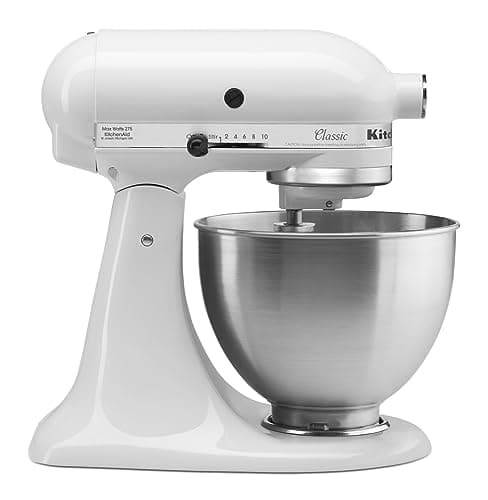
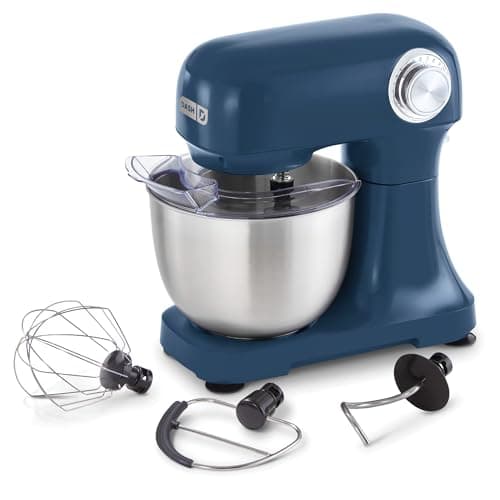
The two cheapest ways onto the stand-mixer ladder pull in opposite directions. The Dash 3.5-Qt Tilt-Head is a genuinely tiny, ultra-budget mixer built for a small kitchen and small batches. The KitchenAid Classicis the least expensive way into a machine that can last a decade and grow with you. They barely compete on paper, and the honest question isn't which is better — it's which of two very different jobs you're buying for.
Start with price, because it's the whole reason both machines exist. The Dash lands well under a hundred dollars, which makes it one of the cheapest real stand mixers you can put on a counter. The Classic is the entry point to the KitchenAid line, so it costs several times more than the Dash — still budget-friendly against the pricier Artisan and bowl-lift models, but a real step up in outlay. If the budget is the hard constraint, the Dash wins before you read another spec; if the budget stretches to a genuine KitchenAid, the rest of this comparison is about whether it's worth it.
Capacity is the first place the gap shows. The Dash carries a 3.5-quart bowl, which is right-sized for a single small batch — a dozen cookies, one cake, a bowl of whipped cream — and starts to feel tight the moment you scale up. The Classic's 4.5-quart bowl is the smallest in the KitchenAid family, but it's a full quart bigger than the Dash and comfortably handles a standard single batch, with a little more room before it runs out. Neither is a big-batch machine; if you routinely bake doubles, both are the wrong size and our best-for-cake-batter picks point at roomier bowls. But between these two, the Classic gives you the more usable everyday capacity.
Motor and durability are where the spec sheet is most likely to mislead you, and it's worth slowing down. On rated wattage the Dash actually lists a higher number — 350 rated watts to the Classic's 275 — which looks like a win for the cheaper mixer. It isn't. Rated watts describe electrical input, not the torque that reaches the beater, and the Dash is a light-duty, plastic-bodied machine designed for small, soft mixtures. The Classic is a cast KitchenAid with the same ten-speed planetary drive as every model above it, built to keep working for years. The Dash's own honest limits are a light-duty motor for small batches and a build that isn't made to last like a cast machine, plus a short one-year warranty (two years only if you register). The Classic's limits are milder: its 275-watt motor is the weakest in the KitchenAid line and its bowl gets tight on a full double batch. One is a mixer you replace; the other is a mixer you keep. Read the full Dash review and the KitchenAid Classic review for the complete picture on each.
The attachment ecosystem is the quiet dividing line. Both machines ship with the essentials — the Dash includes a dough hook, paddle, whisk and splash guard, and the Classic comes with its own beater set — so out of the box you can bake with either. The difference is what happens after. The Classic carries the same front PowerHub as every pricier KitchenAid, which means the deepest attachment ecosystem in the category (pasta rollers, grinders, spiralizers, ice-cream bowls) is open to it even at the entry price. The Dash has no ecosystem to grow into; what's in the box is what you get. If you think you'll ever want to expand, that hub is a real reason to step up.
The rule:buy the Dash if your kitchen is tiny, your batches are small, and the price has to be low — it's a lot of mixer for the money and an honest first-timer's tool. Buy the KitchenAid Classic if you want the machine you buy once, the bigger usable bowl, and the door to the whole KitchenAid world. They're not really rivals; they're answers to two different budgets and two different kitchens.
The short answer
Quick picks
| # | Product | Best for | Score | Price |
|---|
| 01 | Dash 3.5-Qt Tilt-Head Stand MixerThe mini stand mixer for a tiny kitchen or a first-timer. A 3.5-quart tilt-head with a paddle, dough hook, whisk and splash guard in the box, for well under a hundred dollars. It's light-duty and plastic-bodied — it won't knead heavy dough or last a decade — but for small-batch baking in a small space it's a lot of mixer for the money. | Small kitchens / occasional small batches | | $79.99·Amazon |
| 02 | KitchenAid Classic 4.5-Qt Tilt-Head (K45SS)The cheapest way into the KitchenAid ecosystem. Slightly smaller bowl and a hair less power than the Artisan, but the same attachment hub and the same 10-speed planetary action. For occasional bakers this is the smart buy. | Budget / occasional bakers | | $399.00·Amazon |
#ad · Live prices from the Amazon Product API, as of Sep 19, 2026. Where we have no verified live price we show none — a gap beats a number that has rotted.
In detail
The picks, in full
Small kitchens / occasional small batches
Dash 3.5-Qt Tilt-Head Stand Mixer
350 W rated3.5-qt bowl12 speedsTilt-headHook + whisk incl.
The mini stand mixer for a tiny kitchen or a first-timer. A 3.5-quart tilt-head with a paddle, dough hook, whisk and splash guard in the box, for well under a hundred dollars. It's light-duty and plastic-bodied — it won't knead heavy dough or last a decade — but for small-batch baking in a small space it's a lot of mixer for the money.
- Motor / dough
- 5.5
- Capacity
- 5.5
- Build & durability
- 6
- Ease of use
- 8
- Value
- 8.5
Pros
- +Compact and light (~6 lb) — easy to store in a small kitchen or dorm
- +Ships with a dough hook, paddle, whisk and splash guard, all dishwasher-safe
- +Costs a fraction of a full-size stand mixer
Cons
- −3.5-qt bowl and light-duty motor are for small batches, not heavy or high-volume dough
- −Plastic-forward build feels budget and isn't made to last like a cast machine
- −Short 1-year warranty (2 years only if you register)
Don't buy this if…
…you bake bread or double batches — even a budget full-size mixer like the Hamilton Beach 4-qt has the bowl and motor you'll want.
Budget / occasional bakers
KitchenAid Classic 4.5-Qt Tilt-Head (K45SS)
275 W rated4.5-qt bowl10 speedsTilt-headPowerHub port
The cheapest way into the KitchenAid ecosystem. Slightly smaller bowl and a hair less power than the Artisan, but the same attachment hub and the same 10-speed planetary action. For occasional bakers this is the smart buy.
- Motor / dough
- 7
- Capacity
- 7
- Build & durability
- 8
- Ease of use
- 9
- Value
- 9
Pros
- +Usually the lowest price for a genuine KitchenAid planetary mixer
- +Takes the same front-hub attachments as the pricier models
- +4.5-qt bowl is plenty for single batches
Cons
- −275 W rated motor is the weakest in the line
- −4.5-qt bowl gets tight on a full double batch
- −Fewer bowl/color options than the Artisan
Don't buy this if…
…you routinely bake double batches or bread — the extra half-quart and motor of the Artisan is worth the step up.
Which cheap stand mixer should you actually buy?
Buy the Dash 3.5-Qt if…
You have a small kitchen or a small budget and you bake in small batches. The Dash is compact and light enough to store in a cupboard or a dorm, it ships with a dough hook, paddle, whisk and splash guard that are all dishwasher-safe, and it costs a fraction of a full-size mixer. For a first-timer testing whether they even like using a stand mixer, or for someone whose counter genuinely can't take a big cast machine, it's the sensible, low-risk way in. It anchors our best-for-small-kitchens roundup for exactly those reasons.
Who it's notfor: anyone who bakes bread or double batches. The 3.5-quart bowl and light-duty motor are built for small, soft mixtures, not heavy or high-volume dough, and the plastic-forward build isn't made to last like a cast machine. If you already know you'll bake often, spending on the Dash first and the Classic later costs more than buying the Classic once.
Buy the KitchenAid Classic if…
You want a machine that lasts and can grow. The Classic is a genuine cast KitchenAid with the same ten-speed planetary action and the same front-hub attachments as the pricier models, so you're not locked out of pasta rollers or grinders later — the only things you give up versus the Artisan are half a quart of bowl and a little motor. For a baker who wants the resale value, the parts network and the buy-once durability, it's the smart budget entry, and the value anchor of our budget roundup. If you're still weighing where to start, the best-for-beginners roundup frames the same call against a wider field.
Who it's notfor: someone on the tightest budget or with the tightest counter. It costs several times the Dash and it's a heavier machine to store, so if the money or the space simply isn't there, the Dash does the small jobs honestly for far less.
How to read the wattage gap
Don't let it flip the decision. The Dash's 350 rated watts against the Classic's 275 reads like the mini out-muscles the KitchenAid, but rated watts are electrical input, not kneading torque, and the two machines are built to completely different durability standards. The Classic's cast drivetrain and planetary gearing will out-work the Dash on anything stiff despite the lower number on the box. Treat the Dash's wattage as a sign it can handle its own small batches, not as evidence it beats a real KitchenAid.
The step up within KitchenAid
If the Classic tempts you but you bake more than single batches, the honest next question is whether to jump to the Artisan rather than down to the Dash. The Artisan adds half a quart of bowl and a bit more motor for a higher price, and our KitchenAid Artisan vs Classic guidelays out when that step is worth it. If you're also cross-shopping the value Cuisinart tilt-head, the Classic vs Precision Master comparison covers that trade.
The deciding question
Ask how long you want the machine to last and how much you'll ask of it. If the answer is "a little, in a small space, for as little money as possible," the Dash is a genuine bargain and the KitchenAid tax buys you durability you won't stress. If the answer is "years of regular baking, and maybe an attachment or two," the Classic is the buy, and the Dash's low price is a false economy. Still not sure a stand mixer is the right category at all? Our is-a-stand-mixer-worth-it guide is the gut-check to read first.
How we picked
We don't run a testing lab
We read the manuals, compiled the published specifications, did the wattage-to-dough math and weighed aggregated owner reviews, then scored each product against a published rubric. The scores are judgments from documented research — they are not measurements we took, because we do not have a lab and we're not going to pretend we do. Every spec is the manufacturer's published figure, cited in Sources.
Questions
Frequently asked
Is the Dash or KitchenAid stand mixer better?+
They aim at different buyers. The Dash 3.5-qt is the cheaper, smaller machine for tiny kitchens and small batches; the KitchenAid Classic is the buy-once machine that lasts and takes the whole attachment range. If you want durability and room to grow, the Classic is better; if you want the lowest price for occasional small-batch baking, the Dash is enough.
The Dash lists more watts than the KitchenAid Classic - is it more powerful?+
No. The Dash lists 350 rated watts to the Classic's 275, but rated watts are electrical input, not kneading torque, and the Dash is a light-duty, plastic-bodied mixer while the Classic is a cast KitchenAid built to last. The Classic out-works it on anything stiff despite the lower number on the box.
Can the Dash stand mixer knead bread dough?+
Only lightly. The Dash ships with a dough hook, but its 3.5-quart bowl and light-duty motor are built for small, soft mixtures, not heavy or high-volume bread dough. If you bake bread or double batches, even a budget full-size machine like the KitchenAid Classic has the bowl and motor you'll want — see our
best budget stand mixers for the alternatives.
Is the KitchenAid Classic worth the extra money over the Dash?+
For most bakers who plan to keep baking, yes. The Classic is a genuine cast KitchenAid with a bigger 4.5-quart bowl, the same ten-speed planetary drive as the pricier models, and the front PowerHub that opens the full attachment ecosystem. You're paying for durability and a platform, not just a bigger mixer. If you only bake occasionally in a tiny kitchen, the Dash is the honest cheaper pick.
Receipts
Sources
We don't run a testing lab, and we don't pretend to. Specs are the manufacturer's published figures, cited above; scores are our judgments from that research. Where we couldn't verify something, we say so on the page rather than quietly leaving it out. Read our full method.