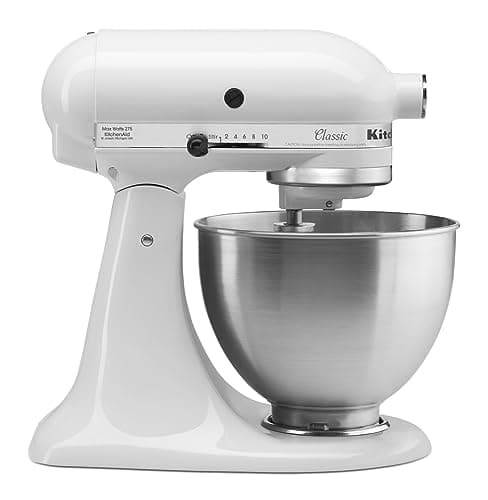
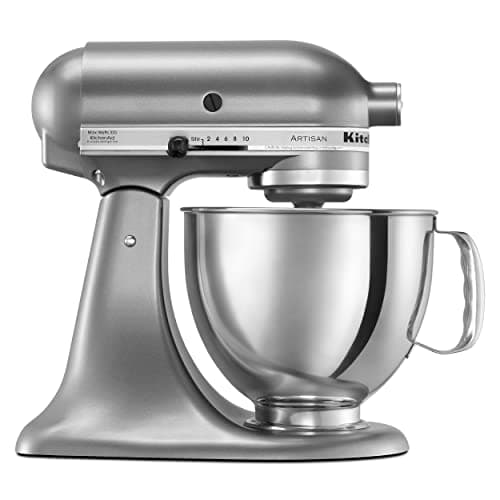
This is the most common decision inside the KitchenAid lineup: the entry Classic or the step-up Artisan. They look nearly identical and share the two things that define a KitchenAid — the 10-speed planetary action and the front PowerHub that every attachment fits — so the real question is whether the specific differences are worth the price gap for how you bake.
The differences are genuinely small. The Artisan has a 5-quart bowl to the Classic's 4.5, a slightly stronger rated motor, and many more color and bowl options; the Classic has the weakest motor in the line and the smallest bowl, at the lowest price. In practice: for single batches — a cake, a batch of cookies, whipped cream, one loaf of soft dough — you will not feel a difference between them. The extra half-quart and motor show up on double batches and on stiffer, more frequent bread dough, where the Artisan has the headroom and the Classic starts to work harder.
Neither is a compromised machine. The Classic is a right-sized KitchenAid for an occasional, single-batch baker; the Artisan is the safer buy for anyone who bakes more, makes double batches, or expects to knead bread regularly. Because they share the ecosystem, you're not locked out of anything by starting with the Classic — the only thing you can't easily add later is bowl size and motor. Our Classic review and Artisan review cover each in full.
The short answer
Quick picks
| # | Product | Best for | Score | Price |
|---|
| 01 | KitchenAid Artisan 5-Qt Tilt-Head (KSM150)The default for a reason: 5-qt tilt-head, a mature attachment ecosystem, and enough motor for a couple of loaves a week. Not the mixer for daily heavy dough — but that's a small slice of home bakers. | Most home bakers | | $449.00·Amazon |
| 02 | KitchenAid Classic 4.5-Qt Tilt-Head (K45SS)The cheapest way into the KitchenAid ecosystem. Slightly smaller bowl and a hair less power than the Artisan, but the same attachment hub and the same 10-speed planetary action. For occasional bakers this is the smart buy. | Budget / occasional bakers | | $399.00·Amazon |
#ad · Live prices from the Amazon Product API, as of Sep 19, 2026. Where we have no verified live price we show none — a gap beats a number that has rotted.
In detail
The picks, in full
Most home bakers
KitchenAid Artisan 5-Qt Tilt-Head (KSM150)
325 W rated5-qt bowl10 speedsTilt-headPowerHub port
The default for a reason: 5-qt tilt-head, a mature attachment ecosystem, and enough motor for a couple of loaves a week. Not the mixer for daily heavy dough — but that's a small slice of home bakers.
- Motor / dough
- 8
- Capacity
- 8
- Build & durability
- 8.5
- Ease of use
- 9
- Value
- 8.5
Pros
- +Huge attachment ecosystem (grinder, pasta, ice cream) via the front PowerHub
- +5-qt bowl handles roughly a double batch of cookie dough or 2 loaves of bread dough
- +Holds resale value and parts availability better than any rival brand
Cons
- −Tilt-head flex shows on very stiff, low-hydration dough
- −325 W rated motor is mid-pack — it will bog if you knead dense dough daily
Don't buy this if…
…you knead stiff bagel or heavy rye dough every day — a bowl-lift or a Bosch has the motor headroom you'll keep asking for.
Budget / occasional bakers
KitchenAid Classic 4.5-Qt Tilt-Head (K45SS)
275 W rated4.5-qt bowl10 speedsTilt-headPowerHub port
The cheapest way into the KitchenAid ecosystem. Slightly smaller bowl and a hair less power than the Artisan, but the same attachment hub and the same 10-speed planetary action. For occasional bakers this is the smart buy.
- Motor / dough
- 7
- Capacity
- 7
- Build & durability
- 8
- Ease of use
- 9
- Value
- 9
Pros
- +Usually the lowest price for a genuine KitchenAid planetary mixer
- +Takes the same front-hub attachments as the pricier models
- +4.5-qt bowl is plenty for single batches
Cons
- −275 W rated motor is the weakest in the line
- −4.5-qt bowl gets tight on a full double batch
- −Fewer bowl/color options than the Artisan
Don't buy this if…
…you routinely bake double batches or bread — the extra half-quart and motor of the Artisan is worth the step up.
Which KitchenAid should you actually buy?
Buy the Classic if…
You bake occasionally and in single batches, and you'd rather save the money. It does everything a light-to-medium baker asks and shares the same attachment hub, so you can still grow into pasta or grinding later. For an occasional baker, paying more for bowl and motor you won't use is the real mistake.
Buy the Artisan if…
You bake often, make double batches, or knead bread more than occasionally. The extra half-quart and motor are exactly the headroom you'll keep reaching for, and buying it up front usually costs less than upgrading twice. It's also the one to pick if you want the wider range of colors and bowl options.
The buy-once test
The cleanest way to decide: if you already know you'll bake weekly for years, buy the Artisan and stop thinking about it. If you're genuinely unsure how much you'll bake, the Classic is the lower-risk entry, and you can step up later without losing your attachments. Our worth-it guide helps you judge which baker you are before you spend.
The bottom line
The gap between these two is smaller than the marketing suggests. Match the machine to your hardest common job — single batches point to the Classic, double batches and regular bread point to the Artisan — and don't overpay for capacity you'll rarely use.
How we picked
We don't run a testing lab
We read the manuals, compiled the published specifications, did the wattage-to-dough math and weighed aggregated owner reviews, then scored each product against a published rubric. The scores are judgments from documented research — they are not measurements we took, because we do not have a lab and we're not going to pretend we do. Every spec is the manufacturer's published figure, cited in Sources.
Questions
Frequently asked
What's the real difference between the KitchenAid Artisan and Classic?+
The Artisan has a 5-quart bowl (vs 4.5), a slightly stronger rated motor and far more color and bowl options; the Classic is the cheapest, with the smallest bowl and weakest motor. Both share the same 10-speed planetary action and the same attachment hub.
Is the KitchenAid Artisan worth the extra money over the Classic?+
If you bake often, make double batches or knead bread regularly, yes — the extra bowl and motor are the headroom you'll use, and buying up front beats upgrading twice. For occasional single-batch baking, the Classic saves money without giving up the ecosystem.
Do the Artisan and Classic use the same attachments?+
Yes — both have the same front PowerHub, so pasta rollers, grinders and other attachments fit either. Starting with the Classic doesn't lock you out of the ecosystem; only bowl size and motor differ.
Receipts
Sources
We don't run a testing lab, and we don't pretend to. Specs are the manufacturer's published figures, cited above; scores are our judgments from that research. Where we couldn't verify something, we say so on the page rather than quietly leaving it out. Read our full method.