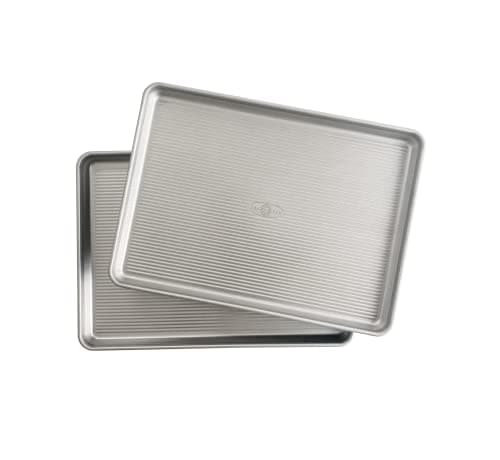
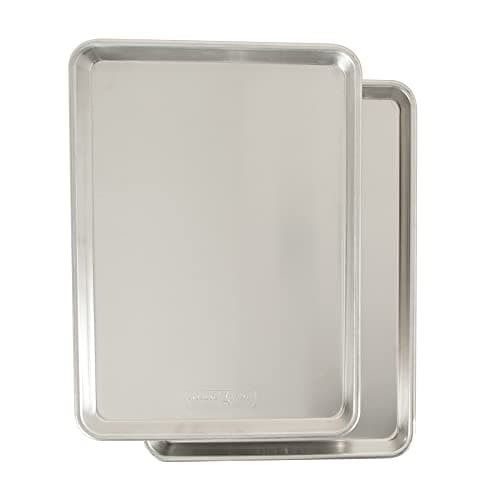
Buy the Nordic Ware Naturals half sheet two-pack unless you specifically want a coating.Bare aluminum browns cookies the most evenly of anything here, there is no coating to scratch or wear out, and — the point most comparisons miss — there is no published temperature ceiling to exceed, so it roasts at 500°F without you breaking a rating. Buy the USA Pan half sheet two-pack if you want a release surface made without PTFEand you never roast above 450°F, which is USA Pan's published maximum for the line.
These two brands are much closer than USA Pan and Nordic Ware are on loaf pans. Both pans here are made in the USA, sold in pairs, carry a lifetime warranty and have a reinforced rim — and the reinforced rim is the specific feature that stops a sheet pan warping with a bang in a hot oven. Both are a standard half-sheet footprint, so they share racks, liners and recipes. The genuine decision is coating versus no coating, and the temperature ceiling that comes with it.
The 450°F ceiling is the thing to decide on
USA Pan publishes 450°F as the maximum for its Americoat-coated bakeware. That covers every cookie, every sheet cake, every tray bake and most roasting. It does not cover roasting vegetables at 500°F, it does not cover a 500°F pizza, and we are not going to tell you to run a pan past its published rating.
Bare aluminum has no equivalent coating to degrade, which is why the Nordic Ware is the pan that goes wherever your oven goes. If you mostly bake cookies at 350°F, this paragraph is irrelevant to you and you can decide on the coating alone. If you roast hot — and a lot of people bought a sheet pan precisely to roast vegetables hard and fast — it is the whole decision.
Browning: why bare aluminum wins on cookies
Light, bare aluminum reflects more radiant heat and conducts quickly, so it browns gently and evenly. Dark or coated surfaces absorb more and brown harder from below, which is the main reason cheap dark pans burn cookie bottoms while the tops are still pale. We score the Nordic Ware highest here on browning for exactly that reason — a judgment from published construction and aggregated owner reports rather than a measurement, as how we pick sets out.
The USA Pan is not far behind, and it has a feature the Nordic Ware does not: a fluted surface that lifts the bake a fraction off the pan and improves airflow underneath. The flip side is that the fluting prints faint ridge lines on the underside of thin cookies and pastry. Neither of these is a reason to buy or avoid either pan; they are the texture of the difference.
The coating question, honestly
USA Pan's Americoat is a silicone coating made without PTFE, PFOA or BPA, which matters to a lot of people and is a legitimate reason to pick it. It releases sticky bakes cleanly and means you can skip parchment for well-greased cookies.
The counter-argument is simple: with bare aluminum, parchment or a silicone mat is effectively mandatory — and most people who bake a lot use parchment anyway. If you do, the coating buys you nothing and costs you a wear item, because every coating has a finite life and bare metal does not. That is the entire case for the Nordic Ware, and for most readers it is the right one.
Two shared caveats. Nordic Ware says hand wash — the dishwasher discolours bare aluminum permanently — and so does USA Pan. And bare aluminum darkens and mottles with age; it bakes the same but it will never look new, which bothers some people more than they expect.
The two specialist pans
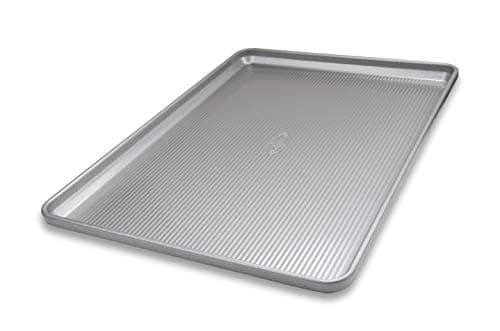
USA Pan Heavy Duty half sheet — for anyone whose pans keep warping. A noticeably thicker-gauge version of the standard USA Pan, with more rim reinforcement. The extra mass is the single best defence against warping and also evens out oven hot spots, so a tray of cookies bakes more uniformly. Two honest cons: it is sold as one pan for close to the price of the two-pack, and the gauge buys durability, not temperature — the ceiling is still 450°F. If your current pans are not warping, the two-pack is the better value.
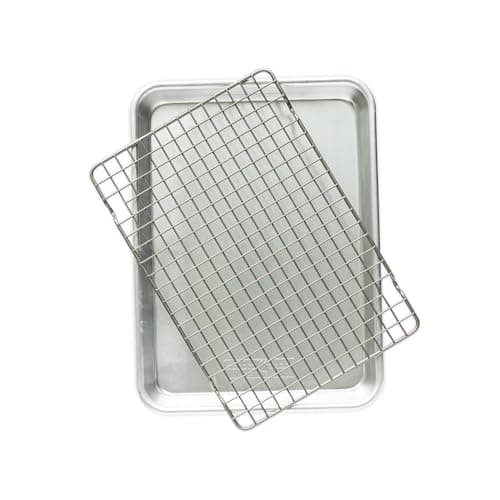
Nordic Ware Naturals quarter sheet — for small batches and toaster ovens.Half the footprint, same Naturals construction, with a nonstick grid included that works as an in-pan roasting rack or a small cooling rack. It fits a toaster oven and most countertop ovens, where a half sheet simply will not go, and it is the right size for toasting nuts or baking four cookies without heating a full pan. It is a supplementary pan, never a first one — and the included grid is the one wearable part of an otherwise coating-free pan. Our cooling rack guide covers how that grid differs from a proper rack.
The rule:default pair for almost everyone, and the only pick here that roasts above 450°F → Nordic Ware Naturals two-pack. A PTFE-free release surface and you bake rather than roast hot → USA Pan two-pack. Pans that keep buckling → USA Pan Heavy Duty. Toaster oven or four cookies → Nordic Ware quarter sheet. The full field, including the 550°F ceramic-coated pan and the budget option, is in the best baking sheets.
How to choose a half sheet pan
Start with your hottest recipe
This single question resolves most of the decision. Write down the highest temperature you actually cook at on a sheet pan. Under 450°F and both brands are in bounds, so choose on coating. At or above 475°F and you want bare aluminum, because exceeding a published rating is how a coating fails early and it voids the terms you bought the pan under.
Then decide whether you use parchment
If you line pans as a habit, buy bare aluminum and save the money and the wear item. If you grease pans and bake directly on them, the coating is worth paying for and USA Pan's PTFE-free version is a sound way to get one. There is no third answer here, and anyone telling you a coating is strictly better or strictly worse is selling you something.
Buy two, not one
Both brands sell these in pairs and that is not a marketing device. One pan bakes while the other cools, which is the only way to get through a batch of cookies without waiting out a hot pan between trays — and dropping dough onto a warm sheet is why the second tray always spreads more than the first. If you only ever buy one piece of bakeware from this page, buy the two-pack.
Check the rim, every time
An encapsulated steel wire or rod in the rolled rim is the feature that stops a pan warping. Every pan on this page has one. If you are price-shopping against something cheaper, that is the spec to look for, and its absence is why a bargain pan buckles audibly in a hot oven and then rocks on the rack forever afterwards.
What a half sheet is for, in a baking kitchen
It is the most-used pan you will own
Cookies, sheet cakes, roasted vegetables, a tray of scones, toasting nuts, catching drips under a pie, holding a cooling rack, proofing rolls under a damp towel. A half sheet does more jobs than any other single piece of bakeware, which is why we are comfortable recommending a pair of properly made ones over a stack of thin ones.
It is not a bread pan, and not a bread vessel
You can bake a free-form loaf on a sheet pan, and it will be a flatter, paler loaf than one baked covered. Sheet pans cannot trap steam, and steam in the first half of the bake is what gives a loaf spring and a crackling crust. If bread is your main interest, the sheet pan is not the purchase that will change your loaves — a covered cast iron vessel is, and a proper loaf pan is. Buy the sheet pans for everything else you bake.
Liners, and what they cost you
Parchment is the default and the right answer most of the time. A silicone mat is reusable and insulates slightly, which means marginally less browning on the base — useful for delicate cookies, unhelpful if you want a crisp bottom. Neither liner changes which pan you should buy, but a mat does narrow the browning gap between bare aluminum and a coated pan, because at that point neither surface is touching your dough.
Care that actually extends them
Hand wash both brands. Do not scour a coated pan, and do not put bare aluminum in the dishwasher. Store them flat or on edge rather than stacked with heavy pots on top, because a dent in the base is as bad for even baking as a warp. Treated that way, either of these pans outlives several cheap ones, which is the whole argument for buying them — see the baking essentials starter kit for where sheet pans sit in a first kit, and USA Pan vs Nordic Ware loaf pans for the same two brands fighting over a different pan.