Cookies look like the easy job for a stand mixer, and mostly they are. But how a machine creams butter and sugar, scrapes the sides of the bowl, and swallows a double batch without bogging down is exactly what separates a mixer you love on cookie day from one you merely tolerate. This is a job about finesse and capacity, not the raw dough-kneading muscle you'd chase for bread.
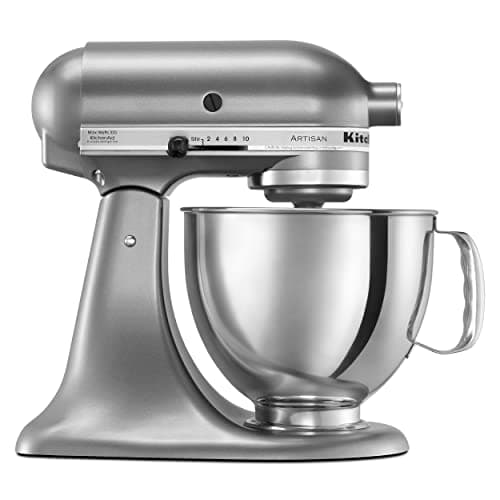
The foundation of almost every cookie is creaming — beating softened butter with sugar until it's pale and fluffy, which whips in the air that gives a cookie its lift and tender texture. A stand mixer's planetary flat beater does this far more evenly, and far more hands-free, than you ever could by hand. The KitchenAid Artisan is our top pick here for one reason above the rest: the depth of its attachment ecosystem, and specifically the flex-edge beaterthat clips into it. That accessory has a flexible silicone wing along one edge that wipes the bowl as it turns, so butter and sugar don't get stranded in a ring near the rim while the center over-creams. For cookies, that even, no-stopping creaming is worth more than any number on the box.
The Artisan earns the top spot beyond the beater, too. Its 5-quart bowl comfortably holds a double batch of dough with chips folded in, the 10-speed planetary action gives you a controlled low end for adding flour without a cloud, and the same front hub that takes the flex-edge beater also takes the rest of the KitchenAid accessory range if your baking grows. It's the platform a cookie baker is least likely to outgrow.
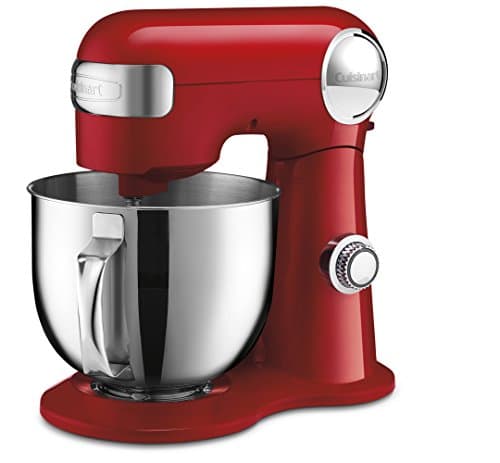
The Cuisinart Precision Mastertakes second on value and capacity. Its larger 5.5-quart bowl is the most forgiving of the three for a genuine double batch, and its 12 speeds give you a slow enough start to fold in a pound of chocolate chips without flinging them across the counter. You give up the KitchenAid attachment world — there's no equivalent flex-edge beater — but for the price it creams and mixes cookie dough with room to spare, and it ships with the beater, whisk and dough hook in the box.
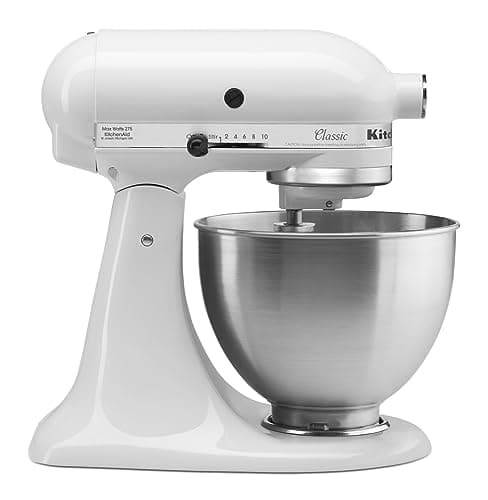
The KitchenAid Classicrounds out the list as the compact pick. Its 4.5-quart bowl is half a quart smaller than the Artisan's — plenty for a standard batch and a modest double — and it shares the same 10-speed planetary action and the same front hub, so the flex-edge beater fits it just as well. For a home baker whose cookie output is a tray or two at a time, it does everything the Artisan does in a slightly smaller package.
The short answer
Quick picks
| # | Product | Best for | Score | Price |
|---|
| 01 | KitchenAid Artisan 5-Qt Tilt-Head (KSM150)The default for a reason: 5-qt tilt-head, a mature attachment ecosystem, and enough motor for a couple of loaves a week. Not the mixer for daily heavy dough — but that's a small slice of home bakers. | Most home bakers | | $495.00·Amazon |
| 02 | Cuisinart Precision Master 5.5-Qt (SM-50)The value tilt-head. A larger 5.5-qt bowl and a stronger rated motor than the Artisan, usually for less money. The trade is a thinner accessory ecosystem and slightly rougher fit and finish. | Best value tilt-head | | $279.95·Amazon |
| 03 | KitchenAid Classic 4.5-Qt Tilt-Head (K45SS)The cheapest way into the KitchenAid ecosystem. Slightly smaller bowl and a hair less power than the Artisan, but the same attachment hub and the same 10-speed planetary action. For occasional bakers this is the smart buy. | Budget / occasional bakers | | $399.00·Amazon |
#ad · Live prices from the Amazon Product API, as of Aug 5, 2026. Where we have no verified live price we show none — a gap beats a number that has rotted.
In detail
The picks, in full
Most home bakers
KitchenAid Artisan 5-Qt Tilt-Head (KSM150)
325 W rated5-qt bowl10 speedsTilt-headPowerHub port
The default for a reason: 5-qt tilt-head, a mature attachment ecosystem, and enough motor for a couple of loaves a week. Not the mixer for daily heavy dough — but that's a small slice of home bakers.
- Motor / dough
- 8
- Capacity
- 8
- Build & durability
- 8.5
- Ease of use
- 9
- Value
- 8.5
Pros
- +Huge attachment ecosystem (grinder, pasta, ice cream) via the front PowerHub
- +5-qt bowl handles roughly a double batch of cookie dough or 2 loaves of bread dough
- +Holds resale value and parts availability better than any rival brand
Cons
- −Tilt-head flex shows on very stiff, low-hydration dough
- −325 W rated motor is mid-pack — it will bog if you knead dense dough daily
Don't buy this if…
…you knead stiff bagel or heavy rye dough every day — a bowl-lift or a Bosch has the motor headroom you'll keep asking for.
Best value tilt-head
Cuisinart Precision Master 5.5-Qt (SM-50)
500 W rated5.5-qt bowl12 speedsTilt-headSplash guard
The value tilt-head. A larger 5.5-qt bowl and a stronger rated motor than the Artisan, usually for less money. The trade is a thinner accessory ecosystem and slightly rougher fit and finish.
- Motor / dough
- 8
- Capacity
- 8.5
- Build & durability
- 7.5
- Ease of use
- 8.5
- Value
- 9
Pros
- +Bigger bowl and higher rated wattage than the same-price KitchenAid
- +12 speeds with a genuinely useful low start speed
- +Comes with dough hook, flat beater and whisk in the box
Cons
- −Far fewer first-party attachments than KitchenAid
- −Resale value and long-term parts support trail KitchenAid
- −Head latch feels less refined
Don't buy this if…
…you want to grow into pasta rollers, grinders and the wider attachment world — that's KitchenAid's home turf.
Budget / occasional bakers
KitchenAid Classic 4.5-Qt Tilt-Head (K45SS)
275 W rated4.5-qt bowl10 speedsTilt-headPowerHub port
The cheapest way into the KitchenAid ecosystem. Slightly smaller bowl and a hair less power than the Artisan, but the same attachment hub and the same 10-speed planetary action. For occasional bakers this is the smart buy.
- Motor / dough
- 7
- Capacity
- 7
- Build & durability
- 8
- Ease of use
- 9
- Value
- 9
Pros
- +Usually the lowest price for a genuine KitchenAid planetary mixer
- +Takes the same front-hub attachments as the pricier models
- +4.5-qt bowl is plenty for single batches
Cons
- −275 W rated motor is the weakest in the line
- −4.5-qt bowl gets tight on a full double batch
- −Fewer bowl/color options than the Artisan
Don't buy this if…
…you routinely bake double batches or bread — the extra half-quart and motor of the Artisan is worth the step up.
What actually makes a stand mixer good at cookies
Cookie baking rewards a specific set of strengths, and none of them is the horsepower you'd chase for bread dough. Here's what to weigh.
Even creaming is the whole game
Nearly every cookie starts by creaming butter and sugar, and doing it evenly is what gives you a consistent crumb instead of pockets of greasy, under-mixed dough. A planetary flat beater on any of these machines creams far better than a hand mixer, because the beater travels the full circle of the bowl. What separates the three is how much butter gets left clinging to the sides.
Bowl scraping: why the flex-edge beater matters
A standard flat beater leaves a ring of butter and sugar near the rim that you have to stop and scrape down by hand two or three times a batch. The flex-edge beater— a KitchenAid accessory that fits the Artisan and Classic alike — has a flexible edge that wipes the bowl as it mixes, so creaming stays even and you stop far less often. If cookies are your main use, it's the single best upgrade you can make to any KitchenAid.
Capacity for a double batch
Cookie recipes scale up naturally — you rarely make just one dozen. A 5 to 5.5-quart bowl comfortably holds a double batch of dough with mix-ins; a 4.5-quart bowl handles a standard batch and a modest double. Don't oversize past that, though: a small amount of butter in a cavernous bowl just gets stranded above the beater. Our size guide works through the batch math.
Don't over-beat once the flour goes in
The one mistake a powerful mixer makes easy is over-mixing after the flour is added. Creaming wants air; the flour stage wants restraint, because working the dough hard develops gluten and toughens the cookie. Drop to a low speed and stop the moment the flour disappears. This is exactly why the Cuisinart's slow 12-speed start and the KitchenAid's controlled low end matter more than a big top speed.
Where a hand mixer is honestly enough
Cookies are also the job a good hand mixer does well, so be honest about whether you need a stand mixer at all. If you bake a batch every few weeks, a hand mixer built for cookie dough creams and mixes fine and lives in a drawer. A stand mixer wins when you bake often, make double batches, or want the hands-free, walk-away creaming — see stand mixer vs hand mixerif you're weighing the two.
How we picked
We don't run a testing lab
We read the manuals, compiled the published specifications, did the wattage-to-dough math and weighed aggregated owner reviews, then scored each product against a published rubric. The scores are judgments from documented research — they are notmeasurements we took, because we do not have a lab and we're not going to pretend we do. Every spec is the manufacturer's published figure, cited in Sources.
Questions
Frequently asked
What's the best stand mixer for cookies?+
The KitchenAid Artisan, mainly because of its attachment ecosystem. Paired with the optional flex-edge beater it creams butter and sugar evenly while scraping the bowl for you, which is the job cookies live or die on. The Cuisinart Precision Master is the value pick with the biggest bowl, and the compact KitchenAid Classic covers a baker making a tray or two at a time.
Do I need the flex-edge beater for cookies?+
You don't need it, but it's the best single upgrade for cookie baking on a KitchenAid. It scrapes the bowl as it mixes, so butter and sugar cream evenly without you stopping to scrape by hand. Our
flex-edge beater reviewcovers what it does and doesn't help with.
What size mixer do I need for a double batch of cookies?+
A 5 to 5.5-quart bowl handles a double batch of most cookie doughs comfortably, which is why the Artisan and Cuisinart lead here. A 4.5-quart Classic takes a standard batch and a modest double. Bigger isn't automatically better — a small amount of butter gets stranded above the beater in an oversized bowl.
Can I over-beat cookie dough in a stand mixer?+
Yes. Creaming butter and sugar wants air, but once the flour is in, mixing hard develops gluten and toughens the cookie. Drop to a low speed and stop as soon as the flour disappears — a mixer with good low-speed control makes that easy.
Receipts
Sources
We don't run a testing lab, and we don't pretend to. Specs are the manufacturer's published figures, cited above; scores are our judgments from that research. Where we couldn't verify something, we say so on the page rather than quietly leaving it out. Read our full method.