Holiday baking is a different kind of test than everyday baking, and it's the season that shows you whether your mixer is really up to the job. Between Thanksgiving and New Year's the same kitchen turns out dozens of cookies in a sitting, two or three cakes for a single gathering, pie dough by the batch, and recipes doubled to feed a crowd — often back to back, in a single long afternoon. That's a volume problem more than a finesse problem, so the machine you want is one with enough bowl to hold a doubled batch, enough motor headroom to run for an hour without straining, and the right attachments to switch from creaming butter to whipping cream to kneading dough without missing a beat. This ranking weighs those seasonal realities rather than the specs that win a single-recipe test.
Three machines cover the three ways people bake at the holidays, and a different one wins each. If you want the do-everything default that handles the widest range of festive baking with the least fuss, that's the KitchenAid Artisan— the 5-quart tilt-head most holiday bakers picture and most holiday recipes are written for. If your batches get genuinely big and your dough turns stiff — multiple loaves of enriched holiday bread, doubled cookie dough by the bowlful — the KitchenAid 5.5-quart bowl-lift stays planted where a tilt-head starts to flex. And if you want the most bowl and rated motor for the money, the Cuisinart Precision Master is the value pick, with a bigger bowl than the same-price KitchenAid. None of the three is a bad machine; the honest differences below are about which holiday kitchen each one suits.
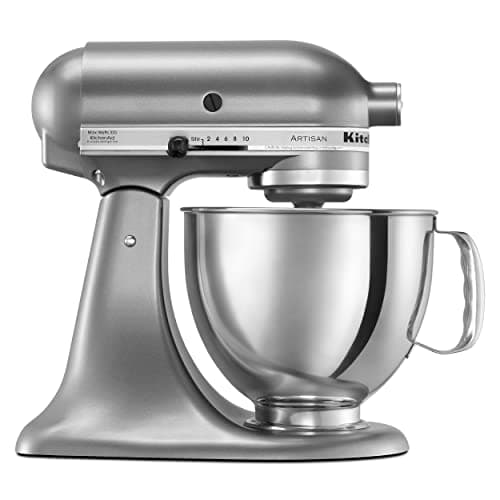
KitchenAid Artisan — the do-everything default.For the vast majority of holiday bakers, the Artisan is simply the right answer. Its 5-quart tilt-head bowl comfortably holds roughly a double batch of cookie dough or the batter for a couple of cakes, its ten well-spaced speeds cover everything from gently folding in flour to whipping cream for a trifle, and its front PowerHub opens the deepest attachment ecosystem in the category if you want to add a pasta roller for a holiday dinner or a grinder for sausage. It holds resale value and parts availability better than any rival, which matters for a machine you'll lean on every December for a decade. The honest cons are the ones we always name: the rated 325-watt motor is only mid-pack, so it will bog if you push stiff, dense dough through it for hours, and the tilt-head can flex on very low-hydration dough. For a baker doing cookies, cakes, pies and the occasional loaf, neither ceiling bites — which is exactly why it's the default. See the full KitchenAid Artisan review and our best-for-cookies roundup for the cookie-focused angle.
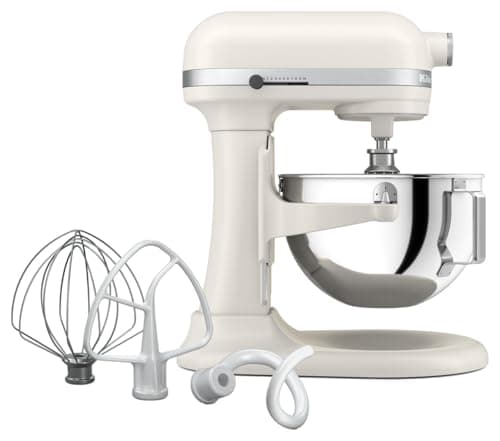
KitchenAid 5.5-quart bowl-lift — when the batches get big and the dough gets stiff. The step up is for the baker whose holiday output has outgrown a 5-quart tilt-head. The bowl-lift design plants the head firmly over a larger 5.5-quart bowl, so it stays steady on stiff, heavy dough where a tilt-head can flex and bounce — the difference you feel when you're kneading a doubled batch of enriched holiday bread or running the machine hard for a full afternoon. The bigger bowl also means fewer trips: a doubled cookie dough that would crowd a 5-quart bowl has room to move. It takes the same front-hub attachments as every other KitchenAid, so nothing is a dead end. The honest cons: it costs more than the tilt-head Artisan for what most bakers need, the lift design is a little less convenient for quick bowl and beater swaps, and it's heavier and taller — check your under-cabinet clearance before you buy. Don't step up to it if you bake a normal holiday spread on a normal counter; the Artisan does that for less. The 5.5-quart bowl-lift review and our best-for-large-batches roundup have the detail.
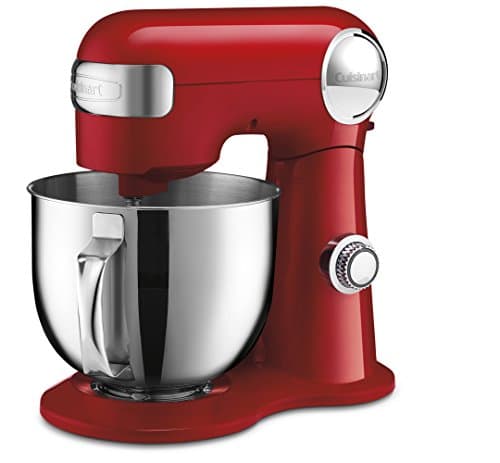
Cuisinart Precision Master — the value pick with a bigger bowl.If the budget is doing the deciding, the Cuisinart is the most machine for the money at holiday time. Its 5.5-quart bowl is larger than the same-price KitchenAid's, its rated motor is stronger on paper, and it arrives with a flat beater, dough hook and whisk in the box — plus a splash guard that earns its keep when you're creaming butter and sugar for the tenth time and don't want powdered sugar over the counter. Twelve speeds include a genuinely useful low start. The honest cons are the ownership ones rather than the baking ones: it has far fewer first-party attachments than KitchenAid, its resale value and long-term parts support trail the KitchenAid line, and the head latch feels a little less refined. For a baker who wants a roomy, capable mixer for a busy season without spending at the top, it's the value route. Read the Cuisinart Precision Master review for the full trade-off.
How to choose a stand mixer for holiday baking
The holidays turn a mixer from an occasional helper into a workhorse, so the criteria shift. For a single Tuesday-night cake you can get away with almost anything; for a December of doubled recipes and back-to-back bakes you want capacity, motor headroom and the right attachments in that order. Here is how to weigh each one against how you actually bake at this time of year, so you buy the machine that fits the season rather than the spec sheet.
Capacity: size the bowl to your biggest batch, not your average one
The first thing holiday baking exposes is bowl size, because December is when you double recipes. A 5-quart bowl — the Artisan's — comfortably handles roughly a double batch of cookie dough or the batter for a couple of cakes, which covers most home holiday baking with room to spare. A 5.5-quart bowl — on both the bowl-lift and the Cuisinart — gives you a little more headroom for the days you're making three or four dozen cookies at once, or doubling an enriched dough. The rule of thumb is to size for your biggestplanned bake, not your average one, because a bowl that's too small forces you to split batches and mix in shifts, which is exactly the tedium you bought a mixer to avoid. Whipping needs headroom too: egg whites and cream can triple in volume, so leave room above the mixed level. If you're genuinely baking in bulk — multiple loaves, big doubled doughs — our best-for-large-batches roundup looks at the same question from the high-volume end.
Motor headroom: it's the long sessions that find the limit
Motor headroom matters far more in a holiday marathon than it does for a single recipe, because it isn't any one bake that strains a mixer — it's the hour of running that a big baking day involves. Whipping cream and creaming butter are light work that no capable mixer struggles with, but kneading stiff, enriched holiday dough — brioche, stollen, cinnamon-roll dough by the doubled batch — is where a mid-pack motor labors and heats up. The Artisan's rated 325-watt motor is fine for a normal spread of cookies, cakes and pies, but it will bog if you push heavy dough through it for a full afternoon. The bowl-lift and the Cuisinart both carry more headroom for that stiffer, longer work. If a burning-warm smell ever appears mid-session, that's the motor telling you it's overloaded — our guide to why a stand mixer smokes explains the difference between a harmless break-in smell and a real warning, and stepping down a batch size usually fixes it.
Attachments for holiday tasks: the whisk, the beater and the hook all earn their keep
Holiday baking asks a single mixer to do three different jobs, sometimes within one recipe, so the attachments matter as much as the motor. The flat beater creams butter and sugar for cookies and cakes and mixes most batters; the wire whip whips the cream for pies and trifles and the egg whites for meringue and lighter cakes; the dough hook kneads the enriched breads and rolls that show up this time of year. All three picks ship with all three attachments, so you're covered out of the box. Beyond the basics, the KitchenAid front PowerHub is the real holiday advantage — it takes pasta rollers for a festive dinner, a meat grinder, an ice-cream maker and more, which is why the two KitchenAids score so well on versatility. Our overview of the wider stand mixer attachments shows what the hub can add if your holiday menu goes beyond baking.
Tilt-head vs bowl-lift: which design suits a heavy season
The single biggest structural choice is tilt-head versus bowl-lift, and the holidays are exactly when the difference shows. A tilt-head like the Artisan or the Cuisinart is friendlier day to day — you flip the head back to swap the bowl or beater, which is quicker when you're running recipe after recipe — and it's lighter and shorter on the counter. A bowl-lift plants the head over the bowl on a raised arm, which keeps it rock-steady on stiff dough and heavy loads, at the cost of a little convenience and a taller footprint. For most holiday bakers the tilt-head is the better fit; for the person doubling stiff dough all season, the bowl-lift's stability is worth the trade. Our tilt-head vs bowl-lift guidewalks through the mechanics in full so you can match the design to how hard you'll push it.
Matching the three picks to your holiday kitchen
Line the three up against the way you actually bake in December and the choice usually makes itself. The Artisan is the default: enough bowl and the right control for the cookies, cakes and pies that make up most holiday baking, plus the widest accessory range if your festive cooking grows. The 5.5-quart bowl-liftis the upgrade for the baker whose batches are big and whose dough is stiff — the steadiest platform for a long, heavy afternoon. The Cuisinartis the value route to a roomy, capable machine, giving up the deep ecosystem and some resale value in exchange for a bigger bowl and a lower price. Buy for the season you actually have rather than the one you imagine, and you won't over- or under-spend.
Batch order and timing for a big baking day
A capable mixer is only half of a smooth holiday session; the other half is the order you work in, and a little planning keeps a single machine from becoming the bottleneck. Group your bakes by attachment so you're not swapping and washing between every recipe — do the creamed batters and doughs that use the flat beater together, then the whipped jobs that use the wire whip, then any kneading on the dough hook — and you'll spend far less of the afternoon at the sink. Save the delicate whipped elements, like the cream for a trifle or the meringue for a pie, for last, since they're best made close to serving and don't hold as well as a baked cookie or a rested dough. Mix the stiff, motor-taxing doughs earlier while the machine is cool rather than at the end of a long, warm session, and let it rest a few minutes between the heaviest batches. With a sensible order, even the mid-pack Artisan comfortably carries a full day of festive baking, and the bigger machines simply give you more room to work fast.
A few holiday-specific habits that save the day
However capable the machine, a heavy baking day goes better with a little planning. Have your butter and eggs at room temperature before you start, so the beater does its job without overworking the motor. Weigh your flour rather than scooping it, because a doubled recipe multiplies any measuring error and an over-floured dough bakes dense and dry. Give the machine short rests between big, stiff batches rather than running it flat out for an hour straight. And if you're still deciding whether a stand mixer earns its counter space for a once-a-year push, our take on whether a stand mixer is worth itis a good gut check — for anyone who bakes seriously at the holidays, the answer is usually yes. Read the individual reviews above before you commit, since each is honest about the cons a roundup can only summarize.