If you bake yeasted sandwich bread, buy the USA Pan 1-lb loaf pan. It is a true 8.5 x 4.5-inch baking surface, which is the size most yeast-bread recipes are actually written for, in heavy aluminized steel with a PTFE-free coating that releases a loaf without a fight. If you bake banana bread and quick breads, buy the Nordic Ware Naturals 1.5-lb instead— its 9.1 x 5.3-inch interior is close to the classic 9 x 5 pan those recipes assume, and bare aluminum browns gently, which is what a long sugary bake needs.
Almost everyone arriving at this comparison thinks they are choosing between two brands. They are really choosing between two pan sizes that happen to be sold by two different companies, and the size is the decision that will change your bread. Get it wrong and the symptom is predictable: a yeast dough sized for 8.5 x 4.5 put into a 9 x 5 pan rises sideways instead of up and comes out squat, and a quick-bread batter sized for 9 x 5 put into an 8.5 x 4.5 pan crests and spills over the rim.
The two pans, side by side
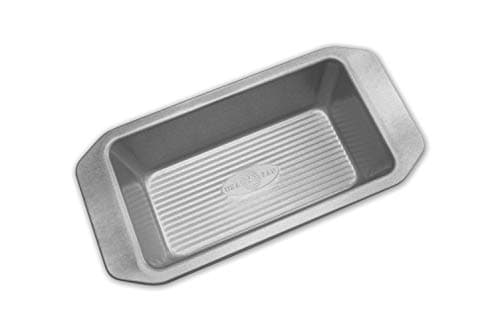
USA Pan American Bakeware Classics 1-lb (1140LF)— 8.5 x 4.5 x 2.75 in, aluminized steel, USA Pan's fluted surface, the Americoat coating (made without PTFE, PFOA or BPA), a steel-wire-reinforced rim, rated to 450°F, made in the USA. It is a coated pan that browns evenly rather than aggressively, and the reinforced rim is the specific feature that stops a pan buckling in a hot oven.
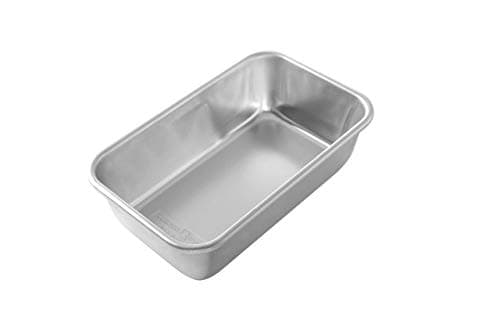
Nordic Ware Naturals 1.5-lb— 9.1 x 5.3 x 2.8 in inside, uncoated natural aluminum, encapsulated galvanized steel rim, made in the USA. Pure aluminum conducts heat quickly and browns gently instead of scorching the crust, which is exactly right for a banana bread or pound cake that sits in the oven for an hour. Nordic Ware advises against the dishwasher — detergent and heat discolour bare aluminum permanently.
Coated or uncoated: the real trade
The USA Pan is coated and the Nordic Ware is not, and this is a genuine fork rather than a better-or-worse. A coating releases sticky, high-sugar batters more easily and means less greasing. It is also a wear item: scratch it or scour it and the pan's useful life is shortened, and no coating lasts the way bare metal does. An uncoated pan asks you to grease, flour or line it every single time, and punishes you the one time you forget — in exchange, there is nothing to scratch, blister or wear off.
If you are the kind of baker who reaches for parchment anyway, uncoated is the better long bet. If you want to butter the pan and go, coated is worth it. Our how to grease and line a loaf pan guide covers the parchment-sling method that makes the uncoated question mostly moot.
Heat behaviour, and why it shows up in your crust
Light-coloured bare aluminum reflects more and browns more gently; darker coated steel absorbs more and browns harder. For a yeasted sandwich loaf baked in 35 to 45 minutes, a slightly firmer brown on the sides is desirable — it is structure, and the USA Pan gives it to you. For a dense, sugary quick bread in the oven for an hour, hard browning is the enemy: the edges set before the middle cooks, and you end up with a dark crust around a wet centre. That is the Nordic Ware's case, and it is a real one.
Two practical notes that follow from this. First, the USA Pan's fluted surface lifts the loaf a fraction off the metal and improves airflow, which is useful, and it prints faint ridge lines down the sides of the loaf, which some bakers dislike. Second, both pans are hand-wash recommended, so neither is a throw-it-in-the-dishwasher pan whatever the coating does.
The two other pans worth knowing about
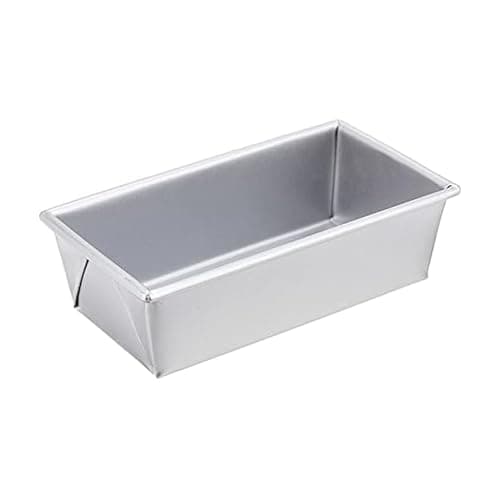
Chicago Metallic Commercial II uncoated 1-lb — for bakers who do not want a coating.The bakery pan, and the quiet value answer. Same 8.5 x 4.5 footprint and the same heavy aluminized steel as the USA Pan, but with no coating at all — nothing to scratch, nothing to blister. Folded corners and a wire-rod reinforced rim keep it flat through repeated hot bakes, the Commercial II line carries a lifetime warranty, and it is usually the cheapest pan on this page. It will darken with use and never look new again, and sticky batters grab harder than they would on nonstick. If you already grease every pan out of habit, this is arguably the most rational buy here.
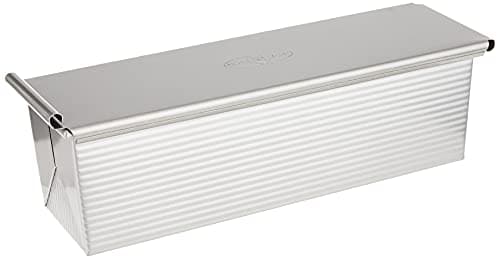
USA Pan Pullman loaf pan with lid — for square sandwich bread. A different pan for a different ambition: 13 x 4 x 4 in with a sliding lid, which is how you get pain de mie— a flat-topped loaf that slices into perfect squares. Heavy corrugated aluminized steel, the same PTFE-free Americoat surface, made in the USA, rated to 450°F and hand-wash only. It costs several times what a basic loaf pan does, and the lidded shape is wasted on you if you only bake the occasional banana loaf. For the full story, read our USA Pan Pullman review.
The rule:yeasted sandwich bread → USA Pan 1-lb. Banana bread and quick breads → Nordic Ware Naturals 1.5-lb. Both, cheaply, and you do not mind greasing → Chicago Metallic Commercial II. Square-sided sandwich bread → USA Pan Pullman. The whole field is ranked in the best loaf pans.
Work out which size you need before you pick a brand
Read the recipe, not the pan
Open the recipe you bake most often and find the pan size. If it says 8.5 x 4.5 — which is what the majority of yeasted sandwich-bread recipes built on about three cups of flour specify — the USA Pan or the Chicago Metallic is your pan. If it says 9 x 5, which is the standard for banana bread, zucchini bread and pound cake, the Nordic Ware is your pan. If you bake both regularly, own both: they are inexpensive relative to how much bread they will make, and a mismatched pan is the single most common reason a loaf comes out the wrong shape. Our how to choose a loaf pan guide goes through the sizes in detail.
Measure the pan you already own
Pan markings lie, and more to the point they measure different things — some brands quote the outside, some the inside, some the volume. Measure across the top of the interior, corner to corner. A pan that measures 8.5 inches inside is not the same vessel as one that measures 9.1 inches inside, and that two-thirds of an inch is the difference between a loaf that climbs and one that spreads.
Volume beats dimensions when you are unsure
If the markings are unreadable, fill the pan with water a cup at a time. A true 8.5 x 4.5 loaf pan holds roughly six cups; a 9 x 5 holds roughly eight. That is the fastest way to know which recipe family your pan belongs to without trusting a label.
What to look for in a loaf pan, brand aside
A reinforced rim is the feature that matters most
Every pan on this page has one — a steel wire or rod encapsulated in the rolled rim — and it is the single best predictor of whether a pan will still be flat in five years. A thin pan with an unreinforced rim warps, and a warped pan rocks on the oven rack and bakes unevenly for the rest of its life. If you are comparing a cheaper pan against these, that is the spec to check.
Gauge, because thin pans scorch
Heavy-gauge metal evens out oven hot spots; thin metal transmits them straight into your crust. This is most of the difference between a supermarket pan and the pans here, and it is why we are comfortable recommending pans that cost several times as much as the cheapest option: they bake better and they outlast a stack of the thin ones.
Check the temperature ceiling against your bake
Both USA Pan pans here publish a 450°F maximum. That is fine for yeasted sandwich bread and every quick bread, and it is not fine for a very hot artisan-style bake. If your recipes preheat to 475°F or above, you are not looking for a loaf pan at all — you want a covered cast iron vessel, which is a different page: the best Dutch ovens for bread and what size Dutch oven for bread.
Care, so the pan survives being right
Hand wash all four of these. For the Nordic Ware specifically, Nordic Ware's own use and care guidance is explicit that the dishwasher discolours bare aluminum, and the discolouration is permanent — it bakes the same afterwards but it will never look new. For the coated USA Pans, avoid metal utensils and abrasive pads, because the coating is the part with a finite life. Our greasing and lining guide doubles as the way to extend any of these pans: a parchment sling means almost nothing ever touches the surface.
Where a loaf pan sits against the rest of your kit
A good loaf pan is one of the cheapest real upgrades in baking — cheaper than a mixer attachment, cheaper than a banneton, and it changes every loaf you make in it. If you are building out from here, the next two purchases that actually move the needle are a scale and a thermometer: see kitchen scales and the bread thermometer guide. And if the dough is the hard part rather than the pan, our best stand mixers for bread dough roundup is the page to read.