Skip to content
Plug & Prep

Hub 05 · Guides · Guides & Comparisons

Lodge vs Le Creuset Dutch oven

Two enameled cast iron pots, both published to 500°F, both capable of the same loaf. Here is exactly where the price difference goes - and the one reader who should pay it.

By Stephen V.Updated How we pick
#ad

We earn a commission when you buy through our Amazon links, at no extra cost to you. It never changes our rankings, and we say so when the cheaper product is the better buy. How this works.

If the pot is for bread, buy the Lodge 6-quart.It publishes the same 500°F oven-safe ceiling as the Le Creuset, it has the same stainless knob, and six quarts is the volume a standard boule actually wants — and it costs a fraction of the French pot. Buy the Le Creuset Signature 5.5-qt instead if the pot is going to live on your stove and do everything: it is the only pick here Le Creuset lists as dishwasher safe, it carries a limited lifetime warranty, and it is a visibly better-finished object. What it is not is better bread.

That is the honest headline of this comparison, and it is worth stating before the detail, because the two pots are far more alike than the price gap suggests. Both are enameled cast iron. Both are published heat-resistant to 500°F, which is the number that matters for a no-knead or sourdough preheat. Both use a stainless knob rather than a phenolic one, so there is no plastic part you have to swap before a hot bake. Both trap steam the same way, because trapping steam is a function of a heavy lid sitting on a heavy pot, and physics does not read the badge.

What a Dutch oven is actually doing to your loaf

A covered cast iron pot does two things for bread, and neither is brand-sensitive. First, it traps the moisture coming out of the dough through the first half of the bake, which keeps the crust soft long enough for the loaf to spring instead of setting early. Second, the mass of preheated iron dumps a large amount of heat into the base of the loaf in the first few minutes, which is what gives you oven spring and an open crumb. King Arthur Baking's own guidance on baking bread in a Dutch oven, cited below, describes exactly this mechanism — and it is why a cheap pot and an expensive pot produce loaves most bakers could not separate blind. The full field is ranked in our best Dutch ovens for bread roundup.

So the question is not “which bakes better bread.” The question is what else you want from the pot, and how long you intend to own it.

Where the money actually goes

Finish and tolerances. The Le Creuset is made in France, and the enamel is smoother, the handles better balanced for the weight, the lid seated with less rattle. These are real differences you notice every time you pick the pot up. They are not differences the dough notices.

Dishwasher and warranty.This is the most concrete thing the premium buys. Le Creuset lists the Signature as dishwasher safe and backs it with a limited lifetime warranty. Lodge's enamel pots are best treated as hand-wash. Chip the interior enamel and it cannot be repaired on either pot — but only one of them has a lifetime warranty behind it. If you are the kind of cook who wants to put a pot in the dishwasher after a braise and not think about it, that is worth real money to you.

Handling.The Le Creuset's wider 5.5-qt profile and larger loop handles make it the easiest enameled pot here to maneuver in and out of a hot oven. Neither pot has a silicone grip; both need two dry mitts, and both will burn you if you forget.

Where the Lodge wins outright

Size, for bread specifically.This is the part most comparisons skip. The Le Creuset Signature round is 5.5 quarts; the Lodge Essential Enamel is 6. For a standard 500 g boule, six quarts is close to ideal — walls tight enough that the dough climbs rather than spreads, with enough headroom that a confident spring does not hit the lid. At 5.5 quarts the Le Creuset is slightly tight for a 1 kg loaf. If you bake big, our what size Dutch oven for bread guide walks the sizing by dough weight, and the Lodge 7.5-qt below is the answer.

Price per loaf. Four to five times the money for a loaf you could not pick out of a lineup is a poor trade if bread is the only job. On a fixed gear budget, the Lodge plus a proofing basket and an instant-read thermometer will improve your loaves considerably more than the same money spent on one French pot.

Colour pricing.One practical warning: Amazon pricing on the Le Creuset swings widely by colour, so the identical pot can cost considerably more in a different shade. Check two or three colours before you add to cart. The prices in the table above come from the Amazon Product API and are stamped with the date we read them — we never write a price into prose, because prose rots and a live number does not.

The two picks that are neither

Lodge Essential Enamel 7.5-qt — for large loaves and double duty.Our top pick with another quart and a half of headroom. Same published 500°F ceiling, same stainless knob. Buy it if you bake 1 kg loaves or want one pot that is also the household braiser. Do not buy it for standard boules: a small loaf in a wide pot spreads sideways instead of climbing, which costs you height. It also takes noticeably longer to come up to temperature, so preheats stretch out.

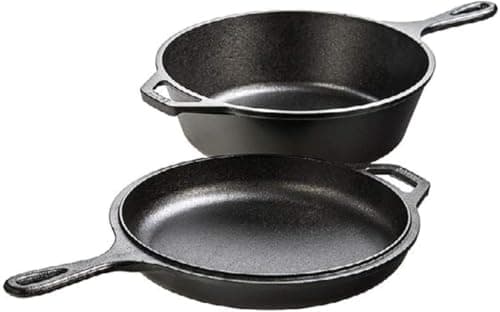
Lodge Cast Iron Combo Cooker — for anyone nervous about loading a hot pot.The one pick here that beats both on the most dangerous part of the process. It is bare seasoned cast iron, made in the USA, and it inverts: the 10.25-inch shallow skillet is the base and the 3.2-qt deep pot becomes the lid. You set a proofed round onto a flat surface at counter height and cap it, instead of lowering dough blind into a hot well and scraping your knuckles on the rim. The trade-offs are maintenance — Lodge's own instruction is hand wash, dry and oil, every time — and capacity, since 3.2 quarts suits one modest boule. For the material question, see enameled vs bare cast iron for bread.

The rule:bread only, or a first Dutch oven → Lodge 6-qt. One pot for bread and daily cooking that you want to own for thirty years and put in the dishwasher → Le Creuset Signature 5.5-qt. Big loaves → Lodge 7.5-qt. Nervous about loading a preheated pot → Lodge Combo Cooker.

The short answer

Quick picks

#ProductBest forScorePrice
01
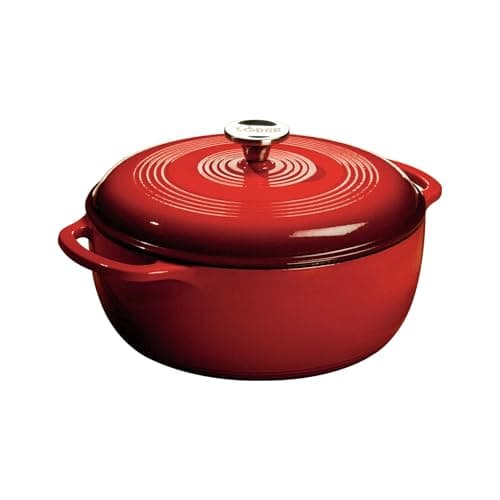
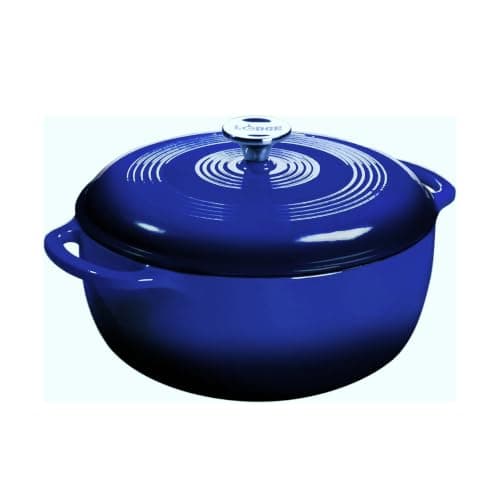
Lodge Lodge Essential Enamel Cast Iron Dutch Oven, 6 Quart
Lodge Essential Enamel Cast Iron Dutch Oven, 6 Quart

The sweet spot for bread. Six quarts is the volume a standard 500 g boule wants, the published 500°F ceiling clears the temperature most no-knead recipes ask for, and the enamel means you skip seasoning entirely. It costs a fraction of a French-made pot and bakes a functionally identical loaf.

Most sourdough and no-knead bakers
8.8
$66.49Amazon
02
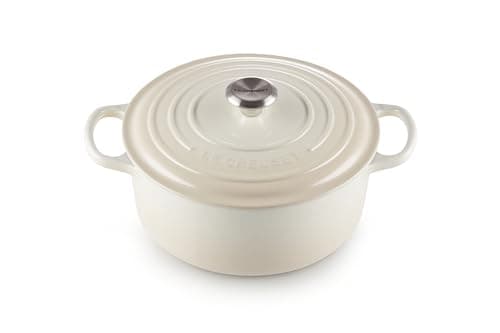
Le Creuset Le Creuset Signature Round Dutch Oven, 5.5 Qt
Le Creuset Signature Round Dutch Oven, 5.5 Qt

Made in France, heat-resistant to 500°F, dishwasher safe, stainless knob, limited lifetime warranty. It is a genuinely better-finished pot than anything else here — smoother enamel, better-balanced handles — and it bakes a loaf most bakers could not separate from the Lodge's. Buy it because you want to own it for thirty years, not because it bakes better bread.

A lifetime pot you will also cook in daily
8.5
$315.00Amazon
03
Lodge Lodge Essential Enamel Cast Iron Dutch Oven, 7.5 Quart
Lodge Essential Enamel Cast Iron Dutch Oven, 7.5 Quart

The same pot as our top pick with another quart and a half of headroom — the one to buy if you bake 1 kg loaves or want a pot that doubles as the family braiser. The extra volume is not free: a small loaf in a big pot spreads out rather than climbing, so this is the wrong buy if your loaves are modest.

Large loaves and double-duty braising
8.3
$83.99Amazon
04
Lodge Lodge Cast Iron Combo Cooker, 3.2 Quart
Lodge Cast Iron Combo Cooker, 3.2 Quart

The bread baker's cult pick, and for a real reason: the shallow skillet becomes the base and the deep pot inverts over it as a lid, so you load a proofed round onto a flat surface at counter height instead of dropping it blind into a deep, 450°F well. Bare cast iron, so there is no enamel to chip.

Loading dough without burning your knuckles
8.8
$59.90Amazon

#ad · Live prices from the Amazon Product API, as of October 5, 2026. Where we have no verified live price we show none — a gap beats a number that has rotted.

In detail

The picks, in full

01
Lodge Lodge Essential Enamel Cast Iron Dutch Oven, 6 Quart

Most sourdough and no-knead bakers

Lodge Essential Enamel Cast Iron Dutch Oven, 6 Quart

6-qt capacityEnameled cast iron500°F oven-safeStainless knobInduction ready
8.8/10

The sweet spot for bread. Six quarts is the volume a standard 500 g boule wants, the published 500°F ceiling clears the temperature most no-knead recipes ask for, and the enamel means you skip seasoning entirely. It costs a fraction of a French-made pot and bakes a functionally identical loaf.

Crust & steam
9
Build quality
8.5
Ease of use
8.5
Versatility
9
Value
9

Pros

  • 6-qt round shape gives a standard boule room to spring without spreading into a pancake
  • Published 500°F ceiling covers the preheat most no-knead and sourdough recipes specify
  • Enamel needs no seasoning and will not take on a garlic-and-stew flavor from other cooking

Cons

  • Enamel chips if you knock it or drop a lid on the rim, and a chipped interior cannot be repaired
  • No silicone grip — the loop handles get screaming hot and need two dry mitts
  • Heavier than it looks; lowering it into a low oven is awkward if you have weak wrists

Don't buy this if…

…your recipe preheats the vessel past 500°F — bare cast iron, not enamel, is the tool for a 550°F bake.

$66.49View on Amazon

$89.9026% off

Price as of October 5, 2026. Prices change — Amazon's at checkout is the one that counts.

#ad · we may earn a commission from this link to Lodge Essential Enamel Cast Iron Dutch Oven, 6 Quart

02
Le Creuset Le Creuset Signature Round Dutch Oven, 5.5 Qt

A lifetime pot you will also cook in daily

Le Creuset Signature Round Dutch Oven, 5.5 Qt

5.5-qt capacityEnameled cast iron500°F heat-resistantStainless steel knobLimited lifetime warranty
8.5/10

Made in France, heat-resistant to 500°F, dishwasher safe, stainless knob, limited lifetime warranty. It is a genuinely better-finished pot than anything else here — smoother enamel, better-balanced handles — and it bakes a loaf most bakers could not separate from the Lodge's. Buy it because you want to own it for thirty years, not because it bakes better bread.

Crust & steam
9
Build quality
9.5
Ease of use
9
Versatility
9
Value
6

Pros

  • The only pick here Le Creuset lists as dishwasher safe, with a limited lifetime warranty behind it
  • Stainless knob is rated to the same 500°F as the pot, so there is no plastic part to swap out
  • Wide 5.5-qt profile and large handles make it the easiest of the enameled pots to maneuver

Cons

  • Four to five times the price of the Lodge for a loaf most bakers could not tell apart
  • Amazon pricing swings widely by color, so the same pot can cost considerably more in a different shade
  • 5.5 qt is slightly tight for a 1 kg loaf — size up if you bake big

Don't buy this if…

…the pot is only ever going to bake bread — the money is better spent on the Challenger, which is purpose-built for it.

$315.00View on Amazon

$454.9531% off

Price as of October 5, 2026. Prices change — Amazon's at checkout is the one that counts.

#ad · we may earn a commission from this link to Le Creuset Signature Round Dutch Oven, 5.5 Qt

03
Lodge Lodge Essential Enamel Cast Iron Dutch Oven, 7.5 Quart

Large loaves and double-duty braising

Lodge Essential Enamel Cast Iron Dutch Oven, 7.5 Quart

7.5-qt capacityEnameled cast iron500°F oven-safeStainless knobInduction ready
8.3/10

The same pot as our top pick with another quart and a half of headroom — the one to buy if you bake 1 kg loaves or want a pot that doubles as the family braiser. The extra volume is not free: a small loaf in a big pot spreads out rather than climbing, so this is the wrong buy if your loaves are modest.

Crust & steam
8
Build quality
8.5
Ease of use
7.5
Versatility
9
Value
8.5

Pros

  • 7.5 qt comfortably takes a 1 kg loaf without the dough touching the walls
  • Same published 500°F ceiling and stainless knob as the 6-qt version
  • Big enough to be the household's main braising pot, so it earns its shelf space twice

Cons

  • A small boule spreads sideways in a pot this wide instead of springing upward
  • Noticeably heavier than the 6-qt — a real consideration lifting it in and out of a hot oven
  • Takes longer to come up to temperature, so preheats stretch out

Don't buy this if…

…you bake standard 500 g boules — the 6-qt gives those loaves tighter walls to climb, which means a taller loaf.

$83.99View on Amazon

$99.9016% off

Price as of October 5, 2026. Prices change — Amazon's at checkout is the one that counts.

#ad · we may earn a commission from this link to Lodge Essential Enamel Cast Iron Dutch Oven, 7.5 Quart

04
Lodge Lodge Cast Iron Combo Cooker, 3.2 Quart

Loading dough without burning your knuckles

Lodge Cast Iron Combo Cooker, 3.2 Quart

3.2-qt deep pot10.25 in skillet lidBare seasoned cast ironMade in USA12.85 lb
8.8/10

The bread baker's cult pick, and for a real reason: the shallow skillet becomes the base and the deep pot inverts over it as a lid, so you load a proofed round onto a flat surface at counter height instead of dropping it blind into a deep, 450°F well. Bare cast iron, so there is no enamel to chip.

Crust & steam
9
Build quality
9
Ease of use
9
Versatility
8
Value
9

Pros

  • Load the loaf onto the flat skillet, then cap it — far safer and more accurate than lowering dough into a deep pot
  • No enamel means nothing that can chip, and bare cast iron is not limited by an enamel temperature rating
  • Two pans in one: the skillet sears and bakes cornbread, the pot handles braises and soup

Cons

  • Needs seasoning maintenance — Lodge's own instruction is hand wash, dry, oil, every time
  • 3.2 qt suits one modest boule; a big 1 kg loaf will touch the sides
  • Bare cast iron will take on and give back strong flavors if you also braise in it

Don't buy this if…

…you want a zero-maintenance pot you can leave wet in the sink — this one rusts if you do, and enamel is the answer instead.

$59.90View on Amazon

Price as of October 5, 2026. Prices change — Amazon's at checkout is the one that counts.

#ad · we may earn a commission from this link to Lodge Cast Iron Combo Cooker, 3.2 Quart

How to decide, in four questions

1. Is this pot only ever going to bake bread?

If yes, the premium is very hard to justify and the Lodge 6-qt is the answer. A pot that only bakes bread is used once or twice a week, cools on a trivet and goes back in the cupboard; the finish quality and the dishwasher rating never come into play. If the pot is going to braise short ribs, make chili and cook rice as well as bake, the calculus changes and the Le Creuset starts to look reasonable — you are amortising it over daily use rather than one loaf a week.

2. What size loaf do you actually bake?

Weigh your dough once and the answer falls out. Around 500 g of dough → 5.5 to 6 quarts, which is where the Lodge 6-qt sits and where the Le Creuset is fine. Around 900 g to 1 kg → size up to the Lodge 7.5-qt, because at 5.5 quarts a big loaf touches the walls. One modest boule and nothing bigger → the 3.2-qt Combo Cooker is plenty, and it loads far more safely. If you have never weighed your dough, our how to measure flour by weight guide is the five-minute fix.

3. How hot does your recipe preheat?

Both Lodge enamel pots and the Le Creuset publish 500°F, so anything up to that is in bounds for either. Above 500°F, enamel is the wrong tool and you want bare cast iron — the Combo Cooker, which has no enamel to blister and no enamel rating to exceed. This is also why we do not recommend the cheapest enameled pots for bread: a 450°F rating rules out the 475-500°F preheat many no-knead recipes specify, and exceeding a published rating is not a risk we will tell you to take.

4. Can you lift it, and will you maintain it?

Enameled cast iron is heavy and gets heavier as it gets bigger, and lowering a loaded 7.5-qt pot into a low oven is a genuine wrist job. If that is a concern, the Combo Cooker is the lightest route to a covered bake, though at 12.85 lb it is hardly light either. On maintenance: enamel needs no seasoning and will not carry a garlic-and-stew flavour into a loaf, which is its real advantage over bare iron. Bare iron needs the hand-wash-and-oil routine and rusts if you leave it wet in the sink. Neither is wrong; they ask for different habits, and you should buy the one that matches yours rather than the one you intend to deserve.

Three arguments that do not justify the upgrade

“Le Creuset holds heat better”

Both pots are cast iron of broadly similar mass, and mass is what stores heat. Neither manufacturer publishes a thermal figure we could compare, so anyone claiming a measurable heat-retention edge is guessing. We are not going to guess for you — see how we pick, where we say plainly that our scores are judgments from published specifications and aggregated owner reports, not measurements we took.

“The lighter interior enamel helps you judge browning”

True of a braise, largely irrelevant to bread. You bake a loaf with the lid on for the first half and then remove it, at which point you are looking at the crust from above rather than at the pot's interior. A light interior is a cooking feature, not a baking one.

“It will last longer”

The warranty is genuinely better, and a limited lifetime warranty has real value. But the failure mode for both pots is the same, and it is not wear — it is a chip, from knocking the rim or dropping the lid, and a chipped interior cannot be repaired on either pot. Careful handling extends a Lodge enamel pot's life considerably more than brand loyalty does.

Where this sits in a bread kitchen

A Dutch oven is the highest-leverage purchase for oven-baked bread, and it comes before almost everything else — ahead of a banneton, ahead of a lame, well ahead of a second mixer. If you are still choosing between hand-shaping into a pot and letting a machine do the whole job, our bread machine vs oven-baked bread comparison is the page to read first, because it decides whether you need a pot at all. If the dough itself is the bottleneck, a mixer with real dough capability matters more than the vessel — start with the best stand mixers for sourdough. And if you want the whole field rather than this head-to-head, the best Dutch ovens for bread roundup ranks six vessels including a budget enameled pot and the purpose-built Challenger.
How we picked

We don't run a testing lab

We read the manuals, compiled the published specifications, did the wattage-to-dough math and weighed aggregated owner reviews, then scored each product against a published rubric. The scores are judgments from documented research — they are not measurements we took, because we do not have a lab and we're not going to pretend we do. Every spec is the manufacturer's published figure, cited in Sources.

Questions

Frequently asked

Is Le Creuset worth it for baking bread?
Not for the bread itself. The Le Creuset Signature and the Lodge Essential Enamel both publish a 500°F ceiling and both trap steam the same way, so the loaf is functionally the same. Le Creuset is worth it if the pot is also your daily braiser: it is the one here listed as dishwasher safe, it has a limited lifetime warranty, and it is a better-finished object. For bread alone, buy the Lodge and spend the difference on flour.
Can you use a Lodge Dutch oven for sourdough?
Yes, and it is our top pick for it. The 6-quart Lodge Essential Enamel publishes a 500°F oven-safe rating, which covers the preheat most no-knead and sourdough recipes specify, and 6 quarts gives a standard 500 g boule tight enough walls to climb. Use two dry mitts - the loop handles get extremely hot and have no silicone grip.
What size Dutch oven is best for one loaf of bread?
Five and a half to six quarts for a standard 500 g boule. That is tight enough that the dough climbs rather than spreading, with headroom for oven spring. Go to 7.5 quarts only if you bake 900 g to 1 kg loaves, and bear in mind that a small loaf in a big pot spreads sideways and bakes shorter.
Is Lodge enamel as good as Le Creuset enamel?
The finish is not as fine - Le Creuset's enamel is smoother and its handles better balanced - and Lodge does not match the limited lifetime warranty or the dishwasher-safe rating. But the two publish the same 500°F ceiling, and the failure mode for both is a chip from a knock, which no warranty prevents and no repair fixes. For bread, the difference does not reach the loaf.
Do you need an enameled Dutch oven, or is bare cast iron fine?
Both work. Enamel needs no seasoning and will not carry flavours between a braise and a loaf; bare cast iron has no enamel to chip and no enamel temperature ceiling, so it handles a preheat above 500°F. Bare iron asks for hand wash, dry and oil every time. We compare the two properly in enameled vs bare cast iron for bread.

Keep reading

More in this category

More guides & comparisons

All guides & comparisons →

Receipts

Sources

We don't run a testing lab, and we don't pretend to. Specs are the manufacturer's published figures, cited above; scores are our judgments from that research. Where we couldn't verify something, we say so on the page rather than quietly leaving it out. Read our full method.