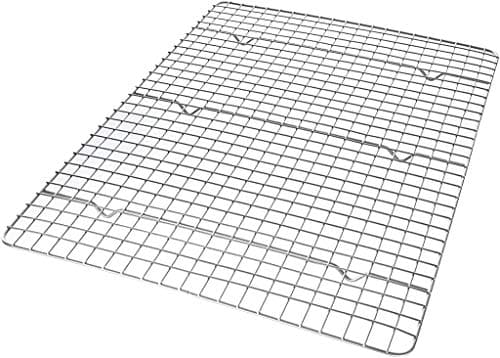
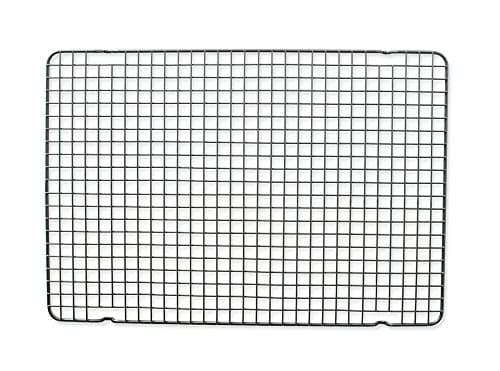
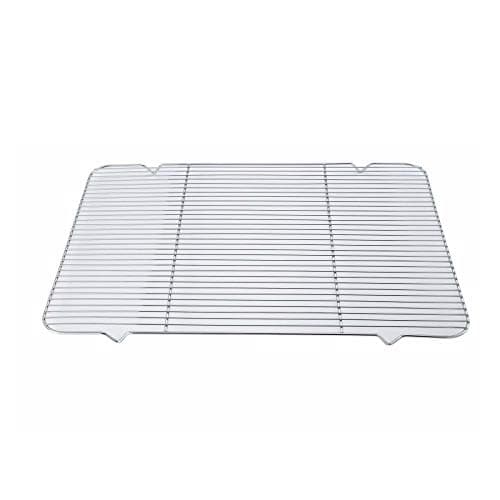
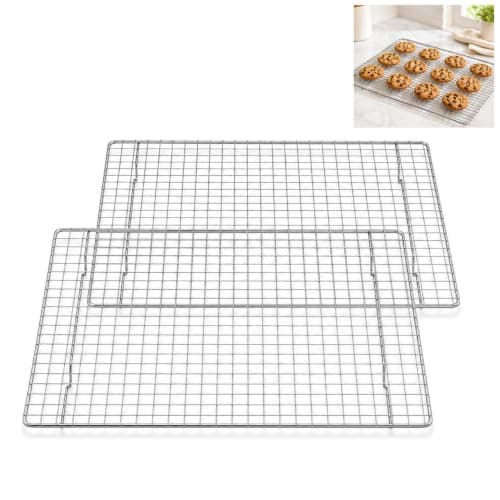
Buy the Mrs. Anderson's Professional half-sheet rack, which comes as a pair. It is the only pick here that gives you two racks, the published oven rating is the highest on this page at 500°F, and the cross-wire weave is tight enough that a macaron or a small cookie sits on the surface rather than sagging through it. Take the USA Pan bakeable rack instead if the rack is going to spend as much time holding bacon over a sheet pan as it does cooling cookies — six raised feet and a 450°F nonstick surface make it the better in-pan roasting insert. The Nordic Ware oven-safe grid is the cheapest single full-size rack worth owning and the obvious partner to a Nordic Ware half sheet. The 25-inch Winco ICR-1725 is the rack to buy when the problem is capacity: it holds roughly double a half-sheet rack for about the same money, and it is a cooling and glazing surface only.
Why a rack changes the bake, not just the tidying-up
A tray of cookies leaving a 375°F oven is full of water, and that water leaves as steam for several minutes after the bake is over. Set the tray on the counter and the steam coming off the underside has nowhere to go: it hits the solid pan, condenses back into liquid, and soaks into the thing that just spent twelve minutes crisping. That is the entire mechanism behind a soft-bottomed cookie, a soggy scone base and a loaf with a damp, leathery underside. A rack solves it by removing the floor — air circulates under the bake, the steam leaves, and the bottom stays as crisp as it was when it came out of the oven.
The same physics is why the rack matters more for some bakes than others. Thin, high-surface-area items — cookies, biscuits, scones, pastry — are the ones ruined by condensation and the ones that benefit most. A dense cake in its pan can rest on a rack for ten minutes and then come out of the pan onto the rack. Bread is the extreme case: a hot loaf should go straight onto a rack, because a loaf cooling on a board steams its own base into something you have to re-crisp.
The two published numbers that actually decide this
Cooling racks look interchangeable on a shelf and are not, and the specs that separate them are both printed on the back of the box rather than the front.
1. The footprint, and whether it fits inside a half-sheet pan. A US half-sheet pan is about 18 x 13 inches outside with an interior near 16.5 x 11.5. A rack built to that interior drops into the pan and sits on the floor of it, which is what makes a pan-plus-rack combination work: fat drips into the pan, the pan catches crumbs, and the whole thing goes in and out of the oven as one unit. A rack sized to the pan's outside dimensions instead perches on the rim, wobbles and defeats the point. Three of the four picks here are built to the interior. The Winco is deliberately not — it is 25 inches long because it is sized for a commercial cooling bench, not a domestic pan.
2. The published oven rating, which is not the same as “oven safe.” Every rack on Amazon says oven safe somewhere. The useful question is the number: Mrs. Anderson's publishes 500°F, USA Pan publishes 450°F, Nordic Ware publishes 400°F, and Winco publishes nothing at all for the ICR-1725. Those differences decide whether a rack can be an in-oven roasting insert or only a cooling surface. A 400°F rack is outside its rating the moment you roast vegetables at 425°F. We have used each maker's own figure and, where there is no figure, we say so instead of guessing — see how we pick.
Then the weave, the feet, and the surface
Cross-wire or parallel bars. A grid where wires run both ways supports a soft bake at many points. A rack with parallel bars and only two or three cross-braces leaves gaps wide enough for a warm cookie to droop into, and it prints bar marks across the base of anything still soft. Every pick here is a cross-wire grid; the cheapest racks on Amazon generally are not.
Foot height. More clearance means more airflow under the bake. The published heights here run from 0.5 inches (USA Pan) to 0.9 inches (Nordic Ware), which sounds trivial and is the difference between air moving under a loaf and air sitting under it. Any of these clears enough for cookies; for bread the taller the better.
Surface: bare, plated or coated.Three different propositions. A nonstick-coated rack (USA Pan, Nordic Ware) releases a glazed bake and wipes clean, and the coating is a wear item you can ruin with a scouring pad. A chrome-plated rack (Mrs. Anderson's, Winco) is cheap, strong and heat-tolerant, and the plating is the part that can eventually chip. Bare 18/8 stainless is the connoisseur's answer — nothing to wear, usually dishwasher safe — and it is the one surface not represented below, for a reason we explain in the buying guide.
Published specifications of the four picks
| Rack | Published size | Oven rating | Surface | Warranty |
|---|
| Mrs. Anderson's half sheet, set of 2 | 16.5 x 11.75 x 0.6 in | 500°F | 3.6 mm chrome-plated wire | Not published |
| USA Pan bakeable half sheet | 16.75 x 11.5 x 0.5 in | 450°F | Nonstick-coated steel | Limited lifetime |
| Nordic Ware grid (43343) | 11.5 x 16.9 x 0.9 in | 400°F | PFOA-free nonstick steel | 5 years |
| Winco ICR-1725 | 25.1 x 16.25 x 1 in | Not published | Chrome-plated wire | 1 year |
Every figure above is the manufacturer's or its distributor's published number, cited in Sources below. “Not published” means exactly that: Winco lists no oven-temperature rating for this rack, and we could not find a published warranty term for the Mrs. Anderson's pair — we will not fill either gap with an assumption. We have not heat-tested a rack ourselves and never claim to.
How many racks do you need? Two.
This is the thing nobody tells first-time buyers, and it is why our top pick is a pair. Cookies come off a sheet in batches and each batch needs somewhere to sit for ten minutes. With one rack, batch two waits on the hot pan — which is the exact condition the rack exists to prevent — or goes onto the counter to steam. With two racks you rotate properly. A layer cake is the same argument: two layers come out of the oven at the same moment and both need to cool out of their pans.
It is also why the Mrs. Anderson's pair wins on value by a distance. Two racks for roughly the price of one mid-range rack is not a near-run thing, and the specification is not a compromise to get there: the highest published oven rating on this page belongs to the cheapest pick.
Cooling rack or roasting rack? The same object, rated differently
A rack inside a sheet pan is the standard way to roast anything you want crisp on all sides: bacon, chicken wings, a rack of ribs, breaded cutlets. Fat drips into the pan, air gets under the food, and nothing sits in its own grease. Whether a given rack can do that job is entirely a matter of its published temperature rating and its surface.
The USA Pan bakeable rack is the pick built for it — the nonstick surface is there precisely so a glaze or a marinade releases, and six feet instead of four keep it stable under something heavy. At 450°F it covers almost every roasting recipe. The Mrs. Anderson's pair goes 50 degrees higher but is plated rather than coated, so sticky glazes are more work to clean off. The Nordic Ware grid stops at 400°F, which rules out most high-heat roasting. The Winco has no published rating at all and should be treated as a cooling and icing surface only, which is no criticism: it is excellent at that, and far better at it than anything half-sheet sized.
Why there is no bare-stainless rack on this page
Uncoated 18/8 (304) stainless is, on paper, the best material for a cooling rack: nothing to chip or wear, no coating to overheat, and usually dishwasher safe. We went looking for one to include. The problem is that the stainless half-sheet racks selling well on Amazon come overwhelmingly from brands that publish no verifiable specification sheet — the temperature ratings and steel grades appear in listing copy and nowhere a manufacturer stands behind. This site does not quote a number it cannot source, so we would rather tell you the gap exists than fill it with a figure we scraped from a product description.
If you specifically want bare stainless, the practical advice is to buy from a foodservice supplier rather than a marketplace listing, check that the wires cross in both directions, and measure your sheet pan's interior before ordering. Everything in the first half of this page applies regardless of who made the rack.
Five things that matter more than which rack you buy
- Move the bake onto the rack promptly. Cookies need two or three minutes on the pan to firm up enough to lift, then they want to be off it. Leaving them on a hot pan for fifteen minutes is the single most common cause of an over-baked, soft-bottomed cookie, and no rack can fix it after the fact.
- Get the pan right first. The rack protects the bottom of a bake; the pan decides it. A thin, dark, warped sheet burns bases before the rack ever gets involved — see the best baking sheets and, for cookies specifically, the best baking sheets for cookies.
- Let bread cool completely on the rack before slicing. A loaf is still setting its crumb as it cools. Cut it at twenty minutes and the interior is gummy; the rack is what lets the base dry out while that happens.
- Weigh your flour. The most reliable upgrade in baking has nothing to do with hardware you can see — how to measure flour by weight and our ranked kitchen scales cover it.
- Match the rack to the pan you own. Measure the interior of your sheet pan, not the outside. Half an inch of error is the difference between a rack that drops in and a rack that sits on the rim.
Care, and what kills a rack
Three of these four are hand wash only, and the reason differs: on the coated racks a scouring pad takes the nonstick off, and on the plated racks a dishwasher cycle plus trapped water is what starts the pitting that eventually lifts the plating. The routine that works is hot water, a dish brush into the junctions where wires cross, and drying it properly rather than leaving it in the sink. A rack that is dried after every wash lasts effectively forever; one that is left wet goes spotty within a year, whatever the surface.
If you use a rack for roasting, line the pan under it with foil or parchment. The rack is easy to clean and baked-on fat in the pan is not.
Where this sits in a baking setup
A rack is the cheapest item in any of our bakeware roundups, and it is the one most likely to be missing from a kitchen that has everything else. If you are assembling from scratch, the baking essentials starter kit is the order to buy things in. If your bakes are coming out of the pan badly rather than cooling badly, the pan is the problem: start with the best loaf pans for bread or the best cake pans for cake. And if it is the dough rather than the bake that is the bottleneck, the mixer pages are the place to go — the stand mixer hub ranks the machines, and stand mixer vs hand kneading is the honest answer on whether you need one at all.