Meringue is one of the purest tests of a hand mixer. There is nowhere to hide: it's just egg whites and sugar beaten with air until they hold their shape, and the whole result comes down to how well the mixer whips. Three things matter, and they're the same three every time. You want a genuine wire whisk to fold in the maximum amount of air, a gentle low speed to start the whites loosening without shocking them, and enough sustained powerto carry them all the way to stiff, glossy peaks without the motor tiring near the end. Raw wattage matters less than you'd think here — a controllable start and a steady finish beat brute force.
That's why we rank these three the way we do. All of them ship with a whisk and all of them will whip whites to peaks; what separates them is how fine their low-speed control is at the start, how comfortably they hold up over the several minutes a good meringue takes, and what they cost. If you want the method before you buy — because with meringue, technique carries as much as the machine — our how to make meringue with a hand mixer guide walks through the clean bowl, the slow start and the gradual sugar that make or break a batch.
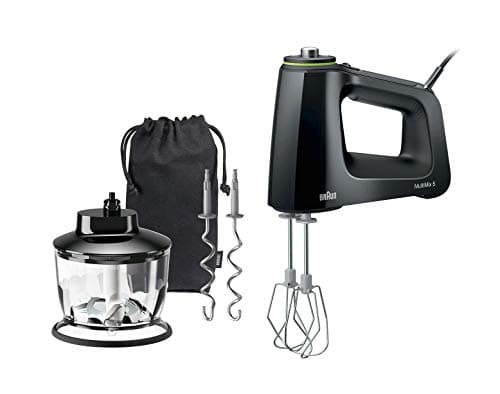
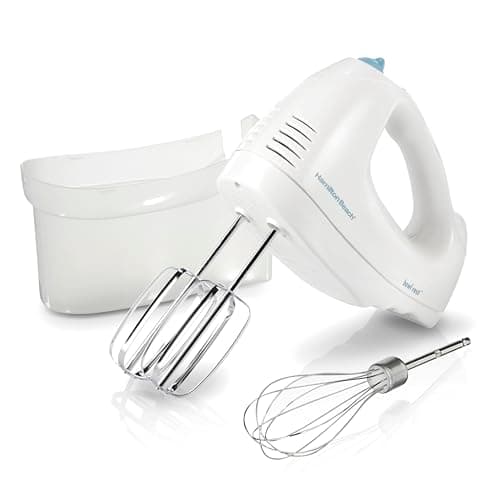
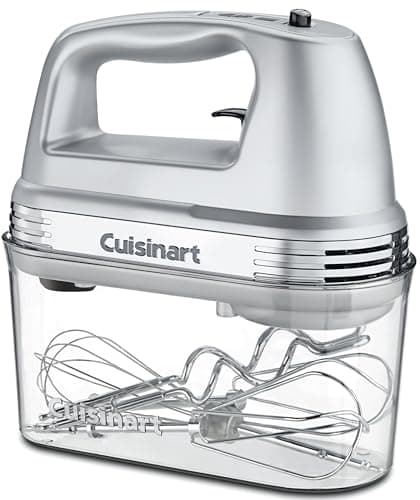
Our pick for most people is the Cuisinart Power Advantage Plus 9-Speed. Nine well-spaced speeds give you the gentle start meringue rewards, it comes with a whisk in a storage case, and it's the value leader of the group. Behind it, the Braun MultiMix 5 is the choice if you want the most power on tap and a turbo button for the final push, in a body light enough to hold through a long whip, and the Hamilton Beach 6-Speedis the cheapest capable option — genuinely enough to whip whites well for the occasional pavlova or batch of cookies.
Cuisinart Power Advantage Plus 9-Speed — our pick.Meringue rewards a controllable low speed so you can start the whites gently and build the foam evenly, and nine well-spaced speeds give you finer steps to ease up through than a six-speed does. It ships with a whisk alongside its beaters and dough hooks in a storage case, its 220 W rated motor has real headroom for the money, and it's usually the best value in the group. The honest cons: Cuisinart's speed 1 is a touch fast for the very gentlest openings, so ease onto the trigger rather than committing to it, and the storage case is bulky in a shallow drawer. Neither hurts a meringue. See the full Cuisinart Power Advantage review for the detail.
Braun MultiMix 5 — the most power, best for the final push.If you want confidence the motor won't fade as the foam gets stiff, the Braun is the pick: its 350 W rated motor is the highest here, and its turbo button plus a SmartMix ramp let you bring the whites up smoothly and then give them a burst of extra muscle to finish at stiff peaks. It comes with a whisk and a chopper attachment, so it does more than just meringue. The honest cons: the European-styling controls take a moment to learn, and its beaters are a single-piece design some people find less familiar than the twin-wire look — though for meringue you'll be using the whisk, not the beaters. For a baker who whips a lot of whites and wants power in reserve, it earns its place. The Braun MultiMix 5 review goes deeper.
Hamilton Beach 6-Speed — the cheapest capable option.You do not need to spend much to whip a good meringue, and the Hamilton Beach proves it. Six speeds, a QuickBurst button for a quick blast of power at the end, a bowl-rest feature that parks it while you add sugar, an included whisk, and a snap-on case — at consistently one of the lowest prices for a capable mixer. It's light, which genuinely helps on a job that can run several minutes. The honest cons: six speeds give you less fine control than the nine-speed rivals, so you have to be a little more deliberate easing onto the low end at the start, and its 250 W rated motor, while ample for whites, has less headroom than the Braun for anything heavier. For meringue a few times a season, it's all most kitchens need. The full Hamilton Beach 6-Speed review has more.
What actually makes a hand mixer good for meringue
Meringue asks for a specific combination: the right attachment, a gentle start, and a steady finish. Get those and almost any capable mixer makes lovely meringue; miss them and even a powerful one disappoints. Here's what matters, and the technique that matters just as much as the machine.
The wire whisk is the most important part
For meringue, the attachment matters more than the motor. The standard twisted beaters push air into whites slowly and inefficiently, because they have few thin wires cutting through the foam. A wire whisk(sometimes called a balloon whisk) has many fine loops that slice through the whites and trap far more air far faster, which is exactly what you want for a light, voluminous meringue. All three mixers here include a whisk, and that's deliberate on our part — a hand mixer without one is the wrong tool for this job. Fit the whisk, not the beaters, before you start. If you want a fuller picture of which attachment does what, our hand-mixer attachments explained guide covers the whisk, the beaters and the dough hooks side by side.
A gentle low speed to start the whites
The single most common meringue mistake is starting too fast. Whipping cold whites hard from the first second builds big, unstable bubbles that collapse later and give you a coarse, weepy foam. The fix is to start lowand let the whites break up and turn frothy before you climb the speeds. This is where fine low-end control earns its keep: a nine-speed mixer like the Cuisinart or Braun gives you more gentle steps at the bottom of the range to feather the start, while a six-speed asks you to be a little more careful. A smooth ramp helps too — the Braun's SmartMix eases up to speed instead of jolting, which keeps the early foam even. The same slow-start logic underpins whipping other light mixtures, which is why the mixers that do well here also lead our best hand mixers for whipping cream roundup.
Sustained power to reach stiff peaks
Meringue is a marathon, not a sprint. Taking whites from liquid to stiff, glossy peaks — especially once the sugar goes in and the foam thickens — can take several minutes of continuous whipping, and a hand mixer's small motor is working the whole time. You don't need enormous power, but you do want a motor that holds a steady speed without fading or heating up as the foam gets heavier near the end. All three here manage it; the Braun's higher rated motor and turbo button simply give you the most headroom, which is reassuring on a big batch or a stiff Swiss or Italian meringue. Read rated watts as a rough guide to that headroom, not as proof of a better meringue — control and the whisk matter more.
A spotlessly clean, grease-free bowl and whisk
This one is outside the machine and it's non-negotiable: any trace of fat kills a meringue. Egg-white foam is fragile, and even a smear of grease or a speck of yolk on the bowl, the whisk or in the whites themselves will stop them whipping up properly, leaving you with a flat, loose foam that never reaches peaks. Wash the bowl and whisk thoroughly and dry them completely, use a metal or glass bowl rather than plastic (plastic holds oily films), and separate the eggs carefully so no yolk sneaks in. Room-temperature whites whip to a bit more volume than fridge-cold ones, so let them sit out for a few minutes first. Do this and even the budget Hamilton Beach turns out a beautiful meringue.
Add the sugar gradually — and a pinch of stabilizer helps
Once the whites are frothy and starting to hold soft peaks, add the sugar a little at a timewith the mixer running, letting each addition dissolve before the next. Dumping it all in at once weighs the foam down and can stop it stiffening; feeding it in slowly builds a smooth, glossy meringue that holds its shape. A small pinch of cream of tartar (or a few drops of lemon juice) added early helps stabilize the foam so it's more forgiving and less likely to collapse. Rub a little meringue between your fingers near the end — if it feels gritty the sugar hasn't fully dissolved, so keep whipping a touch longer.
How to tell when it's at stiff peaks
Most meringues want stiff peaks: lift the whisk out and the foam should stand up in a firm point that holds its shape without flopping over, and the meringue should look thick, smooth and glossy rather than dull or foamy. The classic test is to turn the bowl upside down — properly whipped meringue won't slide out. Be careful not to overshoot: whip well past stiff peaks and the foam turns grainy, dry and curdled-looking as the structure breaks down, and there's no bringing it back. Stop the moment it's glossy and holds a firm peak.
Comfort and weight for a long whip
Because meringue can run several minutes, the weight of the mixer in your hand matters more here than on a quick job. A lighter mixer is easier to hold steady over the bowl without your arm tiring, which is a quiet point in the Hamilton Beach's favor — it's the lightest of the three. The Cuisinart and Braun are a touch heftier but still comfortable for the job, and resting your elbow on the counter helps with any of them. If you have wrist or grip issues, factor the hold time in; whipping meringue is one of the longer things you'll ask a hand mixer to do.
What meringue doesn't need
For this job specifically, most of the extras don't matter. You won't use the dough hooks that come with the Cuisinart or the chopper that comes with the Braun — they're bonuses for other tasks, not meringue. That means you can buy purely on the whisk, the low-speed control and the price. If you want a mixer that does everything well rather than just whites, the best overall hand mixer roundup weighs the whole picture, and the best budget hand mixer page is the place to start if price leads.
When a stand mixer wins
Here's the honest part a lot of roundups skip: for big batches of meringue, or for Swiss and Italian meringues that need continuous whipping while you drizzle in hot syrup, a stand mixer is genuinely easier because it whips hands-free while you work. A hand mixer makes excellent meringue — whipping whites is one of the things it does best — but it ties up an arm for the duration, and a very large or fussy meringue is where that starts to wear. If you regularly make meringue in volume, our guide to whipping egg whites in a stand mixer covers that route. For everyday pavlovas, meringue cookies and pie toppings, a capable hand mixer with a good whisk is all you need.