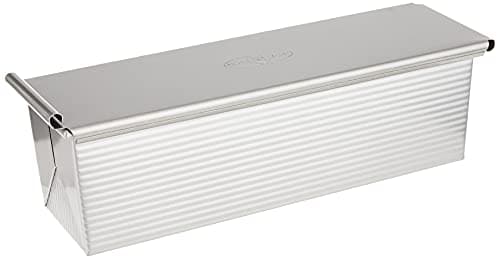
A Pullman pan is a lidded loaf pan, and the USA Pan 13 x 4 Pullman with cover is the one most serious home bakers end up buying. The sliding lid is the whole idea: it caps the rising dough so the loaf bakes into a neat, square-cornered brick — pain de mie — that slices into uniform squares perfect for sandwiches and toast. Take the lid off and it bakes an ordinary domed loaf too. It is heavier, sturdier and pricier than a supermarket loaf pan, and for the baker who makes sandwich bread it is worth every bit of the difference.
The build is the reason to buy it over a thin pan. It is heavy-gauge aluminized steel with a corrugated surface — those ridges add rigidity so the pan resists warping over years of hot oven cycles, and they help heat move evenly across the loaf. A steel-wire rolled rim adds more strength at the edge. The practical result is a pan that heats evenly and holds its shape, where cheap thin pans buckle and develop hot spots that brown one side of a loaf more than the other. It is made in the USA, which is part of why owners keep them for years.
The nonstick is worth a specific mention because coatings are where cheap pans and good ones diverge. USA Pan uses its Americoat coating, which is PTFE-, PFOA- and BPA-free, and owners consistently report loaves releasing cleanly from it. It is not a coating you should punish, though — which brings us to the care, and the honest drawbacks.
This pan is hand-wash only, and it is rated to a maximum of about 450°F — high enough for virtually all bread, but worth knowing. It is not dishwasher-safe; the dishwasher's heat and detergent shorten the life of the coating. Some bakers still give it a light grease despite the nonstick, especially for stickier enriched doughs, and the coating can darken with heavy use — cosmetic, but real. And it costs several times what a basic loaf pan does, which only makes sense if you will use the Pullman shape or value a pan that lasts. If your baking is the occasional banana bread, a plain loaf pan is the smarter buy — our best loaf pans roundup ranks the standard 8.5 x 4.5 and 9 x 5 options alongside this one; if you bake sandwich loaves, this is the upgrade that shows in every slice.
It pairs naturally with the rest of a bread setup — a scale for accurate ratios and a thermometer to check the loaf is baked through — and it earns a place in our baking essentials kit. See how we pick for the standard behind this review.
Is a Pullman pan worth it for you?
A lidded Pullman pan is a specific tool. Here is how to know whether it belongs in your kitchen.
Buy it if you make sandwich bread
The square, flat-topped loaf is the entire point. If you bake sandwich bread, toast bread, or want uniform slices with no domed top to trim, the lidded Pullman shape is exactly right, and this is the pan to get it from. Used without the lid, it also bakes a normal loaf, so it is not a single-trick pan.
Buy it if you want a pan that lasts
Heavy aluminized steel with a corrugated surface simply outlasts thin store pans, bakes more evenly, and does not warp. If you are tired of replacing buckled pans or fighting uneven browning, the sturdier construction is the upgrade — even for ordinary loaves baked lidless.
Skip it if you bake loaves rarely
For the occasional quick bread or banana loaf, a basic loaf pan does the job for a fraction of the price, and you will not miss the lid. The Pullman's cost only pays off if you use the shape or bake often enough to value the build.
Respect the care
Hand-wash it, keep it to about 450°F, and skip the dishwasher to protect the coating. A light grease is cheap insurance for stickier doughs. Treated well, it is a decades-long pan; treated like a disposable one, the coating gives up early.