Skip to content
Plug & Prep

Hub 05 · Guides · Guides & Comparisons

What wattage stand mixer do you need for bread?

The wattage number on the box is the spec people trust most and the one that misleads most. Here's what actually decides whether a mixer can knead your bread.

By Stephen V.Updated How we pick
#ad

We earn a commission when you buy through our Amazon links, at no extra cost to you. It never changes our rankings, and we say so when the cheaper product is the better buy. How this works.

"How many watts do I need for bread?" is the question we get most, and the honest answer is uncomfortable: wattage is one of the weakerpredictors of whether a mixer can knead your dough. It's the number manufacturers print because it's easy to compare, but two mixers with the same rated wattage can behave completely differently on the same stiff dough. This is the methodology page where we show why — because our whole approach is doing this math out loud instead of attaching the word "powerful" to a product.

Here's the mechanism. Rated wattage describes electrical input, not the kneading force (torque) that reaches the dough. Between the motor and the hook sits gearing, and a well-geared 300-watt motor can deliver more usable low-speed torque than a cheap 600-watt one that's geared for speed instead of force. On top of that, drive design decides how sustainably that torque is delivered: a bottom-drive Bosch or a bowl-lift keeps working stiff dough that makes a tilt-head flex and heat up, regardless of the wattage label.

So the wattage number isn't useless — it's just third on the list, behind drive design and gearing, and roughly tied with dough capacity. The KitchenAid Artisan'srated 325 watts is plenty for one or two loaves because it's geared well and sized right; a mixer rated higher but built cheaply can still bog down on the same dough. Read the spec as a rough proxy, then look at the two things that actually matter.

The short answer

Quick picks

#ProductBest forScorePrice
01
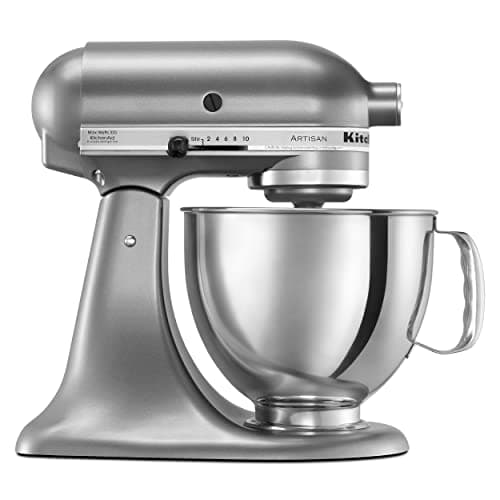
KitchenAid KitchenAid Artisan 5-Qt Tilt-Head (KSM150)
KitchenAid Artisan 5-Qt Tilt-Head (KSM150)

The default for a reason: 5-qt tilt-head, a mature attachment ecosystem, and enough motor for a couple of loaves a week. Not the mixer for daily heavy dough — but that's a small slice of home bakers.

Most home bakers
8.4
$495.00Amazon
02
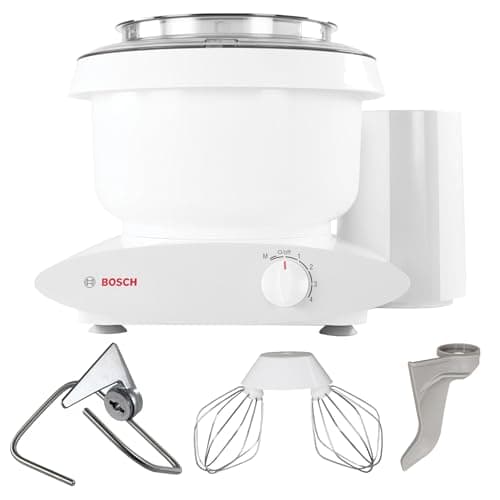
Bosch Bosch Universal Plus Stand Mixer
Bosch Universal Plus Stand Mixer

The bread baker's mixer. A belt-driven motor at the base and a big open bowl let it knead far more dough than a KitchenAid without straining. Less elegant, less versatile for whipping small amounts — but for loaves it's the one.

High-volume bread dough
8.5
$499.00Amazon
03
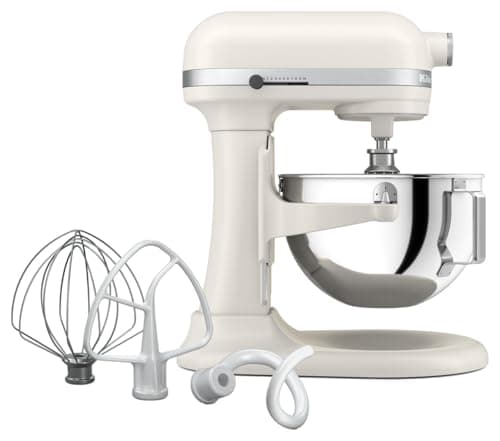
KitchenAid KitchenAid 5.5-Qt Bowl-Lift (KSM55)
KitchenAid 5.5-Qt Bowl-Lift (KSM55)

The step up for a baker who has out-grown a 5-quart tilt-head but wants to stay in the KitchenAid world. The bowl-lift design plants the head over a bigger 5.5-quart bowl, so it stays steadier on stiff dough than a tilt-head — at a premium price.

Frequent, heavier baking
8.3
$499.99Amazon

#ad · Live prices from the Amazon Product API, as of Aug 5, 2026. Where we have no verified live price we show none — a gap beats a number that has rotted.

In detail

The picks, in full

01
KitchenAid KitchenAid Artisan 5-Qt Tilt-Head (KSM150)

Most home bakers

KitchenAid Artisan 5-Qt Tilt-Head (KSM150)

325 W rated5-qt bowl10 speedsTilt-headPowerHub port
8.4/10

The default for a reason: 5-qt tilt-head, a mature attachment ecosystem, and enough motor for a couple of loaves a week. Not the mixer for daily heavy dough — but that's a small slice of home bakers.

Motor / dough
8
Capacity
8
Build & durability
8.5
Ease of use
9
Value
8.5

Pros

  • Huge attachment ecosystem (grinder, pasta, ice cream) via the front PowerHub
  • 5-qt bowl handles roughly a double batch of cookie dough or 2 loaves of bread dough
  • Holds resale value and parts availability better than any rival brand

Cons

  • Tilt-head flex shows on very stiff, low-hydration dough
  • 325 W rated motor is mid-pack — it will bog if you knead dense dough daily

Don't buy this if…

you knead stiff bagel or heavy rye dough every day — a bowl-lift or a Bosch has the motor headroom you'll keep asking for.

$495.00View on Amazon

Price as of Aug 5, 2026. Prices change — Amazon's at checkout is the one that counts.

#ad · we may earn a commission from this link to KitchenAid Artisan 5-Qt Tilt-Head (KSM150)

02
Bosch Bosch Universal Plus Stand Mixer

High-volume bread dough

Bosch Universal Plus Stand Mixer

500 W rated6.5-qt bowlBottom-drive~5–6 lb doughDough hook + whisks
8.5/10

The bread baker's mixer. A belt-driven motor at the base and a big open bowl let it knead far more dough than a KitchenAid without straining. Less elegant, less versatile for whipping small amounts — but for loaves it's the one.

Motor / dough
9.5
Capacity
9.5
Build & durability
8
Ease of use
7.5
Value
8

Pros

  • Bottom-drive motor kneads large, stiff dough batches most tilt-heads can't finish
  • 6.5-qt bowl swallows 3–4 loaves' worth of dough at once
  • Lightweight for its capacity and easy to store

Cons

  • Not ideal for very small jobs — whipping one egg white gets lost in the big bowl
  • Plastic-forward build feels less premium than a cast KitchenAid
  • Smaller accessory ecosystem in the US

Don't buy this if…

you mostly whip cream, beat butter and do single-batch baking — a tilt-head KitchenAid is friendlier for that work.

$499.00View on Amazon

Price as of Aug 5, 2026. Prices change — Amazon's at checkout is the one that counts.

#ad · we may earn a commission from this link to Bosch Universal Plus Stand Mixer

03
KitchenAid KitchenAid 5.5-Qt Bowl-Lift (KSM55)

Frequent, heavier baking

KitchenAid 5.5-Qt Bowl-Lift (KSM55)

5.5-qt bowlBowl-lift designCast metal buildPowerHub portDishwasher-safe bowl
8.3/10

The step up for a baker who has out-grown a 5-quart tilt-head but wants to stay in the KitchenAid world. The bowl-lift design plants the head over a bigger 5.5-quart bowl, so it stays steadier on stiff dough than a tilt-head — at a premium price.

Motor / dough
8.5
Capacity
9
Build & durability
8.5
Ease of use
8
Value
7.5

Pros

  • Bowl-lift head stays planted on stiff dough where a tilt-head can flex
  • 5.5-qt bowl handles a bigger batch than the 5-qt Artisan
  • Takes the same front-hub attachments as every other KitchenAid

Cons

  • Costs more than the tilt-head Artisan for most bakers' needs
  • Bowl-lift is a little less convenient for quick bowl and beater swaps
  • Heavier and taller — check your under-cabinet clearance

Don't buy this if…

you only bake a loaf or two a week — a 5-qt tilt-head Artisan is cheaper, friendlier day to day, and has all the capacity you'll use.

$499.99View on Amazon

Price as of Aug 5, 2026. Prices change — Amazon's at checkout is the one that counts.

#ad · we may earn a commission from this link to KitchenAid 5.5-Qt Bowl-Lift (KSM55)

How to actually size a mixer to your bread

Rank the specs by what predicts kneading

In order: drive design (bottom-drive and bowl-lift handle heavy dough best, tilt-head is fine for moderate dough), dough capacity (a machine run at its rated limit every week wears out fast — buy headroom), gearing / build quality (hard to read from a spec sheet, so lean on owner reports for "bogs on stiff dough"), and only then rated wattage as a loose tiebreaker between similar machines.

Match the machine to your worst-case dough

Size to your hardest, largest recipe, not your average one. A weekend loaf of standard sandwich dough is easy — a 300-watt-plus tilt-head shrugs at it. Low-hydration doughs (bagels, dense rye, some sourdoughs) fight the hook far harder at the same weight, and multiple loaves at once multiply the load. If your worst case is stiff or big, weight the decision toward a bottom-drive or bowl-lift design and more capacity, and treat wattage as secondary.

A practical rule of thumb

For one or two loaves a week of ordinary dough: any well-built planetary mixer around 300 rated watts or more, like the Artisan, is enough. For frequent, stiff, or high-volume bread: prioritize a bottom-drive Bosch or a bowl-lift, and stop worrying about the wattage number entirely — the design is doing the work. Our best-for-bread-dough roundup applies this exact logic to real machines.

Why we publish this instead of a wattage chart

A simple "X watts = Y loaves" table would be easier to read and wrong. The reason we score every mixer on a published rubric— with a named "Motor / dough" metric that weighs drive design and owner reports, not just the wattage sticker — is that the honest answer doesn't fit in one number. If a spec is doing less than it appears to, we'd rather say so.
How we picked

We don't run a testing lab

We read the manuals, compiled the published specifications, did the wattage-to-dough math and weighed aggregated owner reviews, then scored each product against a published rubric. The scores are judgments from documented research — they are notmeasurements we took, because we do not have a lab and we're not going to pretend we do. Every spec is the manufacturer's published figure, cited in Sources.

Questions

Frequently asked

How many watts does a stand mixer need for bread dough?
There's no clean watt threshold. A well-built planetary mixer around 300 rated watts or more handles one to two loaves of ordinary dough comfortably. For frequent, stiff or high-volume bread, drive design (bottom-drive or bowl-lift) matters far more than the wattage number.
Is a higher-wattage mixer always better at kneading?
No. Rated wattage is electrical input, not the torque that reaches the dough. Gearing and drive design can make a well-built 300-watt mixer out-knead a cheap 600-watt one. Treat wattage as a loose proxy, not a guarantee of kneading power.
What matters more than wattage for a bread mixer?
Drive design and dough capacity. A bottom-drive Boschor a bowl-lift delivers sustained kneading torque a tilt-head can't, and buying capacity headroom above your worst-case dough keeps the motor from wearing out. Wattage is a distant third.

Keep reading

Receipts

Sources

We don't run a testing lab, and we don't pretend to. Specs are the manufacturer's published figures, cited above; scores are our judgments from that research. Where we couldn't verify something, we say so on the page rather than quietly leaving it out. Read our full method.