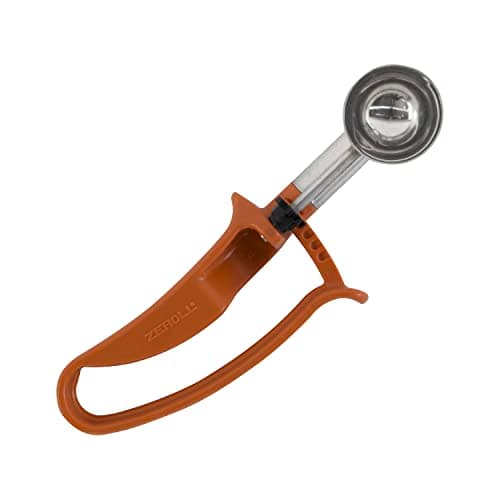
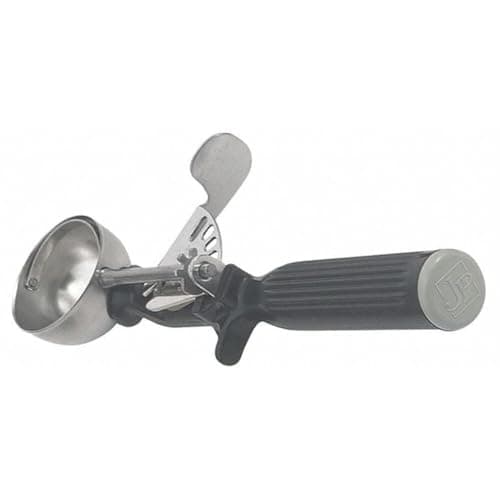
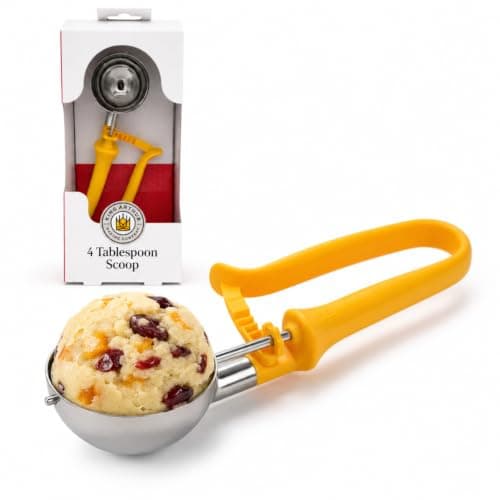
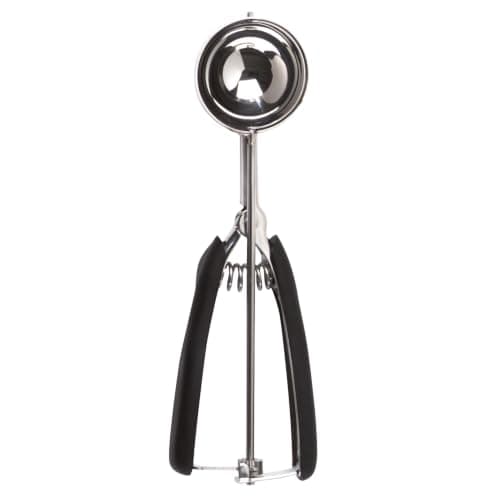
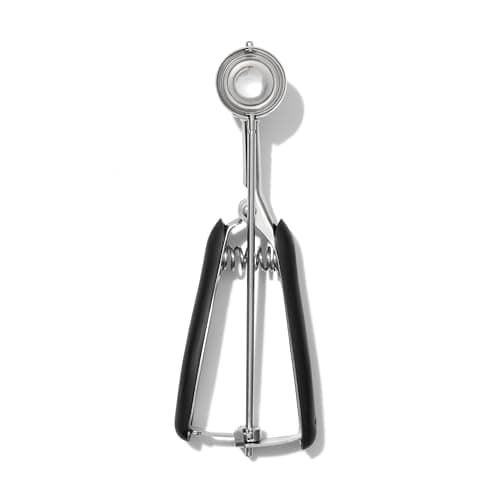
Buy the OXO Good Grips Medium Cookie Scoop. It is a size 40 holding 1.5 tablespoons, and OXO publishes the one figure that actually answers the question people are asking: it makes a 2.75-inch cookie. That is the standard American drop cookie, the size a recipe promising three dozen is written around. It has a stainless bowl, a stainless sweep, spring-loaded cushioned handles and a dishwasher rating. Take the Zeroll 2050if you want the longest-lived mechanism here — a one-piece design with a plastic gear instead of a spring, usable in either hand, NSF approved — as long as you understand that a size 50 is small. The Vollrath size 30 is the foodservice workhorse with a one-piece handle that cannot come apart. The King Arthur 4-tablespoon is not really a cookie scoop at all: it is the scone, muffin and jumbo portion. And the OXO Large is a size 20 that makes the 3.5-inch coffee-shop cookie.
The criteria: the number is the spec, and it runs backwards
This is the thing to understand before you spend anything, because it is the reason people buy the wrong scoop: the number stamped on a disher is how many scoops it takes to empty a quart. Not a volume. Not a diameter. A count.
A quart is 32 fluid ounces, so the arithmetic is simply 32 divided by the number. A size 16 holds about 2 ounces. A size 40 holds about 0.8. A size 60 holds about half an ounce. Which means a bigger number is a smaller scoop— exactly backwards from how every other kitchen measurement works, and the single most common mistake in this category. Somebody who wants a big bakery cookie and buys a “size 60” because it sounds substantial has bought a scoop for mini cookies.
The system comes from commercial foodservice, where the point is portion control: a kitchen that specifies a #30 disher for its cookie dough gets 30 identical cookies out of every quart of dough, and can cost a batch to the cent. It is a genuinely good system. It is just not expressed in anything a home baker thinks in.
So the criteria, in the order they decide a purchase:
1. Does the maker translate the number into something useful?This is the whole reason our top two picks are our top two picks. OXO publishes a finished cookie diameter for each size — 2 inches, 2.75 inches, 3.5 inches. Zeroll publishes the bowl diameter, the capacity in ounces and the overall length. Vollrath, on the listing we feature, publishes the size number and no volume figure at all, while printing the ounces on its other sizes. For a tool whose entire function is a portion, published portion data is the product.
2. The mechanism, because it is the only part that fails. A scoop is a bowl and a sweep arm that wipes dough out of it. The arm is driven by either a spring (OXO, King Arthur, Vollrath) or, in Zeroll's case, a plastic gear with no spring at all. Springs fatigue and snap; that is what ends most cookie scoops. Zeroll's one-piece no-spring design is a real durability argument, with the honest footnote that the gear replacing the spring is also plastic.
3. What the sweep arm is made of.Stainless sweeps outlast plastic ones, and the difference shows up fastest with stiff, cold dough — which is exactly what cookie dough is. Both OXO picks publish a stainless steel wiper. Vollrath publishes stainless bowl and components, plus a detail worth having: the blade extends past the bowl rim, which is what stops sticky dough riding up and jamming the sweep.
4. The handle, because you squeeze it a hundred times in a batch. Cold cookie dough takes real force to eject. A cushioned spring-loaded handle (OXO) is markedly easier on the hand than a bare metal one over four dozen cookies; a one-piece molded handle (Vollrath) cannot come apart; a bare lever is the cheapest and the hardest work.
5. Published care and certification.All five publish a dishwasher rating. Two publish NSF or equivalent foodservice credentials. Where a figure does not exist we say so rather than borrowing one from a sibling size — see how we pick.
The disher size chart, decoded
The left column is the number you will see stamped on a handle or printed in a listing. The middle column is the arithmetic — 32 fluid ounces divided by the size. The right column is only filled in where a maker or a retailer actually publishes a figure for that size, and those published numbers do not always match the arithmetic exactly.
| Size | Approx. volume (32 oz ÷ size) | Published figures we could find |
|---|
| #10 | 3.2 oz | 3.2 oz (Vollrath 47392, retailer) |
| #12 | 2.7 oz | 2.8 oz (Vollrath 47393, retailer) |
| #16 | 2.0 oz | 2 oz (Vollrath listing title) |
| #20 | 1.6 oz | 3 Tbsp, makes a 3.5 in cookie (OXO); 1-5/8 oz (Vollrath) |
| #24 | 1.3 oz | 1-1/3 oz (Vollrath listing title) |
| #30 | 1.1 oz | Retailer charts disagree: 1 oz and 1.125 oz both appear |
| #40 | 0.8 oz | 1.5 Tbsp, makes a 2.75 in cookie (OXO); 0.72 oz (Vollrath 47400, retailer) |
| #50 | 0.64 oz | 0.65 oz, 1.5 in bowl (Zeroll 2050) |
| #60 | 0.53 oz | 0.54 oz (Vollrath 47402, retailer) |
| #70 | 0.46 oz | 1 Tbsp, makes a 2 in cookie (OXO) |
Two honest notes on that table. The #30 row is the one to be careful with: retailer charts for the same Vollrath line give both 1 ounce and 1.125 ounces, and the arithmetic says 1.07, so we have printed the range rather than inventing a figure. And OXO and Vollrath disagree slightly at the same size number— OXO's size 20 is published at 3 tablespoons, which is 1.5 ounces, against Vollrath's 1-5/8 ounces for its own size 20. Dishers are portioning tools built to a count, not laboratory measures, and a few percent at the same size number is normal. If you need the exact capacity of the scoop in your hand, the figure is usually stamped on the handle.
Which size you actually want
Translated out of the foodservice scale into baking, for the things people make:
A standard drop cookie— chocolate chip, oatmeal raisin, snickerdoodle, the recipe that says it makes about three dozen — is a size 40, 1.5 tablespoons, and bakes to roughly 2.75 inches. This is the one scoop to own if you own one, and it is our top pick for exactly that reason.
A bakery or coffee-shop cookie— thick, wide, slightly soft in the middle — is a size 20, 3 tablespoons, around 3.5 inches baked. Worth knowing before you buy: a 3.5-inch cookie needs real spacing, so plan on four to a half sheet rather than the twelve a standard cookie gives you. Our baking sheets for cookies page explains why two pans and a rotation matter more at that size.
A mini or tea cookieis a size 60 or 70, around a tablespoon, baking to about 2 inches. The Zeroll's size 50 sits just above that band.
A muffin or a sconeis 4 tablespoons or more — which is the King Arthur pick, and it is why we have been explicit that it is not a cookie scoop in the ordinary sense. Four tablespoons is roughly two and a half standard drop cookies. For muffins, a 4-tablespoon scoop fills a standard 2.75-inch well about two-thirds full, which is where you want it; see the best muffin pans for why that well diameter is the figure that matters.
Meatballs, falafel, cake batter into cupcake liners, melon, mashed potato, rice for a bowl— all the same tool, which is the argument for buying a slightly better one than the job seems to need.
Why a scoop and not two spoons
The honest case, because this is a tool nobody strictly needs. Two spoons work. What a scoop buys you is three things, and only one of them is speed.
Cookies that bake evenly as a batch. This is the real one. Cookies of different masses on the same sheet finish at different times, so a tray portioned by spoon has some cookies slightly underdone and some with hard edges, and you cannot fix it with the timer because the problem is inside the tray. Equal portions means the whole sheet is done at once. It is the same logic as weighing flour rather than scooping it, covered in how to measure flour by weight: removing a variable you cannot see.
A round, domed portion that spreads predictably. A scooped ball of dough has a consistent shape as well as a consistent mass, so it collapses outward the same way every time. Spooned dough is irregular, and irregular dough spreads irregularly.
Speed and clean hands.Four dozen cookies portioned with a scoop takes a few minutes and you never touch the dough. With spoons it takes considerably longer and you generally end up rolling balls by hand, which warms the butter — and warm dough spreads more and bakes flatter.
What a scoop does not do is replace a scale for the dough itself. If you want genuinely identical cookies, weigh the first scoop and check a few as you go.
How to choose and use a cookie scoop
Buy one size, and buy the standard one
Resist the three-piece sets. The 1.5-tablespoon size 40 is the portion that nearly every drop-cookie recipe in American baking is written around, and the other two sizes in a set will mostly sit in a drawer. If you later find you want a second, buy at the far end of the range — a 4-tablespoon for scones and muffins, or a tablespoon-sized one for minis — rather than the size next door.
The one exception is if you specifically want the big bakery cookie. That is a different recipe and a different bake, and the size 20 is the tool for it.
Scoop cold dough, and chill it after
Cold dough is harder to scoop and makes better cookies, so the order matters: chill the dough, scoop it, then chill the portioned balls again on the tray while the oven heats. Warm butter is what makes a cookie spread into a thin wafer; a cold ball holds its height long enough for the structure to set.
If the dough is too stiff to scoop at all, let it stand ten minutes rather than warming it in the microwave. And if it is too soft and the scoop will not hold a clean ball, it is not ready — back in the refrigerator.
Pack it, then sweep it level
Press the bowl of the scoop into the dough and drag it so the bowl fills completely, then scrape the open face level against the rim of the bowl or along the edge of a bench scraper. A scoop that is only three-quarters full is not a portion, and it is the main reason people find their “identical” cookies are not. Leveling the face is what makes the measurement repeatable.
Stop the dough sticking
Dough riding up in the bowl and jamming the sweep is the standard complaint, and it has three easy fixes. Keep a cup of hot water beside you and dip the scoop every few cookies — warm metal releases dough cleanly. For very sticky doughs, a light spray of neutral oil in the bowl before you start lasts most of a batch. And eject with a decisive squeeze rather than a gradual one; a slow release lets the dough fold rather than drop.
A scoop whose sweep blade extends past the bowl rim — Vollrath publishes this — is the design answer to the same problem, and it is the detail most worth having on a scoop you use often.
Do not put a dense dough through a cheap scoop
The way a cookie scoop dies is a spring, and the way the spring dies is being levered against a dough that is stiffer than the mechanism was built for — a very cold, chunky, chocolate-and-nut-heavy dough is genuinely demanding. Three defenses: buy stainless rather than plastic in the sweep, buy a mechanism with no spring if you scoop a lot (the Zeroll), and do not force a jammed scoop — dip it in hot water and try again.
Cleaning
All five picks publish a dishwasher rating, and all five are easier to clean if you rinse them before the dough dries. The part to pay attention to is the pivot where the sweep arm meets the bowl: dough packs into it, hardens, and then the arm starts to feel gritty. Run water through the mechanism with the arm moving rather than just wiping the bowl.
Dried-on dough in a mechanism is also the one argument for a dishwasher over a quick hand rinse here — the machine gets water into places a sponge does not reach.
What we did not feature, and why
Unbranded three-piece stainless scoop setsare the largest group in this category by listing count, usually 1, 2 and 3 tablespoons for less than a single branded scoop, and they are absent here on purpose. Most publish a tablespoon figure and nothing else — no disher size, no steel grade, no sweep material, no warranty — and many reuse the same photography across unrelated storefronts. The argument of this page is that published portion data is the product. A tablespoon number in a title with nothing behind it is a claim, not a specification. If you want three sizes cheaply that is a legitimate purchase, and we cannot rank it against figures that do not exist.
Ice cream scoops with a solid bowl and no sweep arm are a different tool. Without a sweep, cookie dough stays in the bowl and you are back to prying it out with a finger, which defeats the purpose. The Zeroll and Vollrath picks here are dishers, which is the foodservice term for a scoop with a sweep, and that is the type you want.
Trigger-handle scoops with plastic sweeps are the cheapest mechanism in the category and the one that fails first against cold dough. We would rather recommend a smaller stainless scoop than a larger plastic-sweep one at the same price.
Scoop-and-drop batter dispensersfor cupcakes and pancakes are a genuinely different product — a plunger in a cylinder, for liquid batters. They do not handle cookie dough, and a cookie scoop does handle cupcake batter, so if you are buying one tool, buy the scoop.