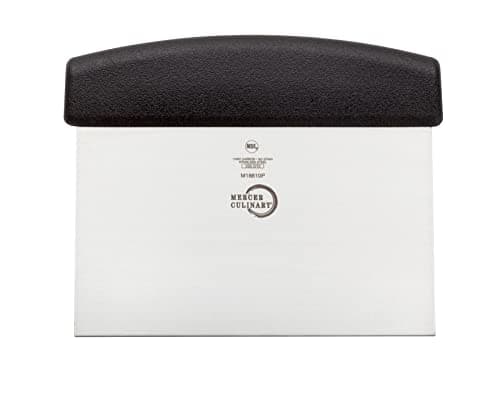
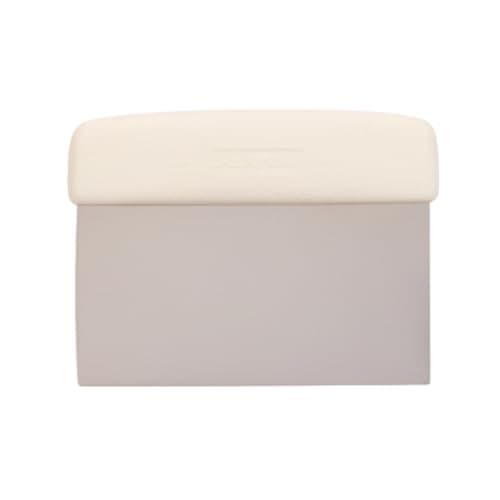
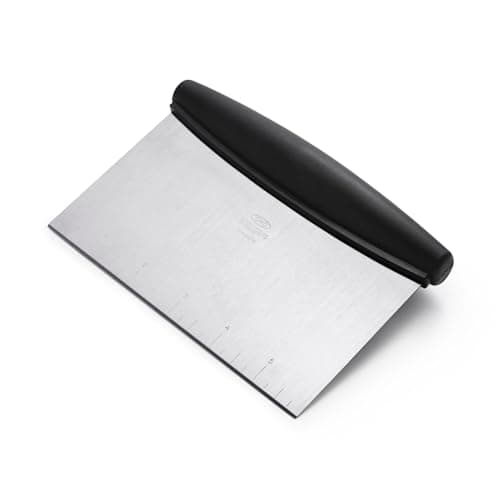
Buy the OXO Good Grips Multi-Purpose Scraper & Chopper. It wins on a feature that sounds trivial and is not: OXO publishes 1-inch markings along the blade, so dividing a dough into eight equal rolls becomes a measurement taken with the tool already in your hand rather than a guess you regret at the proofing stage. It is stainless, the grip is cushioned and non-slip with floury hands, and it is dishwasher safe. Take the Mercer Culinary Millenniafor the best blade per dollar here — precision-ground Japanese stainless, the largest blade on the page — as long as you accept Mercer's own instruction not to put it in the dishwasher. The Dexter-Russell Sani-Safe is the professional answer and the stiffest blade here, with one published caveat that decides it for many people: the blade is carbon steel, not stainless, so it rusts if it air-dries wet. The all-stainless Ateco has nothing on it that can fail, and the Winco is the cheapest honest version of the tool.
The criteria: it is three tools, and nothing is best at all three
A bench scraper is a rectangle of steel with a handle along one long edge. That description hides the fact that it is sold for three different jobs, and the picks on this page are genuinely better and worse at each:
As a divider it cuts. You press straight down through a dough to portion rolls, buns, bagels or a batch of scones. This rewards a rigid blade and a straight edge, because a blade that flexes under the push wanders off the line and tears rather than cuts.
As a surface scraper it cleans. You push it along a counter to lift stuck dough, dried flour and scraps into a pile. This rewards a blade with a little flex, so the edge can conform to a surface that is not perfectly flat, and it is why the stiffest blade here is not the best scraper here.
As a transfer paddle it moves things. You slide it under a shaped loaf, a pile of chopped chocolate or a row of cut scones and carry them to a pan. This rewards blade area and a thin leading edge.
So the criteria, in the order they decide a purchase:
1. Blade rigidity. Stiff cuts, slightly flexible scrapes. The Dexter is published as sharp and rigid and is the best divider here; Mercer publishes its Japanese stainless as balanced between flexibility and stiffness, which is the more useful compromise for a home baker who is doing all three jobs with one tool.
2. Carbon steel or stainless. This is the maintenance decision and it is published, not inferred. The Dexter-Russell Sani-Safe blade is carbon steel: harder, holds a crisper edge, and it will spot and rust if you leave it to air-dry. Everything else here is stainless. If you will not towel a tool dry every single time, that one line decides the page for you.
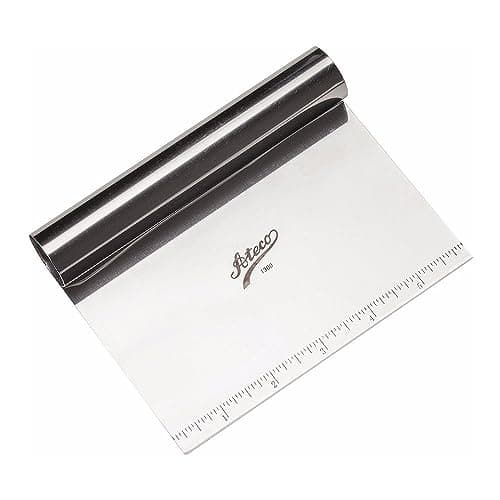
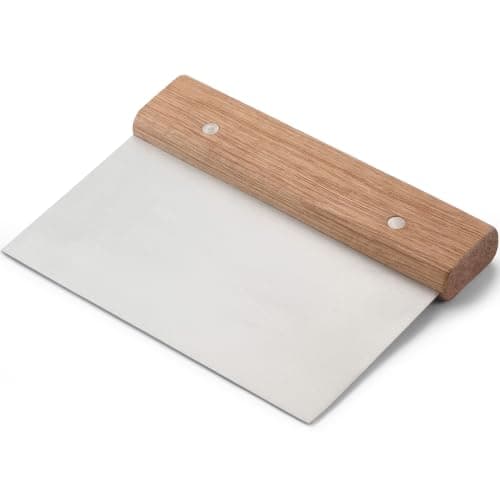
3. The handle-to-blade junction. The least glamorous criterion and the one that determines whether you still like the tool in two years. Dough packs into the seam where a handle meets a blade, and it is the hardest part of any scraper to clean. A sealed molded handle (Dexter, Mercer, OXO) is the commercial answer. A single piece of stainless with no junction at all (the Ateco) is the absolute answer. Plain riveted wood (the Winco) is the one that ages worst.
4. Markings. Only one pick has them, and they change how the tool is used. A ruled blade lets you cut a rectangle of dough into even strips, portion a batch by width rather than by eye, and check that a rolled sheet is as wide as the recipe says. It is the single most useful feature in this category.
5. Published care instructions. Three of these five publish a dishwasher rating, one publishes an explicit instruction againstthe dishwasher, and one publishes a dishwasher rating while fitting a wood handle. We report all three as published and say where we would ignore the label — see how we pick.
Published specifications of the five picks
| Scraper | Blade | Steel | Handle | Dishwasher |
|---|
| OXO Scraper & Chopper | Not published, 1 in markings | Stainless | Soft non-slip | Yes |
| Mercer Millennia | 5 7/8 x 3.5 in | Japanese stainless, precision ground | Sealed polypropylene | No — hand wash |
| Dexter-Russell Sani-Safe | 6 x 3 in, rigid | Carbon steel | Textured polypropylene | Not published |
| Ateco stainless handle | 4 x 3 in (title says 5.9 x 3) | Stainless | Stainless, no seam | Not published |
| Winco wood handle | 6 x 3 in | Stainless | Wood | Listed yes |
Three gaps worth naming rather than filling in. OXO publishes no blade dimensionsfor the Scraper & Chopper — it publishes the markings and the material and nothing about size, so we have not estimated it. Ateco's listing contradicts itself: the title reads 5.9 by 3 inches while its own specification bullet says the blade measures 4 x 3 inches. One is probably the overall tool and the other the blade, and because Ateco does not say which, we have printed both rather than choosing. And none of the five publishes a blade thickness, which is the figure that would let rigidity be compared as a number instead of a description.
The carbon steel question, answered properly
The Dexter-Russell is the tool a working bakery owns, it is NSF certified, it is made in the USA, and its blade is carbon steel. That last fact is published in its own listing and it is not a defect — it is a trade that professional kitchens make deliberately.
Carbon steel is harder than the stainless used in this class of tool. It takes and keeps a crisper edge, which is why the Dexter is the best divider here: it goes through a cold, stiff dough in one push without deflecting. The cost is that carbon steel has no chromium layer protecting it, so water left on the surface oxidizes it. Leave it in a sink overnight and you will find orange spotting along the edge in the morning.
The maintenance is genuinely trivial if you do it: wash, and dry it with a towel immediately, every time. That is the entire routine, and it is the same habit a carbon-steel knife or a bare cast-iron pan asks for — the same logic as our enameled vs bare cast iron comparison. The honest question is not whether the routine is hard; it is whether you will do it. Most people who say they will, do not, and a rust-spotted scraper gets thrown away.
So: buy the Dexter if you are the kind of cook who already hand-dries knives. Buy a stainless pick if you are not, and do not feel you have bought a worse tool — for scraping and transferring, which is most of what a home baker does with this, stainless is just as good and the Mercer's blade is arguably nicer.
Why the seamless one is the sleeper pick
The Ateco is the pick we would expect people to overlook and then be glad about. Blade and handle are a single piece of stainless steel, which means there is no overmold to split, no rivets to weep rust, and crucially no seam between handle and blade for dough to pack into.
That seam is the part of every other scraper here that eventually becomes unpleasant. You scrape a sticky rye or a high-hydration sourdough, a film works into the junction, and the next wash does not quite get it out. On a tool that handles raw dough at every bake, a design with nowhere for that to happen is a real hygiene advantage rather than a theoretical one.
The price is grip. A bare stainless handle is cold, slick, and offers nothing once your hands are wet or greasy — it is the exact opposite choice to the OXO. And Ateco publishes no dishwasher rating for it, which on a tool made of one piece of stainless steel reads as an omission rather than a warning. If you want a scraper that will outlive the kitchen and you do not mind a plain handle, this is it.
What you actually use it for, beyond bread
Worth knowing before you decide this is a sourdough-only tool. It portions sandwich-loaf dough into even halves; it cuts scones, biscuits and cinnamon-roll logs cleanly, where a knife drags and seals the cut edge; it is the correct tool for the stretch-and-fold and the pre-shape in sourdough, covered in how to use a bench scraper; it transfers a mound of chopped chocolate, nuts or herbs from board to bowl without the spillage a knife blade guarantees; it lifts and squares off a sheet of rolled pastry; it scrapes a floured counter clean in four strokes; and it is what professionals use to finish the side of a frosted cake, held vertical against the buttercream while the turntable rotates underneath.
That last one is the job that surprises people, and it is the reason a bench scraper and an offset spatula are a natural pair: the offset does the top, the scraper does the sides.
How to choose and use a bench scraper
Decide from the job you do most
Three questions settle it. Do you divide doughinto portions regularly — rolls, bagels, scones, buns? Buy markings, which means the OXO, or buy rigidity, which means the Dexter. Do you mostly scrape and transfer— cleaning a floured counter, moving chopped ingredients, handling slack sourdough? Buy blade area and a little flex, which means the Mercer. Do you want a tool you will never have to think about? Buy the one-piece stainless Ateco.
The combination we would avoid is paying mid-range money for a wood-handled scraper. Wood is the one handle here that measurably degrades, and the all-stainless and sealed-polypropylene options cost about the same.
Six inches by three is the size, and here is why
Three of these five are at or near 6 x 3 inches, which is not a coincidence. Three inches of blade depth is enough to get under a shaped loaf without the dough drooping over the edge, and six inches of width spans a standard portioning cut in one press. Go much wider and the tool stops fitting your hand comfortably and will not sit in a drawer; go much narrower and you are making two cuts where one would do, which is how a straight edge ends up ragged.
Cutting dough: press, do not saw
Position the blade, then push straight down in one decisive motion and lift straight up. Do not drag it sideways and do not saw. A clean vertical cut leaves the gluten structure at the cut face intact; a dragged cut smears and seals it, which is what gives you a roll that proofs lopsided or a scone that will not rise at the edge. Flour the blade for sticky doughs, or wet it for very wet ones — the opposite of what feels right, and it works.
For even portions, weigh the whole dough and divide by the number of pieces, then use the scraper to cut and a scale to check. The markings on the OXO get you close enough that most bakes do not need the scale at all, but the scale is the honest method and we say so in how to measure flour by weight.
Scraping a counter: low angle, long stroke
Hold the blade at a shallow angle — around 30 degrees to the counter, not vertical — and push away from you in long strokes, gathering into a pile. A vertical blade chatters and skips; a shallow one gets under the film. For dough that has genuinely dried on, wet the counter and give it a minute first: the scraper is for lifting softened material, not for chiseling.
Do not use a steel bench scraper on a soft-coated or nonstick surface, and be careful on a sealed wooden board — a rigid steel edge at a steep angle will score both. On stone, laminate and stainless it is the right tool.
The pre-shape, which is what sourdough bakers buy it for
Slack, high-hydration dough is nearly impossible to handle with hands alone, because it sticks to you and tears. The scraper is what makes it a material you can work. Slide the blade under one edge, lift and fold the dough over on itself to build tension, then use the blade and your other hand to drag the ball toward you across the counter in short strokes, tucking the underside tight. The dough tightens into a round without you ever touching the sticky surface.
This is the step that produces a loaf that holds its shape in the oven instead of spreading, and it is covered properly in how to proof bread dough alongside the rest of the sourdough tool kit.
Cleaning and care, by pick
OXO: published dishwasher safe. The markings are printed on a surface that gets scraped, so expect them to fade over years of heavy use.
Mercer: Mercer explicitly publishes do not place in dishwasher or submerge for long periods. Hand wash with warm water and mild soap, rinse, dry completely. This is the only pick with an instruction against the machine, and it is the maker's own.
Dexter-Russell: carbon steel. Wash and towel dry immediately, every single time. No dishwasher rating is published and we would not machine wash a carbon-steel blade regardless. If it does spot, a scouring pad and a wipe of neutral oil will take it back.
Ateco: one piece of stainless, so there is nothing to protect; Ateco simply publishes no dishwasher rating. Wash it however you like and dry it.
Winco: listed dishwasher safe with a wood handle, which is a contradiction we would resolve in favor of the wood. Hand wash and dry it, the same rule as every wooden-handled baking tool.
What we did not feature, and why
Unbranded stainless bench scrapers with laser-etched scalesare the largest group in this category by listing count, usually in two-packs for less than a single branded tool, and they are absent here deliberately. Most publish no steel grade, no blade thickness and no warranty, and many reuse identical photography across unrelated storefronts. A measurement scale printed on a blade is a genuinely useful feature — it is the reason the OXO is our top pick — and it is not a substitute for a published specification.
Flexible plastic bowl scrapers are a different tool that shares the word scraper, and they are worth owning alongside one of these rather than instead. A thin, flexible plastic crescent follows the curve of a mixing bowl, which is the one place a rigid steel rectangle cannot reach. The sets that bundle a steel bench scraper with two plastic bowl scrapers are sensible; we have not ranked them because the steel blade in those sets is the unbranded kind described above.
Griddle scraperscome up in the same searches and are built for a different job — heavier, usually with a longer handle, designed to be pushed hard across a hot flat-top. They work on dough and they are heavier than they need to be for it.
Pastry blenders (the curved-wire tool for cutting butter into flour) are sometimes shelved and sold as dough scrapers. Different tool, different job, not interchangeable.