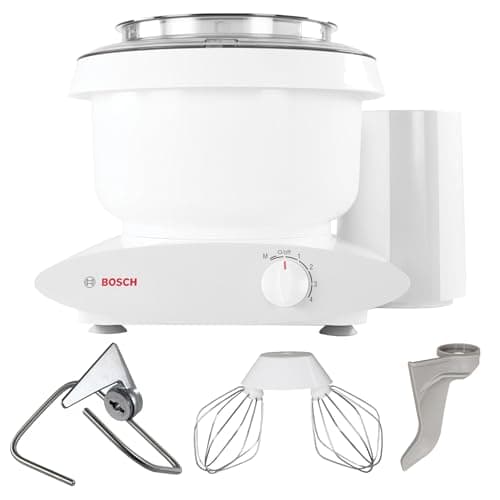
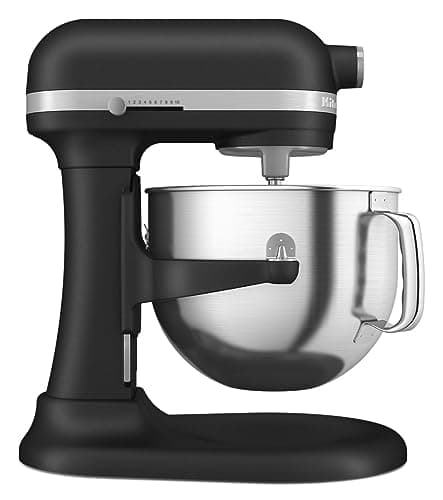
If you bake in real volume — multiple loaves at a time, big holiday batches, dough that fills a bowl — you eventually stop cross-shopping the everyday tilt-heads and land on these two: the KitchenAid 7-quart bowl-lift and the Bosch Universal Plus. Both are built for capacity most home mixers can't touch, and both cost real money, so the choice is worth getting right. They get there by opposite routes: the KitchenAid is a planetary bowl-lift with a cast build and the deepest attachment ecosystem in the category, while the Bosch is a belt-driven, bottom-drive machine engineered around one job — kneading large, stiff batches of bread dough without straining.
The short version: buy the KitchenAid 7-quartif you want the biggest bowl, a premium cast machine and an attachment platform you'll grow into; buy the Boschif raw dough throughput and value are the whole point and you bake bread in volume week after week. Neither is the wrong answer — they're tuned for different priorities. Our KitchenAid vs Bosch stand mixer comparison covers the brand matchup at the everyday-Artisan level; this page is the big-capacity version of that same decision.
Start with capacity, since that's why you're here. The KitchenAid's 7-quart bowlis the largest KitchenAid sells for a home kitchen, rated to take up to roughly sixteen cups of flour or about eight pounds of bread dough in a single go — genuinely a lot of mixing. The Bosch's open 6.5-quart bowlis a touch smaller on paper, and Bosch quotes it around five to six pounds of dough per batch, but the way it handles that dough is the real story: its bottom-drive motor spins the bowl from underneath and kneads big, stiff batches — three to four loaves' worth — without the head flex or motor strain a top-heavy machine can show. So the KitchenAid has the bigger bowl and the higher stated dough number, while the Bosch is arguably the more relaxed high-volume kneader. For most heavy bread bakers that's a closer call than the raw specs suggest.
Drive design is the deeper difference. The KitchenAid uses a planetary action— the beater or hook orbits the bowl while spinning — on a bowl-lift frame that cranks the bowl up to a fixed head, which stays planted on stiff dough where a tilt-head would flex. The Bosch puts the motor at the baseand drives the bowl itself, a layout naturally suited to sustained, heavy kneading and a big reason it's the bread baker's default. If you want the two layouts in the abstract, our planetary vs bottom-drive guide and tilt-head vs bowl-lift guide both dig in. The practical upshot: the Bosch is purpose-built for dough, the KitchenAid is a heavy-duty generalist that also does dough very well.
Versatility is where the KitchenAid pulls decisively ahead. It ships with six accessories and takes the full KitchenAid PowerHub attachment range— pasta rollers, grinders, spiralizers, ice-cream bowls — a first-party ecosystem nothing else in this class matches, and the Bosch's US accessory range is smaller. The KitchenAid also whips, creams and beats small-to-medium jobs with more finesse; the Bosch's big open bowl is superb for dough but can lose a single egg white or a small batch of buttercream in all that space. If your mixer needs to do everything, not just bread, that's a real point for the KitchenAid.
Then there's the practical stuff. The KitchenAid is a cast, premium-feeling machine, but it's tall— around sixteen and a half inches, so it often won't fit under a standard eighteen-inch wall cabinet — and heavy, near thirty pounds, so it lives on the counter rather than moving around. Its bowl is stainless-only, with no glass or ceramic option, and the finish can dull over time. The Bosch is lighterfor its capacity and its bowl detaches for easy storage, which some bakers prefer when counter space is tight, though its plastic-forward build feels less premium than the cast KitchenAid. On price, the Bosch typically costs less while delivering huge dough capacity — it's the value pick — while the KitchenAid's premium buys the bigger bowl, the ecosystem and the build. Read the full KitchenAid 7-quart bowl-lift review and Bosch Universal Plus review for the complete detail on each.
The short answer
Quick picks
| # | Product | Best for | Score | Price |
|---|
| 01 | KitchenAid 7-Qt Bowl-Lift Stand Mixer (KSM70SKXX)The most mixer KitchenAid sells for a home kitchen. A 7-quart bowl on a bowl-lift frame and a 500-watt motor mean it swallows big, heavy batches — up to roughly 8 pounds of bread dough — without the head flex a tilt-head shows. The trade is size, weight and price: it's tall, heavy, and dear. | Big batches / heavy, frequent baking | | $635.00·Amazon |
| 02 | Bosch Universal Plus Stand MixerThe bread baker's mixer. A belt-driven motor at the base and a big open bowl let it knead far more dough than a KitchenAid without straining. Less elegant, less versatile for whipping small amounts — but for loaves it's the one. | High-volume bread dough | | $499.00·Amazon |
#ad · Live prices from the Amazon Product API, as of Sep 20, 2026. Where we have no verified live price we show none — a gap beats a number that has rotted.
In detail
The picks, in full
Big batches / heavy, frequent baking
KitchenAid 7-Qt Bowl-Lift Stand Mixer (KSM70SKXX)
500 W rated7-qt bowl11 speedsBowl-liftPowerHub port
The most mixer KitchenAid sells for a home kitchen. A 7-quart bowl on a bowl-lift frame and a 500-watt motor mean it swallows big, heavy batches — up to roughly 8 pounds of bread dough — without the head flex a tilt-head shows. The trade is size, weight and price: it's tall, heavy, and dear.
- Motor / dough
- 9
- Capacity
- 9.5
- Build & durability
- 8.5
- Ease of use
- 7.5
- Value
- 7
Pros
- +7-qt bowl handles up to ~16 cups of flour or ~8 lb of bread dough in one go
- +Bowl-lift frame stays planted on stiff, heavy dough where a tilt-head flexes
- +Ships with six accessories and takes the full KitchenAid PowerHub attachment range
Cons
- −Tall (~16.5 in) — often won't fit under a standard 18-in wall cabinet
- −Heavy (~28 lb), so it's a machine you leave out rather than move
- −Stainless-only bowl; no glass or ceramic bowl option, and it can dull over time
Don't buy this if…
…you bake single batches on a normal counter — a 5-qt Artisan does that in far less space for far less money, and you'll never miss the extra capacity.
High-volume bread dough
Bosch Universal Plus Stand Mixer
500 W rated6.5-qt bowlBottom-drive~5–6 lb doughDough hook + whisks
The bread baker's mixer. A belt-driven motor at the base and a big open bowl let it knead far more dough than a KitchenAid without straining. Less elegant, less versatile for whipping small amounts — but for loaves it's the one.
- Motor / dough
- 9.5
- Capacity
- 9.5
- Build & durability
- 8
- Ease of use
- 7.5
- Value
- 8
Pros
- +Bottom-drive motor kneads large, stiff dough batches most tilt-heads can't finish
- +6.5-qt bowl swallows 3–4 loaves' worth of dough at once
- +Lightweight for its capacity and easy to store
Cons
- −Not ideal for very small jobs — whipping one egg white gets lost in the big bowl
- −Plastic-forward build feels less premium than a cast KitchenAid
- −Smaller accessory ecosystem in the US
Don't buy this if…
…you mostly whip cream, beat butter and do single-batch baking — a tilt-head KitchenAid is friendlier for that work.
KitchenAid 7-quart vs Bosch Universal Plus: how to choose
Capacity and dough throughput
The KitchenAid has the bigger bowl — 7 quarts to the Bosch's 6.5 — and the higher stated dough figure, up to roughly eight pounds versus the Bosch's quoted five to six. On paper that's a KitchenAid win. In practice, the Bosch's bottom-drive layout kneads three to four loaves' worth of stiff dough with less strain, so the two are closer than the numbers imply. If your batches are simply large, the KitchenAid's bowl is the roomier one; if they're large and stiff and frequent, the Bosch's composure is the draw. Either way, both belong on our best for large batches shortlist for a reason.
Drive design and heavy kneading
This is the heart of the decision. The KitchenAid's planetary bowl-lift stays planted where a tilt-head flexes, and it's a serious dough machine — but the Bosch's belt-driven, bottom-drive motor is purpose-built for sustained, heavy kneading and runs cooler under a full, stiff load. If low-hydration doughs like bagels or dense rye are your regular work, the drive design tilts toward the Bosch. If you knead heavy but also want a machine that does everything else, the KitchenAid's all-round design is the safer generalist. Our wattage guide explains why both matter more than the shared 500-watt rating.
Versatility and attachments
No contest here: the KitchenAid wins. Its PowerHub takes the deepest first-party attachment range in the category, and it handles small and delicate jobs — a single egg white, a small buttercream — with more finesse than the Bosch's big open bowl, where little amounts get lost. The Bosch comes with a dough hook and whisks and does its core jobs superbly, but its US accessory ecosystem is smaller. If the mixer has to be the one machine that does bread, pasta, grinding and everyday baking, that's a KitchenAid strength the Bosch doesn't match.
Footprint, weight and storage
The KitchenAid is tall — around sixteen and a half inches — and heavy at close to thirty pounds, so it often won't clear a standard eighteen-inch wall cabinet and isn't a machine you move. Plan to leave it out and measure your clearance first. The Bosch is lighter for its capacity and its bowl detaches, so it stores more easily when counter space is tight. If your kitchen can house a big, permanent machine, the KitchenAid's presence is part of the appeal; if space is at a premium, the Bosch's smaller stored footprint is a genuine advantage.
Price and value
The Bosch typically costs less while delivering enormous dough capacity, which makes it the value champion of this pairing — you're paying for kneading power, not polish. The KitchenAid's higher price buys the bigger bowl, the cast build, the attachment ecosystem and the resale value KitchenAid holds better than any rival. Decide what your money is really buying: pure dough throughput per dollar (Bosch), or a premium, do-everything platform you keep for years (KitchenAid).
Which to buy
Buy the KitchenAid 7-quart bowl-liftif you want the largest bowl, a premium cast machine, small-job finesse and the deepest attachment ecosystem — and you have the counter space and cabinet clearance for a tall, heavy mixer. Buy the Bosch Universal Plusif bread in volume is the whole reason you're buying, you want a bottom-drive kneader that shrugs at stiff dough, and you'd rather spend the money on capacity than on build and attachments. Read both full reviews for the complete cons before you commit.
How we picked
We don't run a testing lab
We read the manuals, compiled the published specifications, did the wattage-to-dough math and weighed aggregated owner reviews, then scored each product against a published rubric. The scores are judgments from documented research — they are not measurements we took, because we do not have a lab and we're not going to pretend we do. Every spec is the manufacturer's published figure, cited in Sources.
Questions
Frequently asked
Which is better for bread, the KitchenAid 7-quart or the Bosch Universal Plus?+
For high-volume, stiff dough week after week, the Bosch Universal Plus — its belt-driven, bottom-drive motor kneads three to four loaves' worth without straining. The KitchenAid 7-quart has the bigger 7-quart bowl and a higher stated dough capacity, and it's a serious dough machine too, but the Bosch is the more relaxed heavy kneader. See the
Bosch review for the full picture.
Does the KitchenAid 7-quart hold more than the Bosch?+
On bowl size, yes - the KitchenAid's 7-quart bowl is larger than the Bosch's 6.5-quart, and KitchenAid rates it to take up to about eight pounds of dough versus the Bosch's quoted five to six. But the Bosch's bottom-drive design kneads big, stiff batches with less strain, so real-world dough handling is closer than the raw numbers suggest.
Will the KitchenAid 7-quart fit under my cabinets?+
Often not. It stands around sixteen and a half inches tall, which is more than a standard eighteen-inch wall cabinet leaves above the counter, so measure your clearance before buying. It's also heavy at close to thirty pounds, so it's a machine you leave out rather than move. The Bosch is lighter and its bowl detaches for easier storage.
Which has more attachments, the KitchenAid or the Bosch?+
The KitchenAid, by a wide margin. Its front PowerHub takes the deepest first-party attachment range in the category — pasta rollers, grinders, spiralizers and more — while the Bosch's US accessory ecosystem is smaller. If you want one machine that does far more than knead dough, the KitchenAid is the platform; the Bosch is the specialist. Our
KitchenAid vs Bosch guide covers the wider trade.
Receipts
Sources
We don't run a testing lab, and we don't pretend to. Specs are the manufacturer's published figures, cited above; scores are our judgments from that research. Where we couldn't verify something, we say so on the page rather than quietly leaving it out. Read our full method.