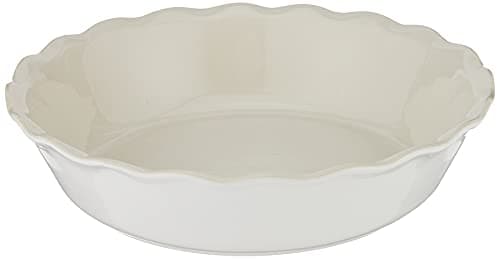
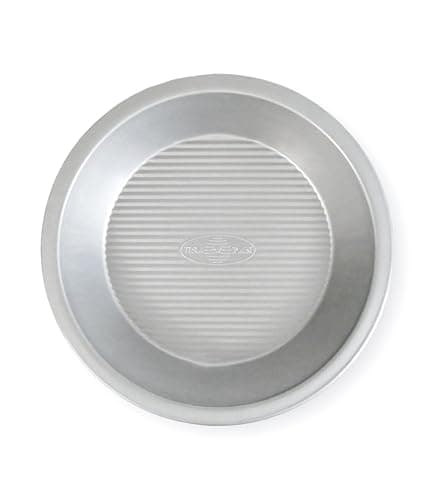
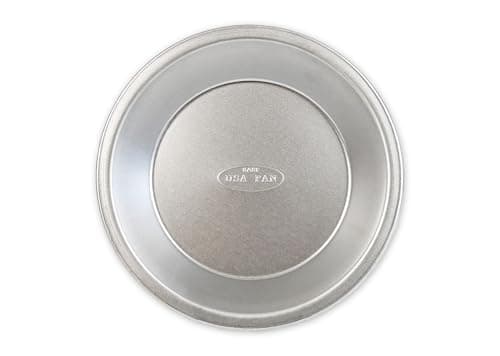
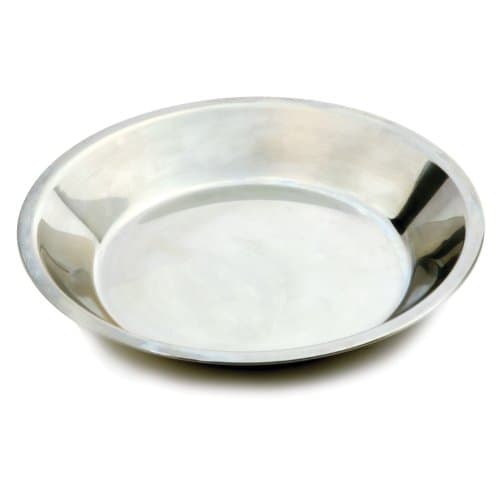
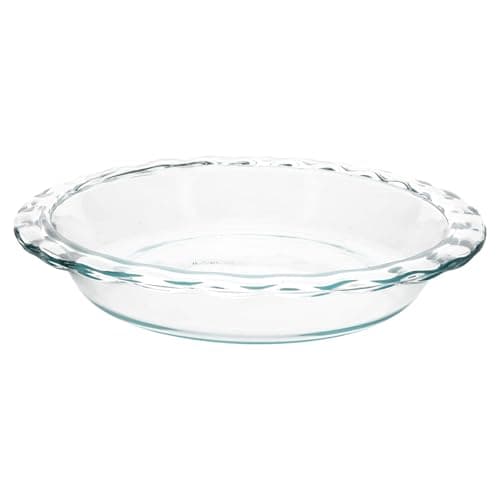
Buy the Pyrex 9.5-inch fluted-rim glass pie plate. Pie has one characteristic failure — a pale, wet bottom crust under a browned top — and glass is the only material on this page that lets you look at the base while it bakes instead of guessing. Pyrex publishes tempered glass, a 9.5-inch diameter, a 2-year limited warranty, and safe use in the freezer, the microwave, the dishwasher and a preheated oven. Take the Emile Henry Modern Classics deep dish if you want the pie to arrive at the table in the dish it baked in: published 1.7 quarts, HR Ceramic from Burgundy clay, a 500°F ceiling, freezer-to-oven use and a 10-year warranty, made in France. The USA Pan aluminized steel pan is the one that browns a base fastest, and its new Bare uncoated sibling is the same steel with nothing on it to wear out. The Norpro stainless pan costs under ten dollars and will outlive the oven.
The criteria: everything here is downstream of one failure
A pie bakes from the outside in, and the two crusts are in competition. The top crust is exposed to dry oven air and browns fast. The bottom crust is underneath a wet filling, insulated from the oven by the pan, and has to set before the filling soaks into it. When a pie fails, that is nearly always what failed. Everything a pie pan can do is either an attack on that problem or an acceptance of it, so these are the criteria:
1. Can you see the bottom crust?Only glass can show you. This sounds like a convenience feature and it is not — it is the only direct feedback available on the thing most likely to go wrong, and it is how you learn, over a season of pies, what a done base actually looks like in your oven. Every other material asks you to infer it.
2. How fast does the material conduct heat into the base? Metal is far better at this than glass or ceramic. A dark, thin metal pan drives heat into the pastry quickly and sets the base before the filling can wet it. This is the mechanical attack on the same problem, and it is why professional bakeries use metal.
3. Depth and capacity. Standard American pie recipes assume a 9-inch pan roughly 1.25 to 1.5 inches deep. A deep-dish recipe assumes something closer to 2 inches, and putting a deep-dish filling in a standard pan is how you get a pie that boils over onto the oven floor. Capacity, where a maker publishes it, is the honest spec.
4. Does it go to the table? A pie is usually served out of the dish it baked in, so the dish is also serveware. Ceramic wins this outright, glass is acceptable, and bare metal is not something most people want in the middle of a Thanksgiving table.
5. What will kill it. Glass shatters, ceramic chips, coatings wear out, bare steel discolors. Each material has a published or well-understood end-of-life, and the right pan depends partly on which of those you mind least.
Glass vs metal vs ceramic, decided
This is the comparison the category actually turns on, and the short version is that there is no material that wins all five criteria — but there is a clear answer for most bakers.
Glass is a poor conductor of heat. That is a disadvantage for setting a crust fast, and it is the reason glass pies take a little longer. What glass buys instead is transparency, and transparency converts an invisible problem into a visible one. You rotate the pie, you look at the base through the side, you leave it another eight minutes because the base is still pale. That loop is worth more to most home bakers than a faster conduction rate, because the faster rate does not tell you when to stop. Glass is also the only material here that is published safe across the freezer, the microwave, the dishwasher and the oven, which matters for a make-ahead pie.
Metal is the professional choice because it solves the problem rather than reporting it. Aluminized steel is aluminum-coated carbon steel: the aluminum conducts, the steel gives it stiffness, and the result drives heat into pastry faster than glass or ceramic can. If your pies come out with soggy bottoms despite watching them, metal is the upgrade. The cost is that you are back to inference, and that a coated pan has a published temperature ceiling and a finite coating life.
Ceramic is the slowest of the three to heat, so it is the weakest answer to the soggy bottom. It earns its place on the other criteria: Emile Henry publishes 1.7 quarts of capacity against the roughly 1-inch depth of a standard glass plate, so it holds the filling a deep-dish recipe calls for; it is published freezer-to-hot-oven, so a quiche can be assembled a week ahead; and it is the only one of the three you would willingly put in the middle of a table. Buy it as a serving dish that bakes well, not as a fix for pale pastry.
Published specifications of the five picks
| Pan | Material | Published size / capacity | Oven ceiling | Warranty |
|---|
| Pyrex 9.5 in fluted glass | Tempered glass | 9.5 in dia x 1.0 in high | Preheated oven; no broiler | 2 years |
| Emile Henry Modern Classics deep | HR Ceramic (Burgundy clay) | 1.7 qt; 10.25 x 2.6 in | 500°F | 10 years |
| USA Pan 9 in pie pan | Aluminized steel + Americoat | 9 in, 1.5 in deep (retailer) | 450°F (retailer) | Limited lifetime |
| USA Pan Bare 9 in pie pan | Uncoated aluminized steel | Not published | Not published | Not published for this item |
| Norpro stainless 3811 | Stainless steel | 9 x 1.5 in (listing) | No coating to limit it | Not published |
Three gaps worth naming. USA Pan publishes no spec sheet for the Bare pie pan — the Bare uncoated collection was introduced in 2026 and the pie pan's dimensions, depth, oven rating and care guidance are not published anywhere we could find, so we rank it on its material and its construction and say the rest is unknown rather than copying the coated pan's numbers across. The coated USA Pan's 450°F rating and 1.5-inch depth come from retailer listings, not from USA Pan's own spec sheet, and retailer figures for its outer dimensions disagree. And Norpro publishes no gauge figure, so we cannot tell you how heavy its steel is against the USA Pan's. Where a figure does not exist we say so — see how we pick.
Depth: the spec that decides whether your filling fits
Nine inches is the standard diameter and nearly every American pie recipe is written for it. Depth is the variable, and the spread here is larger than it looks.
- Pyrex:published at 9.5 in across and 1.0 in high. A standard shallow plate — and note it is 9.5 in, not 9, which is a half-inch more base area than a recipe assumes.
- USA Pan and Norpro: 1.5 in deep per their listings. Standard-to-generous.
- Emile Henry: published 1.7 qt with an outer height of 2.6 in. This is the deep-dish pan on the page.
The practical consequence: a filling written for a deep-dish pie — a tall apple pie, most quiches, anything with a published cup count above about four — will overflow a 1-inch plate, and it will do so onto the floor of your oven roughly forty minutes into the bake. If deep pies and quiches are the reason you are buying, buy the ceramic dish or put a sheet pan under whatever you do buy. The same arithmetic applies to round cake pans and we work it through in our 8-inch vs 9-inch cake pan guide: capacity scales with both diameter and depth, so a half-inch either way is a different pan, not a bigger one.
Coated, uncoated, stainless: three kinds of metal pan, and why all three are here
The three metal picks are not three price tiers of the same thing. They are three different decisions.
Coated aluminized steel(the USA Pan pie pan) is the best browner here and the easiest to serve from, because Americoat — a silicone coating USA Pan states is made without PTFE, PFOA and BPA — lets the first slice out without a fight. The coating is a consumable: retailer listings cap the pan at 450°F and recommend hand washing, and when the finish eventually fails you have a pan that sticks.
Uncoated aluminized steel (USA Pan Bare, new in 2026) is the same steel with the coating left off, for less money. There is nothing to peel, nothing to scratch and no coating ceiling — bare metal is limited by your oven, not by a finish. The trade is the same one we lay out across the uncoated bakeware lane: an uncoated pan is not a release surface, so you grease it, and a sticky fruit filling that has boiled over the edge will let you know. It also discolors, permanently and harmlessly.
Stainless steel(Norpro) is the outlier, and it is on this page because it costs under ten dollars and is effectively indestructible. Stainless conducts heat less readily than aluminized steel, so it browns a base less eagerly than the USA Pan does — it sits between glass and aluminized steel rather than at the top. What you get for the price is a pan with no coating, no reactivity with acidic fruit, and no realistic failure mode.
What actually fixes a soggy bottom, pan aside
Since the pan is only part of it, and since recommending a pan as a cure would be overselling: four things matter at least as much, and three of them are free.
Preheat a sheet pan and bake the pie on it. This is the biggest single improvement available, and it works with any pan on this page. A hot metal sheet under the pie puts heat into the base from the first minute instead of waiting for the oven floor to radiate it, and it catches the overflow. A half sheet is the right size — see our best baking sheets roundup.
Bake lower in the oven.The bottom third puts the base nearer the oven's main heat source in most domestic ovens. If your tops brown before your bases set, this is the first thing to change.
Blind bake for wet fillings. Custard, pumpkin and quiche fillings are liquid when they go in, so the base needs to be partly or fully set before the filling arrives. Line the shell, weight it, bake it, then fill it.
Keep the pastry cold until it goes in. Warm butter in a crust smears instead of layering, and a smeared crust absorbs liquid faster. Our best rolling pins page covers the chillable pins that help with this, and the technique that matters more than the pin.
How to choose and use a pie pan
Buy the glass plate first, whatever else you buy
If you own one pie pan, own a glass one. It costs the least of the non-stainless picks here, it is published safe in the freezer, microwave, dishwasher and a preheated oven, and it is the only one that teaches you anything. Bake four pies in it and you will know what a finished bottom crust looks like — at which point a metal pan becomes a useful upgrade rather than a guess. Buying metal first is the common mistake: it is the better pan and the worse teacher.
Glass has rules, and they are not optional
Pyrex's own guidance: do not use the glassware on a stovetop, under a broiler, in a toaster oven or on a grill, avoid abrupt temperature changes, and do not add liquid to hot glass — it warns that doing so may compromise the product's strength and result in breakage. In practice that means: into a fully preheated oven is fine, under the broiler to brown a meringue is not; a hot dish onto a trivet or a dry towel, never onto a wet counter or into a sink of water; and if you are deglazing or topping up a filling mid-bake, use room-temperature liquid. These are not fussy manufacturer disclaimers. Thermal shock is the one way a glass dish fails, and it fails suddenly.
Read the diameter, not the category
The Pyrex plate is 9.5 inches, not 9. Half an inch of diameter is about 11 percent more base area, which means a recipe's pastry stretches a little thinner and the filling sits a little shallower. Nothing goes wrong, but a crust rolled for a 9-inch pan will be short of overhang for crimping. Roll a bit wider, or accept a flatter edge. The same half-inch, on a recipe already short of filling, is the difference between a full pie and a sparse one.
Blind baking, and what to weight it with
Line the chilled shell with a crumpled-then-flattened round of parchment, fill it to the rim with weights, and bake until the edges are set and lightly colored before removing the weights to finish the base. Fill to the rim, not halfway — the weights are there to hold the sides up against gravity, not just to flatten the base, and a half-filled shell slumps at the top edge. Ceramic beads, dried beans and rice all work; a second pie pan nested inside works too, and is free. A docked base (pricked with a fork) is for shells with no liquid filling at all — prick a shell that is going to hold custard and the custard finds the holes.
Deep dish is a recipe instruction, not a marketing word
When a recipe says deep dish, it is telling you its filling volume needs more than a standard plate. Check the capacity rather than the word on the box: Emile Henry publishes 1.7 qt, which is a real deep-dish figure, and the Pyrex plate's published 1.0-inch height is not. If you own a standard pan and the recipe wants deep, either scale the filling down by a third or put a sheet pan underneath and accept that it will boil over a little.
Looking after each material
Glass: dishwasher safe per Pyrex. Avoid the temperature-change rules above, and retire any dish with a visible chip in the rim.
Ceramic:Emile Henry lists the Modern Classics dish as dishwasher safe with a scratch-resistant glaze, and warrants it for 10 years against manufacturing defects — a warranty which, like every ceramic warranty, excludes damage from improper use. Do not take a cold dish straight to a broiler, and do not stack heavy pans on it.
Coated steel: hand wash, no metal servers, no aerosol spray (the propellant leaves a residue that polymerizes on the coating and never comes off). Retailer care guidance for the USA Pan pie pan is hand washing even where a dishwasher label appears.
Uncoated and stainless steel:grease every bake, or line the base. Dry them promptly. Expect the aluminized Bare pan to darken, which is cosmetic. Norpro's guidance on its 9-inch pie pans is to hand wash.
What we did not feature, and why
Disposable aluminum pie platesare genuinely good at browning a base — thin, dark, cheap — and they are the right answer for a pie you are giving away. They are not a pan you buy once, which is what this page is about.
Cast iron pie pans brown a base ferociously and are a legitimate specialist choice. They also need seasoning, react with acidic fruit fillings, and weigh enough that a loaded 9-inch pan is awkward coming out of a hot oven one-handed. A niche worth knowing about rather than a default.
Silicone pie pans insulate, which is the exact opposite of what a bottom crust needs, and they flex while you are transferring a filled shell.
Unbranded ceramic and “borosilicate” pie dishes are the biggest group on Amazon by listing count and are absent on purpose. Several publish no temperature rating, no capacity and no warranty while using the word borosilicate in the title. We rank on published specifications, and a claim in a product title is not one — the same standard we apply in our glass vs metal loaf pan comparison.