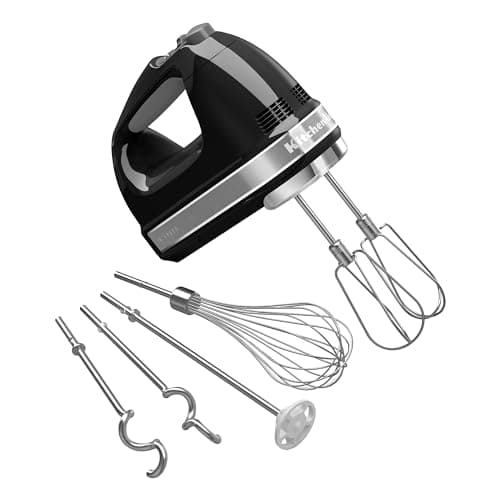
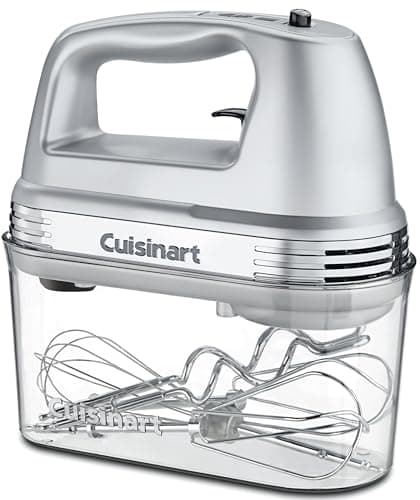
This is the head-to-head most serious home bakers who don't want a stand mixer actually run: two nine-speed hand mixers from the two brands people trust most. The verdict up front — buy the Cuisinart Power Advantage Plus unless you bake often enough to feel the KitchenAid 9-Speed Digital'ssmoother control, in which case the KitchenAid is the nicer tool. Both cover the same everyday jobs, so the decision comes down to what's in the box against how much finesse you want on the first press.
The Cuisinart's case is value done properly. It pairs a 220-watt-rated motor and nine speeds with dough hooks, a whisk and a snap-in storage case in the box — at a price where most rivals hand you two beaters and nothing else. That bundle is the whole argument: a whisk for meringue and whipped cream, hooks for the occasional soft dough, and a case that keeps them from scattering across a drawer. Buy those separately for another mixer and the price gap closes fast. The motor has genuine headroom for the money, handling cake batter and cookie dough without the strain a truly cheap mixer shows.
The KitchenAid's case is control. Its Soft Start ramps the beaters up gradually instead of lurching to full speed, so you can start in a bowl of flour and powdered sugar without a cloud erupting across the counter, and its nine speeds are spaced usefully across the range rather than bunched at the low end. It has the torque to muscle through stiff cookie dough where cheaper mixers stall. The trade-offs are honest: it's the most expensive mainstream hand mixer, it's heavier over a long whipping session, and its dough hooks and whisk are sold as optional accessories rather than included — so the real cost to match the Cuisinart's kit is higher than the sticker.
Here's where the difference actually shows, and where it doesn't. On the light work that fills most baking — whipping cream to stiff peaks, creaming butter and sugar, mixing a cake batter — the two are effectively a wash, and you will not feel a meaningful gap. The KitchenAid pulls ahead in exactly two moments: the first press into a bowl of dry ingredients, where Soft Start keeps the flour in the bowl, and the low end of a stiff dough, where the finer speed spacing lets you ease in rather than fight it. If those two moments happen several times a week in your kitchen, they add up; if you bake a few times a month, they barely register.
The rule:buy the Cuisinart if you want the most complete, capable hand mixer for the money and you don't need the smoothest possible start — which is most home bakers. Buy the KitchenAid if you bake often, value control, and will happily pay for a genuine soft start and finer low-speed spacing. Read the full Cuisinart review and KitchenAid 9-Speed review for the complete picture on each.
Buy the Cuisinart if… / buy the KitchenAid if…
Buy the Cuisinart Power Advantage Plus if…
You want the most mixer-and-kit for the money and you don't need the gentlest possible soft start. The included whisk and dough hooks make it versatile straight out of the box, the storage case keeps everything together, and the rated motor covers everything from whipped cream to a full batch of cookie dough. For a straightforward home baker, it's the smart-money buy and the value champion of our best-for-baking roundup.
Buy the KitchenAid 9-Speed if…
You bake often, you value control, and you want the finest low-speed behavior a hand mixer offers. The Soft Start and well-spaced speeds make everyday whipping, creaming and cookie dough genuinely nicer, and the motor has the headroom to avoid the stall a cheaper mixer hits on stiff dough. Just remember the dough hooks and whisk are extra, so add their cost when you compare it to the Cuisinart's in-the-box kit.
What the bundle really saves you
Compare like for like rather than sticker to sticker. The Cuisinart's price already includes the whisk and dough hooks that are add-ons on the KitchenAid, so the effective gap between them is wider than the shelf prices suggest. If you know you'll want a whisk for meringue or hooks for the occasional soft dough, the Cuisinart is doing more for less; if you'll only ever use the standard beaters, that bundle advantage matters less and the decision swings back toward how much you value control.
Where both stop being enough
Neither of these is a bread machine, and neither is a substitute for a stand mixer once you're kneading bread dough weekly. Their dough hooks handle a small, soft dough occasionally, but the motors are built for whipping and beating, not the sustained torque a full loaf of stiff dough demands. If bread is becoming a habit, our stand mixer vs hand mixer guidewalks through when it's time to step up.
The deciding question
Ask yourself how often you'll actually reach for it. A few times a month: the Cuisinart gives you more tool and more kit for less money, and you won't miss the soft start on an occasional batch. Several times a week, especially with cookie dough or delicate folding in the mix: the KitchenAid's control earns its premium. Match the mixer to your real habit, not the nicest spec sheet.