Hand kneading makes bread every bit as good as a mixer does. That is the honest starting point, and it is not what most buying guides say. Gluten develops when flour protein is hydrated and then worked, and the dough does not know whether the work came from a dough hook or from the heel of your hand. What changes is time, effort and ceiling: by hand a standard loaf wants roughly 15 to 25 minutes of active work, in a mixer it is more like 8 to 12 minutes of standing nearby, and your hands tire long before a motor does. Buy the mixer when the dough gets big, stiff or frequent— double batches, bagel and heavy rye doughs, or baking that has turned into a weekly habit. Keep kneading by hand if you bake occasionally, enjoy it, or have no counter space to lose.
What kneading actually does, so you can judge the trade
Flour contains two proteins, glutenin and gliadin. Add water and they link into gluten; work the dough and those links organize into an elastic network that traps the gas yeast produces. That network is what lets a loaf hold its height instead of spreading. Kneading is simply the mechanical work that organizes it — stretching, folding, pressing, repeating.
Two consequences follow, and both matter for this decision. First, the work can come from anywhere: hands, a dough hook, a bread machine's paddle, or simply time (a no-knead dough develops the same network over hours of rest, with almost no work at all). Second, you can tell when it is done by looking rather than by the clock. King Arthur Baking's windowpane test, cited below, is the standard check: stretch a piece of the dough thin and if light passes through before it tears, the gluten is developed.
That test is the reason hand kneading is more forgiving than its reputation suggests. Over-kneading is a real failure mode — an over-worked dough goes slack and tears instead of stretching — but it is overwhelmingly a machine failure. By hand, you tire out well before the gluten does.
The honest comparison
| Hand kneading | Stand mixer |
|---|
| Time for a standard loaf | Roughly 15-25 min of active work | Roughly 8-12 min, hands free |
| Risk of over-kneading | Very low | Real - a dough can be wrecked at speed |
| Double batches | Hard work, and a big surface | Straightforward within bowl capacity |
| Stiff, low-hydration dough (bagels, rye) | Genuinely tough on the hands | The clearest win for the machine |
| Very wet dough (ciabatta, high-hydration sourdough) | Messy by hand; usually folded instead | Handles it without the mess |
| Feel for the dough | You learn it directly | Learned through a window, if at all |
| Counter and storage space | None | A permanent 20-30 lb resident |
| Cost | Nothing | Mid three figures for a good one |
| Cleanup | A bowl and a bench scraper | Bowl, hook, splash guard, collar |
The time figures are the ranges published baking guidance gives for a standard yeasted loaf, not stopwatch measurements we took, and they move with the dough: an enriched brioche takes longer either way, a slack focaccia barely needs kneading at all. Use the windowpane test rather than the number. See how we pick for how we treat published figures.
Four reasons to buy the machine, and they are all about scale
1. Dough volume.One loaf is pleasant to knead. Three loaves for a family, or a double batch of cinnamon rolls for a holiday, is twenty-five minutes of hard physical work and a counter the size of a table. A 5-quart mixer takes two loaves' worth of dough without complaint; a 7-quart or a Bosch takes more.
2. Stiff dough.Low-hydration doughs — bagels, pretzels, some ryes, pasta dough — are where hands genuinely struggle. The dough resists, your wrists take the load, and twenty minutes of it is unpleasant rather than therapeutic. This is the clearest case for a motor, and it is also the case that eats cheap mixers alive.
3. Frequency. The arithmetic changes when baking becomes a habit. Once a month, hand kneading is part of the fun. Twice a week for years, and twenty minutes of work per loaf is real time you are spending, and the machine pays for itself in attention rather than money.
4. Physical reasons.Arthritis, a wrist injury, a shoulder that objects — these are not minor considerations and they are the reason a lot of people buy a mixer. If kneading hurts, the machine is not a luxury.
Three reasons to keep kneading by hand
You learn the dough.This is the argument experienced bakers make and it is not sentimental. Hydration, slack versus tight, under-developed versus ready — you learn those with your hands in the dough, and that knowledge transfers to every recipe afterwards. Bakers who start on a machine often cannot tell when a dough is wrong, because they have never felt a dough that was right.
It is nearly impossible to ruin a dough by hand. A mixer on speed 4 with a stiff dough can go from under-kneaded to over-kneaded in a couple of minutes, and an over-kneaded dough cannot be rescued. By hand, you stop because you are tired, which is almost always before the dough is damaged.
No mixer is small. A stand mixer is 20 to 30 pounds of metal that needs permanent counter space or a cupboard you can lift it out of. In a small kitchen that is a genuine cost, and it is why plenty of good bakers never own one. If space is the blocker, the best stand mixers for small kitchens covers the compact options, and how to store a stand mixer covers living with one.
The third option most comparisons leave out: no-knead
You can also simply not knead. A no-knead dough uses a long, slow fermentation — typically 12 to 18 hours at room temperature — to develop the same gluten network through time and enzyme activity instead of mechanical work. You mix it with a spoon or a dough whisk, leave it, fold it once or twice, and bake. The results are excellent for rustic, open-crumbed loaves and less suited to a tight-crumbed sandwich loaf.
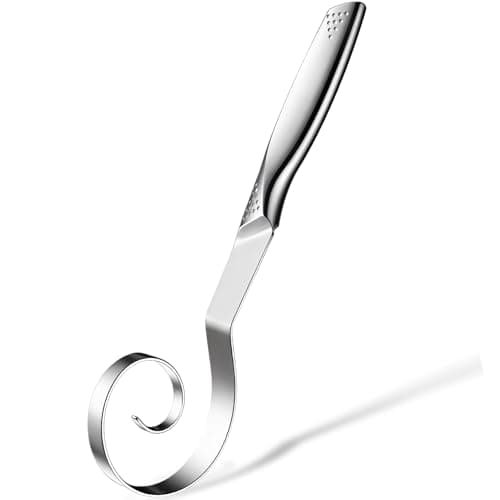
If this is your route, the mixer question disappears and two cheap tools matter instead: a Danish dough whisk, which cuts through wet dough where a spoon clogs, and a lidded vessel that traps steam in the oven — see the best Dutch ovens for bread. Our guide to proofing applies whichever way the gluten got developed.
If you buy the machine, buy enough motor
The mistake people make after deciding to stop kneading by hand is buying the cheapest stand mixer they can find. A light machine with a small motor handles cake batter and cookie dough happily and then struggles with exactly the job you bought it for: bread. Dough is the hardest thing a mixer does, and it is where the difference between a $90 mixer and a $400 one shows up.
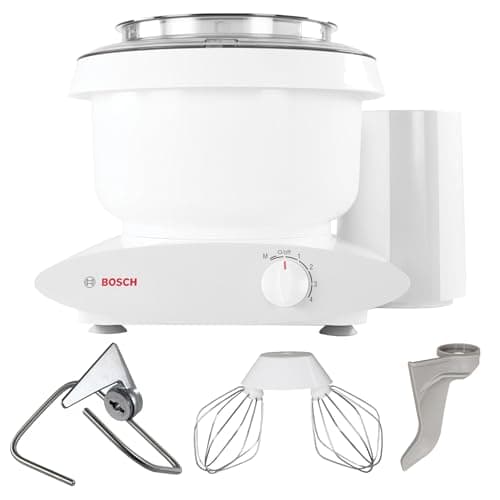
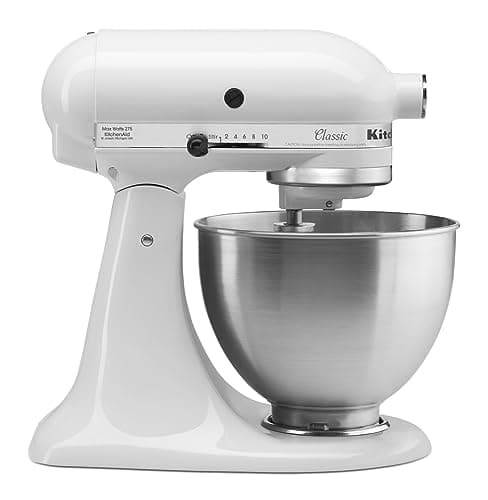
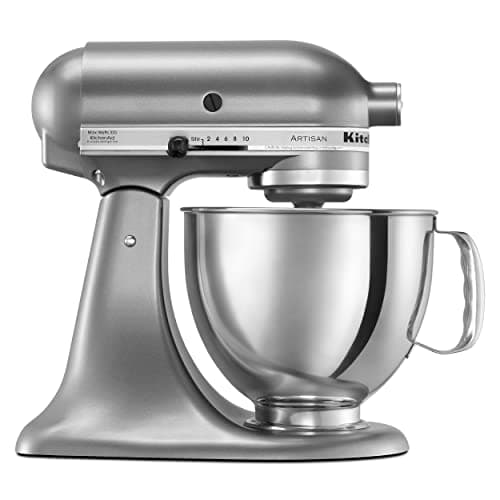
The sensible default is the KitchenAid Artisan — a 5-quart tilt-head that takes roughly two loaves' worth of dough, with the deepest attachment ecosystem and the best parts availability of any brand. If dough is the whole reason you are buying, the Bosch Universal Plus is the machine built around it: a bottom-drive design that keeps the load low and handles stiff, heavy dough that makes a tilt-head flex. If the budget is tight, the KitchenAid Classic is the same mechanism in a smaller bowl, and it is a better buy than a no-name mixer at the same price. And if you have decided to keep kneading by hand, the Danish dough whisk is the few-dollar tool that makes the mixing stage before kneading far less of a fight.
Our ranked pages go deeper: the best stand mixers for bread dough is the page for this specific job, what wattage stand mixer for bread explains why the headline wattage number is less useful than it looks, and tilt-head vs bowl-lift covers the structural difference that matters most for dough.
How to knead in a mixer without wrecking the dough
The machine's one real risk is that it is strong enough to go too far, and fast enough to do it while you are looking at your phone. Four rules keep you out of trouble:
- Use the dough hook and a low speed. Speed 2 on a KitchenAid is the standard for dough; higher speeds stress the gear train and can over-develop a dough quickly. The point is to mimic the pace of hands, not to beat it.
- Check at 6 minutes, not 12. Stop the machine, pull a piece, do the windowpane test. Restart if it needs more. Checking costs nothing; over-kneading cannot be undone.
- Finish by hand. A minute of hand kneading on the bench after the machine is the habit that gets you the best of both: the mixer does the heavy lifting, your hands tell you the dough is right.
- Do not exceed the bowl's dough capacity. Overloading a mixer is what burns out a motor and strips gears. What size stand mixer do I need has the capacity arithmetic by loaf count.
The full method is in how to knead dough in a stand mixer, and how to make bread in a stand mixer walks a whole loaf from flour to oven.
How to knead by hand so it is not miserable
Most people who find hand kneading exhausting are fighting the dough rather than working it. Three things fix that. Autolyse first: mix flour and water and leave it 20 to 30 minutes before you start. The flour hydrates, gluten begins forming on its own, and the dough that comes out of that rest is dramatically easier to work. Rest mid-knead: if the dough is fighting you, walk away for five minutes; it relaxes, and so do your arms. Stop flouring the bench:adding flour to stop sticking stiffens the dough and makes the work harder — use a bench scraper instead, and let a sticky dough be sticky.
How to use a bench scraper covers the one tool that makes hand work cleaner, and bread flour vs all-purpose flour matters here too: a higher-protein flour develops more structure for the same work, which is effort you do not have to supply.
What about a bread machine instead?
A bread machine is the third answer to this question and the cheapest one: it mixes, kneads, proofs and bakes without you. If the goal is a sandwich loaf on a Tuesday with no work at all, it beats both options here on effort and costs less than a stand mixer. What you give up is shape, crust and control — machine loaves are tall and rectangular with a paddle hole in the base, and you cannot make a boule or a baguette in one.
Many people end up using a machine as a dough mixer only: run the dough cycle, then shape and bake in the oven. That is a legitimate strategy and it is covered in the bread machine dough cycle guide. For the straight comparison, see bread machine vs stand mixer, and if you have landed on the simplest possible route, the best bread machines ranks the field.
The honest summary
Nobody needs a stand mixer to bake good bread, and anyone telling you otherwise is selling one. What a mixer buys is capacity and the end of physical work — which is worth a lot if you bake weekly, bake big, bake stiff doughs, or have hands that object. If you bake a loaf now and again, spend the money on better flour and a scale, and keep your hands in the dough.