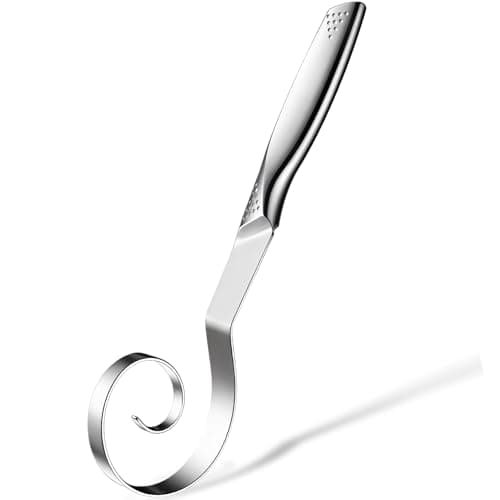
A Danish dough whisk looks like a mistake — a flat, stiff loop of open wire on the end of a handle, as if someone started building a balloon whisk and gave up halfway. It is, in fact, one of the most useful few dollars you can spend on a bread kitchen. That open coil is shaped for exactly the job a spoon, a fork and a balloon whisk all fumble: bringing together a wet, sticky, shaggy dough in the first minute of mixing without turning into a clogged, doughy club in your hand.
The problem with a spoon is that it pushes dough around rather than passing through it. Stir a high-hydration sourdough or a no-knead batter with a wooden spoon and within a few turns you're dragging a solid ball of paste through more paste — the flour on the bottom stays dry, the wet patches stay wet, and you end up mashing instead of mixing. A fork is worse; a balloon whisk is worst of all, because its dense cage of thin wires packs solid with dough almost immediately and takes ten minutes to clean. The Danish whisk's stiff, widely spaced coil is the opposite idea: the wire slices through the mass and lets the dough fall away between the loops instead of building up on them, so a shaggy pile of flour and water becomes a cohesive dough in well under a minute of easy stirring.
In the hand it feels stiffer and more deliberate than any whisk you've used. You don't whip with it; you press and turn, working it through the bowl in a folding, stirring motion. A shaggy no-knead dough that would take a couple of minutes of graceless mashing with a spoon comes together in perhaps twenty to thirty easy strokes, with the flour fully hydrated and no dry pockets hiding at the bottom of the bowl. Because the wire is rigid rather than springy, you can also use the edge of the coil to scrape down the sides of the bowl and gather stray flour as you go, which is a small thing that saves reaching for a separate spatula.
It is very good at one specific stage and honest about the rest. This is the tool for the initial mix — the moment you combine flour, water, starter or yeast, and salt into a rough dough before the long fermentation does the real work. It shines on no-knead breads, sourdough, focaccia, pancake and waffle batter, and any wet batter where a balloon whisk would clog. What it is not is a mixer replacement or a kneading tool: it brings the dough together, then you set it down and let time (or your hands, or a machine) take over. If you're assembling a wider kit, our sourdough tools guide covers where the whisk sits alongside a scale, a banneton and a thermometer, and how to use a proofing basket picks up the next step after the dough is mixed.
Is a Danish dough whisk worth it?
For a few dollars, it removes a small, recurring annoyance from every wet-dough bake. That is the whole case — but it's a genuine one, and it's worth understanding exactly what the tool does well, what it's made of, and where it stops being useful before you add it to a cart.
What the open coil does that a spoon can't
The magic is entirely in the geometry. Instead of a solid paddle or a dense cage, you get a single stiff wire wound into an open, flattened spiral. When you push it through a wet dough, the wire cuts a path and the dough shears around it and drops back off between the loops rather than welding to them. That means three things in practice: the dough comes together faster, you use far less effort than stirring with a spoon, and — crucially — you don't overwork it. A stand mixer or a heavy hand can develop too much gluten too early in a delicate high-hydration dough; a few passes with the whisk hydrates the flour evenly and then gets out of the way, which is exactly what a long, slow ferment wants.
Materials and build
The working end is a stainless steel coil — the part that matters, because it's stiff enough to hold its shape against a heavy dough and won't rust or hold onto flavors. Handles vary by version: some models are fully stainless and dishwasher-safe end to end, while others pair the steel head with a wooden handle. The wooden-handled versions look nicer and feel warm in the hand, but they need to be hand-washed and dried rather than run through a dishwasher, the same way a good wooden spoon does. Neither is wrong; it's just a trade-off between looks and convenience, so check which one a listing is showing you before you buy. Beyond the handle question, there's very little to go wrong here — it's a single piece of bent wire and a grip, with no moving parts to fail.
How it compares to the alternatives
Against a wooden spoon, the whisk wins on effort and on thoroughness — the spoon pushes a growing ball of paste around and leaves dry flour stranded, while the whisk cuts through and hydrates evenly. Against a balloon whisk it's not even close for dough: the balloon whisk's dense cage clogs solid on the first pass and is miserable to clean, which is exactly the failure the open coil is designed to avoid. The only tool that genuinely does more is a stand mixer with a dough hook, which will both mix and knead a larger batch hands-free — so if you're already committed to a machine, the whisk is optional. Where the whisk keeps its edge even then is on small batches, delicate no-knead doughs you don't want to overwork, and the everyday convenience of a five-dollar tool you can grab and rinse without hauling out a mixer for a single loaf.
How to clean it
This is where the open design pays off a second time. Because dough doesn't pack into the coil the way it does a balloon whisk, most of it falls away on its own, and a quick rinse under warm water clears the rest before it dries. Do it promptly — dried-on dough is the one thing that will make a whisk annoying to clean — and the wide gaps mean there are no tight cages to dig into. A fully stainless whisk can go in the dishwasher; a wooden-handled one should be washed by hand and stood up to dry so the handle doesn't sit wet. That's the entire maintenance story.
The honest limits
The whisk earns its keep in one narrow lane, and it's worth being clear about the edges of it. It is only useful for wet doughs and batters — it does nothing for a stiff, low-hydration bagel or pretzel dough, where the wire just can't move, and it's pointless for creaming butter and sugar or whipping cream, which are jobs for a beater or a balloon whisk. It also does not knead: it mixes the dough, and then either time (in a no-knead or sourdough method) or your hands or a machine finish the gluten development. And if you already own or plan to buy a stand mixer that will do the mixing for you, the whisk is a nice-to-have rather than a need — see the best stand mixers for sourdoughif that's the route you're on. It is a hand tool for a specific job, not a do-everything gadget, and it's better for being honest about that.
Who it's for
Buy it if you mix wet doughs by hand: sourdough bakers, no-knead bread makers, and anyone who regularly stirs together a sticky batter and hates the paste-on-a-spoon feeling. At a few dollars it's an easy yes for that person, and it pairs naturally with the accuracy tools that matter more — a scale to hit your ratios and a basket to shape the loaf. If you only bake the occasional quick bread or you do all your mixing in a machine, you can skip it without missing much. For the standard we hold every tool to before it earns a spot on the site, see how we pick.
The bottom line
The Danish dough whisk is the best hand tool for the messy first mix of a wet dough. It cuts through shaggy sourdough and no-knead batter cleanly, doesn't clog like a balloon whisk, and costs about the price of a bag of good flour. Its limits are real and narrow — wet doughs only, no kneading, and redundant if a mixer does the work — but within that lane nothing cheap does the job better. If you mix bread by hand, it's worth having in the drawer.