Pizza dough is the single hardest thing you can ask a home stand mixer to do. A good Neapolitan or New York dough is stiff and low in hydration — often well under 65% water — which means the mixer isn't sloshing a loose batter around, it's dragging a dense, elastic mass against the bowl for eight or ten minutes while the gluten develops. That is the job that bogs a mid-range motor, flexes a tilt-head, and sends a lightweight machine skidding across the counter. So the ranking here isn't about speeds or colors: it's about which mixers have the motor headroom, the drive design and the planted frame to knead a real pizza dough without straining.
Three things separate a pizza-dough mixer from a merely good one. The first is motor headroom— the ability to keep turning at a steady speed when the dough tightens, rather than lugging down and heating up. The second is drive design: a bottom-drive or bowl-lift machine puts the force low and keeps the working head planted over the bowl, where a tilt-head's hinge can flex under a stiff dough. The third is simply capacity with control— a bowl big enough that the dough has room to climb the hook and fall back, without overfilling a machine that then walks or strains. Our three picks each nail those in a different way, and none of them is a tilt-head, for a reason we'll be honest about below.
Our top pick for pure dough is the Bosch Universal Plus. Its belt-driven motor sits at the base and turns a big open 6.5-quart bowl from the bottom, so it kneads far more stiff dough — the maker quotes roughly 5 to 6 pounds — than any tilt-head can finish, and it does it without the head flex that plagues a hinged machine. Behind it, the KitchenAid 7-quart bowl-lift is the big-batch answer for anyone who wants to stay in the KitchenAid world: a 500-watt motor and a 7-quart bowl on a lift frame that stays planted through roughly 8 pounds of dough. And the KitchenAid 5.5-quart bowl-lift is the do-more-dough-without-a-Bosch pick — a smaller, more counter-friendly bowl-lift that stays steadier on stiff dough than any tilt-head, at a lower price and footprint than the 7-quart.
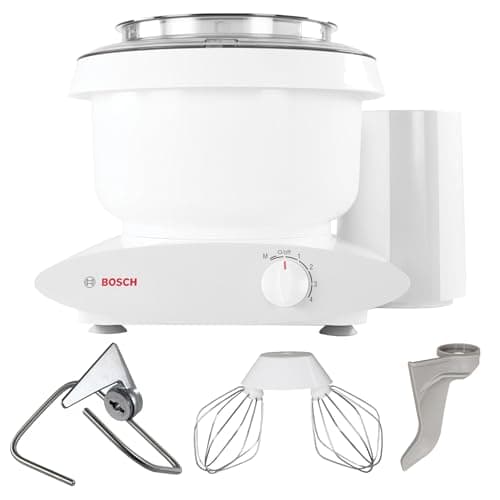
Bosch Universal Plus — our pick for pure dough.This is the bread and pizza baker's mixer. The bottom-drive motor kneads large, stiff batches that most tilt-heads can't finish, the 6.5-quart bowl swallows enough dough for three or four pizzas in one go, and it's light for its capacity and easy to store. Rated at 500 watts, it keeps its speed through a tightening dough where a mid-range planetary mixer would bog. The honest cons: it's not ideal for very small jobs — whipping one egg white gets lost in the big open bowl — the plastic-forward build feels less premium than a cast KitchenAid, and its US accessory ecosystem is smaller. If pizza and bread in volume are the point, none of that matters much; if you want one machine that also whips and creams small amounts elegantly, weigh it carefully. Don't buy the Bosch if you mostly whip cream, beat butter and do single-batch baking — a tilt-head KitchenAid is friendlier for that work.
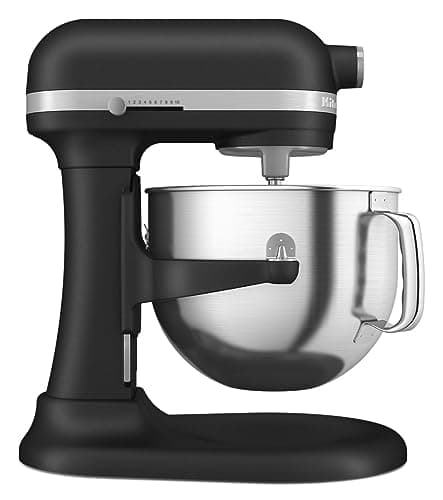
KitchenAid 7-quart bowl-lift — the big-batch KitchenAid answer.The most mixer KitchenAid sells for a home kitchen: a 500-watt motor, an 11-speed bowl-lift frame that stays planted on heavy dough where a tilt-head flexes, and a 7-quart bowl that takes up to roughly 8 pounds of dough or 16 cups of flour at once. It ships with six accessories and plugs into the full PowerHub attachment range, so it grows with you. The honest cons are size, weight and price: it stands about 16.5 inches tall (often too tall to fit under a standard 18-inch wall cabinet), weighs around 28 pounds so it lives out permanently rather than getting tucked away, and comes only with a stainless bowl that can dull over time. Don't buy the 7-quart if you bake single batches on a normal counter — a 5-qt Artisan does that in far less space for far less money.
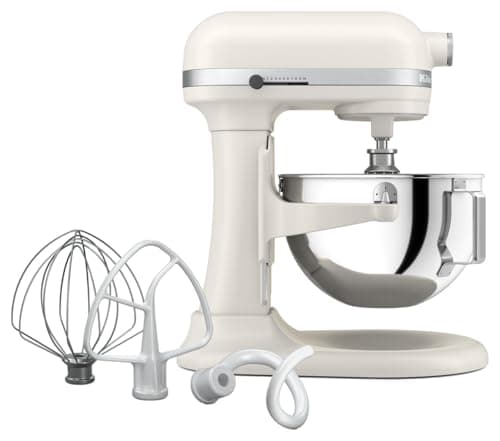
KitchenAid 5.5-quart bowl-lift — more dough without a Bosch.The step up for a baker who has out-grown a 5-quart tilt-head but wants to stay in the KitchenAid world and doesn't want the 7-quart's footprint. Its bowl-lift design plants the head over a bigger 5.5-quart bowl, so it stays steadier on stiff dough than a tilt-head, and it takes the same front-hub attachments as every other KitchenAid. The honest cons: it costs more than the tilt-head Artisan for most bakers' needs, the bowl-lift is a little less convenient for quick bowl and beater swaps, and it's heavier and taller — check your under-cabinet clearance. Don't buy it if you only bake a loaf or two a week — a 5-qt tilt-head Artisan is cheaper, friendlier day to day, and has all the capacity you'll use.
What actually makes a stand mixer good at pizza dough
Pizza dough punishes every weakness a mixer has. It's stiff, it's elastic, and it needs a long, steady knead. Buy for the things that survive that test — drive design, motor headroom and a planted frame — and ignore the marketing numbers that don't.
Why drive design beats wattage
The most useful thing to understand is that the wattage printed on the box tells you very little about how a mixer handles dough. A bottom-drive machine like the Bosch turns the bowl from underneath, so the force is applied low and the dough is pulled down and around rather than fought from above; a bowl-lift KitchenAid keeps its working head fixed and cranks the bowl up to meet it, so nothing hinges or flexes under load. A tilt-head, by contrast, carries the whole motor on a hinge, and that hinge is exactly where a stiff dough makes the machine flex and bounce. Our planetary vs bottom-drive guide walks through why the two approaches feel so different on dough, and what wattage really means for bread explains why the biggest number rarely wins.
Motor headroom is what keeps the knead steady
A pizza dough tightens as the gluten develops, and that rising resistance is where a mid-range motor lugs down, heats up and eventually asks you to stop and let it cool. Headroom — a motor that barely notices the load — is what lets a mixer knead for the full eight or ten minutes at a consistent speed. The Bosch's bottom-drive and both KitchenAid bowl-lifts have that headroom in a way a 275- or 325-watt tilt-head does not, which is the single biggest reason none of our picks here is a tilt-head. If you want to see the machines that fall a step short on this exact job, the tilt-heads in our best-for-bread-dough roundup tell that story.
Hydration: why pizza is harder than most bread
Hydration is the ratio of water to flour, and it decides how hard the mixer has to work. A slack, high-hydration ciabatta or focaccia dough is wet and relatively easy on the motor; a classic pizza dough is deliberately stiff and low in hydration so it can be stretched thin and hold its shape, and that stiffness is exactly what strains a mixer. When you're choosing for pizza, weight the decision toward the stiffest, driest dough you'll make, not an average one. The same logic applies to bagels and stiff enriched doughs, which is why the machines that win here also lead our sourdough and large-batch coverage.
Bowl size: match it to your batch, and don't overfill
Capacity matters twice over for pizza. First, a bigger bowl lets you make dough for several pizzas at once, which is the whole point of a weekend pizza night. Second, and less obviously, overfilling a bowl is one of the fastest ways to strain a motor and make a machine walk, because the hook can't move the dough freely and the load spikes. The Bosch's 6.5 quarts and the 7-quart KitchenAid give you real headroom for multi-pizza batches; the 5.5-quart bowl-lift is plenty for a family's worth. Whatever you buy, size the batch to the bowl rather than cramming it, and if a recipe pushes the limit, split it. If your mixer already dances on the counter under dough, our guide to why a mixer walks covers the fixes.
Knead low and slow — the technique that saves the motor
The best hardware still needs the right technique. Bread and pizza dough should be kneaded on a low speed — the dough hook develops gluten through sustained, gentle folding, not high-speed thrashing, and running the hook fast strains the motor, overheats the machine and makes it walk. Start slow, let the dough come together, and keep it low for the whole knead. Our guide to kneading dough in a stand mixer covers the speeds and timing, and the stand-mixer speeds guide maps which number on the dial belongs to kneading.
Bowl-lift vs bottom-drive: which route to take
Both the KitchenAids and the Bosch avoid the tilt-head's flex, but they get there differently, and that changes the buying decision. A bowl-lift KitchenAid keeps you inside the most mature attachment ecosystem in the category — pasta rollers, grinders and more — and delivers a familiar planetary action with a serviceable, long-lived design. The Bosch trades that ecosystem and a premium feel for the most raw dough capacity per dollar and a machine that's light and easy to store. If you're torn between the two philosophies, our KitchenAid vs Bosch guide works the trade through in detail, and the tilt-head vs bowl-lift guide explains why the lift frame matters so much on stiff dough.
Why we didn't pick a tilt-head — and when one is fine
Being honest: a 5-quart tilt-head KitchenAid will make pizza dough. If you make one or two pizzas on an occasional Friday, a good tilt-head kneads that small, stiff dough without drama, and buying a bowl-lift or a Bosch for it would be overkill. What a tilt-head struggles with is volume and repetition— a big batch, a stiff dough, or making pizza most weeks — because that's when the head flex, the mid-range motor and the walking show up. This roundup is built for the baker who makes pizza seriously and often; if that's not you, the best-for-home-bakers roundup is the more honest starting point.
The 7-quart vs the 5.5-quart: sizing the KitchenAid
If you've decided on a KitchenAid bowl-lift, the choice between the 7-quart and the 5.5-quart comes down to how much pizza you make and how much counter you have. The 7-quart takes the biggest batches but is tall enough to clash with a standard wall cabinet and heavy enough to live out permanently; the 5.5-quart handles a family's worth of dough in a smaller, friendlier footprint. Picture your most ambitious pizza night, not your average one, then size to it — our 5-quart vs 7-quart comparison and the best-for-large-batches roundup both help you size it without overspending.
Read each pick in full before you buy
A roundup is a shortlist, not the last word. Before you commit to a machine that's a real investment, read the individual reviews: the Bosch Universal Plus review for the dough-first pick, the 7-quart bowl-lift review for the big-batch KitchenAid, and the 5.5-quart bowl-lift review for the middle path. Each covers the cons in more depth than a roundup can, so you buy with your eyes open.