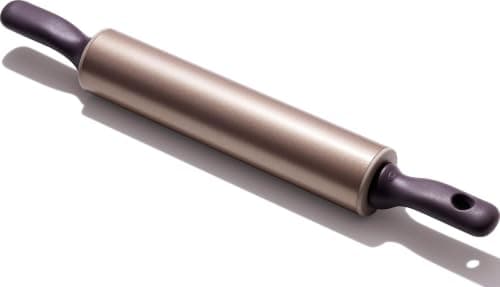
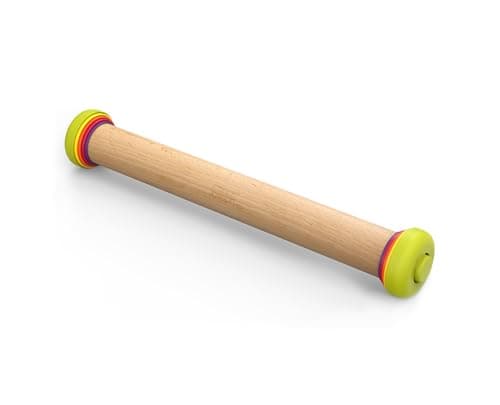
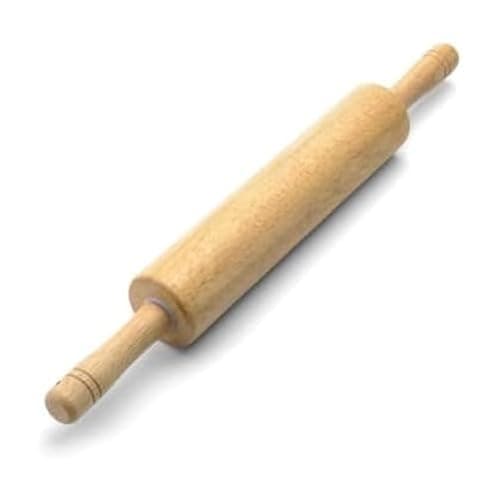
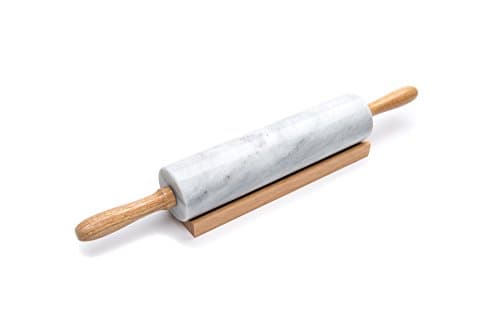
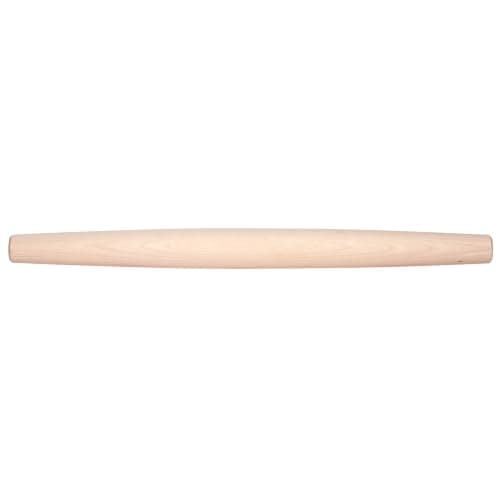
Buy the J.K. Adams French tapered rolling pin. It is a single hardwood dowel — no handles, no axle, no bearings, nothing that can wear out — 20.5 inches long, finished in beeswax, made in Vermont and covered by J.K. Adams' lifetime warranty. The handle-free shape is the whole point: your palms sit on the barrel, so you feel a thick patch while you can still fix it. Take the OXO Good Grips non-stick steel pin instead if butter is your problem — a steel barrel can go in the refrigerator before you roll, which no wood pin can. The Joseph Joseph PrecisionPin fits five pairs of rings that hold the barrel a published 2, 4, 6, 8 or 10 mm off the counter, which is the honest fix for a tray of cookies that bake unevenly. The Farberware Classic is the cheapest real wooden pin here, and the Fox Run marble pin uses weight and cold instead of effort.
The criteria: a rolling pin is judged on four things, and price is not one of them
Every pin on this page costs less than a good sheet pan, so money is not the deciding variable. These four are:
1. Feedback.How much of the dough you can feel through the tool. A handle-free dowel is the direct connection: your hands are on the barrel, pressing the dough, and a thick spot announces itself as resistance under one palm. A handled pin puts an axle between you and the dough — easier to push, but you learn about the uneven patch when you lift the crust and it tears at the thin end.
2. Temperature. Pie, puff and rough-puff pastry all depend on butter staying solid in distinct layers. The moment it smears, you have made a short dough instead of a flaky one. Steel and marble can both be chilled before use and will hold that chill for a few minutes of rolling; wood cannot usefully be chilled and sits at room temperature the whole time. In a warm kitchen this is the single most consequential spec on the page.
3. Repeatability. Whether the pin can put the dough at a known, consistent thickness. Judging 1/8 inch by eye across a whole sheet is harder than it sounds, and the consequence is a tray where the thin cookies burn while the thick ones are still raw. Rings or guides are the only mechanical answer.
4. Barrel width. How wide a sheet the pin can cross in one pass. A 9-inch pie crust needs to be rolled to roughly 12 inches across before it goes in the dish, and a pin narrower than that means working in sections and fighting to keep the sheet an even circle. The pins here run from 10 to 20.5 inches, which is a wider spread than most people realize.
Everything below is sorted by those four. None of the pins wins all of them, which is why there are five.
French, straight, handled, adjustable, marble: what the shapes actually do
The names are used loosely by retailers, so here is what each one means mechanically.
A French tapered pin is one piece of wood, thickest in the middle and narrowing toward both ends. The taper is a steering mechanism: press down on one end and the dough under that end moves faster, which pivots the sheet. That is how you keep a crust round without picking it up and rotating it a dozen times. The J.K. Adams pick is this shape.
A straight dowel pinis the same idea without the taper — a plain cylinder, no handles. It rolls flat sheets beautifully and steers less willingly than a tapered pin. It is the pin most commonly sold as “French” by sellers who do not know the difference, so read the photos rather than the title.
A handled pin(sometimes called an American or baker's pin) is a barrel on a rod, with a grip at each end. The barrel turns and your hands stay still. Some have ball or roller bearings in the handles and some are a fixed rod through a drilled barrel; it makes a real difference to how smoothly the pin runs, and most makers in this price bracket do not publish which they used. The Farberware and OXO picks are both handled.
An adjustable pin is a handled or straight pin with removable discs at each end that hold the barrel a fixed distance off the counter. It cannot roll thinner than the rings allow, which is exactly what you want when the recipe says 1/4 inch. The PrecisionPin is this.
A marble or stone pinis a polished stone barrel with wooden handles. Stone is dense, so the pin's own weight does more of the flattening, and it holds a chill well. It is also brittle and usually short.
Published specifications of the five picks
| Pin | Shape | Barrel / length | Material | Chillable |
|---|
| J.K. Adams French tapered | Tapered dowel, no handles | 20.5 x 1.75 in | North American hardwood | No |
| OXO Good Grips non-stick steel | Handled, raised grips | 12 in barrel (foodservice listing) | Coated steel | Yes |
| Joseph Joseph PrecisionPin | Adjustable, 5 ring pairs | 42 cm (about 16.5 in) | Beech | No |
| Farberware Classic | Handled | 18 in | Hardwood (species not published) | No |
| Fox Run marble with cradle | Handled | 10 in barrel | Polished marble | Yes |
Two gaps worth naming rather than papering over. The OXO pin's dimensions are genuinely unclear: retailer listings for the same model number give a 12-inch barrel, an 18.5-inch length and a 20.9-inch overall length, and OXO's own product page was not reachable for us to settle it. Check the figures on the listing in front of you before you order, because the difference between a 12-inch and a 20-inch pin is the difference between rolling a crust in one pass and rolling it in three. And Farberware publishes no wood species, no barrel diameter and no warranty terms for the Classic pin, which is part of what you accept at that price. Where a figure does not exist we say so rather than borrowing one from a sibling product — see how we pick.
Why the French pin wins, and the case against it
The argument for a handle-free tapered dowel is that pastry is a feel job. The failure mode of a pie crust is not “too thick” or “too thin” — it is uneven, thick in the middle where you started and thin at the edge where you pushed hardest. An even sheet bakes evenly and lifts into the dish without tearing. With your palms directly on the barrel, pressure is something you modulate continuously and asymmetrically: more weight on the left hand to work down a high spot, a rock of the taper to pivot the circle a few degrees. With a handled pin, your hands are at the ends and the barrel is a free-spinning cylinder in between, so you get one pressure for the whole width.
The counter-argument is just as real, and it is the reason this page is not one pin long. No handles means no leverage.On cold, stiff dough — a shortcrust straight from the refrigerator, a dense cookie dough, anything with a lot of butter and very little water — a handled pin lets you put your body weight behind the roll in a way a dowel does not. If your usual complaint is that the dough will not move, the French pin is the wrong answer and the marble pin is the right one.
The second honest caveat is care. Wood is porous and the finish is beeswax, not lacquer: J.K. Adams' care guidance is to hand wash in warm soapy water, never soak or put it in the dishwasher, dry it immediately, and recondition it with mineral oil or a beeswax conditioner whenever it looks dry. If the grain raises, the fix is a light buff with fine sandpaper and another coat of conditioner. That is a two-minute job a few times a year, and it is the price of a tool with a lifetime warranty on it.
The butter problem, and why one pin here is made of steel
Flaky pastry is a stack of butter layers separated by dough layers. In the oven the water in the butter flashes to steam and pushes those dough layers apart; that is a flake. If the butter softens and smears into the flour before it gets to the oven, there are no layers left to separate, and you get a crust that is tender and crumbly rather than flaky. It is not ruined — it is a different pastry than the one you were trying to make.
Rolling is where this goes wrong, because rolling is friction and friction is heat, and your hands are 98°F resting on the tool. A wood pin at room temperature contributes nothing either way. A steel pin out of the refrigerator is an active heat sink, pulling warmth out of the dough for the first few minutes of work, which is usually all the time a crust needs. Marble does the same thing and holds the chill longer because stone is denser, but the Fox Run pin's barrel is only 10 inches wide.
Three habits matter more than the pin, and we would rather say so than oversell a tool: work on the coolest surface you have, work fast and in short sessions, and put the dough back in the refrigerator the moment it starts to feel greasy rather than pushing through. A chillable pin stacks on top of those; it does not replace them.
Even thickness is a mechanical problem with a mechanical answer
The PrecisionPin exists because “roll to 1/4 inch” is an instruction most people cannot follow accurately, and the consequence is visible on every tray of cut-out cookies that comes out with burned edges on some and pale centers on others. Thickness controls bake time; a sheet that varies from 3 to 6 mm is a sheet where the bake time is wrong for half the batch no matter what you set the timer to.
Joseph Joseph publishes five pairs of color-coded rings giving a rolling surface of 2 mm (1/16 in), 4 mm, 6 mm (1/4 in), 8 mm (5/16 in) and 10 mm (3/8 in), and describes the results as approximate rather than exact — which is the right way to describe a pair of discs resting on a countertop. The rings come off and the pin works as a plain beech straight pin. The practical constraints are that you need a clear flat surface the whole width of the pin for the rings to run on, and that ten small parts are ten small parts to lose in a drawer.
This is the pick for cut-out cookies, fondant and anything laminated where the recipe gives a thickness in millimeters. It does almost nothing for pie crust, where the sheet gets lifted into a dish and the thickness stops mattering the moment it does.
How to choose and use a rolling pin
Match the pin to what you bake, not to a star rating
The useful version of this decision is four sentences long. If you mostly make pie and tart pastry, buy the French tapered pin — the feedback is worth more than any other feature on this page. If your kitchen is warm or your butter smears, buy the chillable steel pin. If you mostly roll cut-out cookies, fondant or anything specified in millimeters, buy the adjustable pin. If your complaint is that stiff dough will not budge, buy the marble pin and let the weight do it.
If you bake all of the above a few times a year, the honest answer is the Farberware: it is a competent handled pin for less than the cost of the flour you will put under it, and you can upgrade later when you know which of the four problems is actually yours.
Barrel width, and the number that decides it
Work out the widest sheet you actually roll and buy a barrel at least that wide. A standard 9-inch pie needs a crust rolled to roughly 12 inches across to have enough overhang for the sides and a crimped edge, which the 18- and 20.5-inch pins cross comfortably and the 10-inch marble pin does not. Cookie dough rolled out on a half-sheet-sized area wants the same. The PrecisionPin's published 42 cm overall is about 16.5 inches, with the barrel shorter than that once you account for the ring sections at each end — adequate for cookies, tight for a large crust.
Flour the pin, not just the counter
The pin is where dough sticks, because the pin is the surface that keeps meeting fresh wet dough. Dust it as well as the bench, re-dust it rather than pressing through a sticky patch, and use the minimum that works — every spoonful of bench flour is flour the recipe did not ask for, which makes pastry tougher. A bench scraper is the tool for lifting a sheet that has started to grab, and it is more use here than any amount of extra flour.
The alternative that avoids the problem: roll between two sheets of parchment. The dough touches nothing but paper, you can slide the whole thing onto a tray and refrigerate it mid-roll, and you can peel it back to check thickness. The trade is that you lose the direct feel of the dough under the pin, which is the thing the French pin is for — see our parchment vs silicone mats comparison for which liner suits which job.
Roll from the center out, and turn the dough
Start the pin in the middle of the disc and push away, then come back to the middle and pull toward you. Do not run the pin off the far edge under pressure, which is what makes the rim thin and crumbly while the middle stays thick. Give the dough a quarter turn every few passes — or, with a tapered pin, rock one end to pivot the sheet instead of touching it. Fewer hands on the dough means less warmth going into the butter.
Caring for a wooden pin
Scrape the dried dough off with a bench scraper or a plastic card rather than soaking it. Hand wash with warm soapy water, dry at once, and store it where air can get round it rather than sealed in a drawer with a damp towel. Oil it with food-safe mineral oil (or a beeswax conditioner, which is what J.K. Adams finishes its pins with) when the wood looks pale and dry. Never run a wooden pin through the dishwasher: the heat and the long soak raise the grain, and a raised grain is a pin that sticks for the rest of its life.
Caring for a coated steel pin
Treat the coating the way you treat any nonstick surface, which is to say as a consumable. Wash it by hand even if the listing says dishwasher safe, keep metal scrapers off it, and do not store it loose in a drawer where other tools can gouge it. When the coating eventually goes, the pin becomes a steel pin that sticks — the same end state as the coated bakeware we cover in our uncoated bakeware roundup, and the same reason some bakers skip coatings entirely.
What we did not feature, and why
Silicone rolling pins release well and flex. A pin that flexes under pressure cannot roll a flat sheet, which is the one job it has, and the ones in this price range publish no core material or temperature rating.
Nonstick-coated wood pins. A coating on a porous substrate is the worst of both: you still cannot put it in the dishwasher, and now there is a finish that can wear off into the dough.
Textured and embossing pins (springerle, patterned, lattice) are a different tool for a different job, not a general-purpose pin, and buying one as your only pin is a mistake.
Unbranded “professional” stainless pins are the largest group on Amazon by listing count and are absent on purpose. Several publish no material grade, no dimensions and no warranty while using the word professional in the title. We rank on published specifications, and a claim in a product title is not one.