Skip to content
Plug & Prep

Hub 05 · Guides · Guides & Comparisons

Bosch vs Cuisinart stand mixer

These two mixers cost roughly the same and are built for opposite jobs. One is a dough machine with a bowl you load from the top; the other is a conventional tilt-head that does everything a home baker normally asks.

By Stephen V.Updated How we pick
#ad

We earn a commission when you buy through our Amazon links, at no extra cost to you. It never changes our rankings, and we say so when the cheaper product is the better buy. How this works.

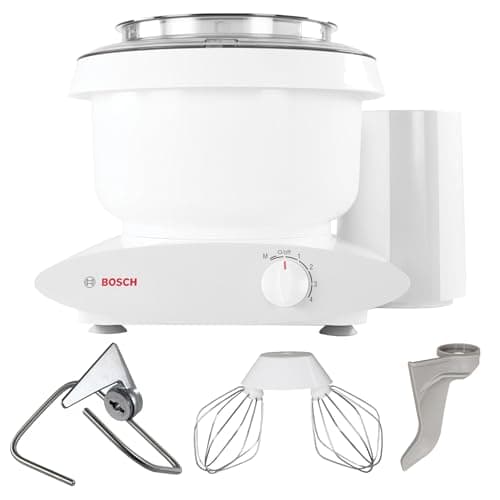
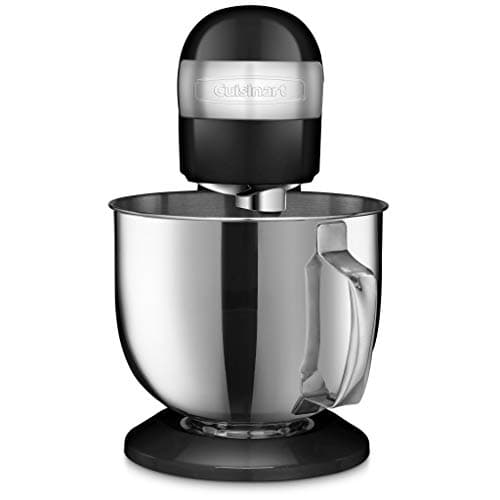
If bread dough is the reason you are buying a mixer, buy the Bosch Universal Plus. It is a bottom-drive machine with a 6.5-quart bowl and a 500 W rated motor, and Bosch rates it for roughly 5 to 6 pounds of dough — three or four loaves in one go. If you bake broadly — cakes, cookies, buttercream, whipped cream, the occasional loaf — buy the Cuisinart Precision Master (SM-50). It is a conventional 5.5-quart tilt-head with 12 speeds and the same 500 W rating, it comes with the dough hook, flat beater and whisk in the box, and it usually costs less than the Bosch. The two are not really rivals: they are different machines that happen to sit at the same price.

The structural difference, which is the whole comparison

A Cuisinart Precision Master is a planetary tilt-head. The motor sits in the head above the bowl, the beater is driven from the top, and the head tilts back so you can get at the bowl. That is the shape almost every home stand mixer takes, KitchenAid included, and it is a good shape: the beater sweeps the bowl in an orbit so one tool reaches the whole mixture, and swapping a whisk for a dough hook takes a second.

A Bosch Universal Plus is a bottom-drive machine. The motor sits underneath, the bowl locks down onto a drive spindle in the base, and the dough hook or whisks are driven from below. Nothing overhangs the bowl, which is why the Bosch looks so unlike a mixer. The consequence is mechanical: the load from a stiff dough goes straight down into the base and the countertop rather than out along a hinged arm. That is why a machine this light handles dough volumes that make a tilt-head's neck flex. Our planetary vs bottom-drive explainer goes through the engineering in more detail.

Published specifications, side by side

Bosch Universal PlusCuisinart Precision Master SM-50
Drive layoutBottom-drivePlanetary tilt-head
Bowl capacity6.5 qt5.5 qt
Rated motor500 W500 W
Speeds412
Dough figure the maker publishes~5-6 lbNo dough weight published
In the boxDough hook + whisksDough hook, flat beater, whisk, splash guard
Attachment ecosystemSmaller in the USThin compared with KitchenAid
Small-quantity workPoor — one egg white is lost in the bowlGood

Every figure above is the manufacturer's published number, cited in Sources, and the wattages are rated input wattage rather than usable torque at the beater. Identical rated watts do not mean identical dough performance, which is exactly why the drive layout matters more than the number on the box — see what wattage stand mixer for bread for why we treat that figure as a weak signal.

Who should buy the Bosch

The Bosch is the right answer for a narrow but very real group: people whose mixer is mostly going to knead. If you bake two, three or four loaves at a sitting, run stiff doughs like bagels or heavy rye, or make pizza dough in batches for a family, the 6.5-quart bowl and the bottom-drive geometry are not marketing — they are the reason the machine exists. It is also light for its capacity, which makes it easier to lift into a cupboard than a cast-metal tilt-head with a comparable bowl.

What you give up is finesse and breadth. Whipping a single egg white or creaming a small amount of butter in a 6.5-quart open bowl is awkward, there are four speeds rather than twelve, and the build is plastic-forward in a way that reads cheaper than it performs. The US accessory range is also narrower than KitchenAid's. If that trade sounds wrong, it probably is wrong for you.

Who should buy the Cuisinart

The Cuisinart is the better all-rounder and the better value. 5.5 quarts is larger than a KitchenAid Artisan's bowl, the 12-speed dial has a genuinely slow first speed for folding, and the box includes the three attachments most people actually use plus a splash guard. For a kitchen that bakes cakes and cookies most weeks and bread occasionally, this is the machine that gets used more.

Its weaknesses are long-term rather than day-to-day: the first-party attachment range is thin next to KitchenAid's, parts support and resale value trail, and the head latch feels less refined than the price-matched competition. Our Cuisinart Precision Master review goes through it in full, and KitchenAid Classic vs Cuisinart Precision Master is the comparison to read if budget is the deciding factor.

The third answer: the KitchenAid Artisan

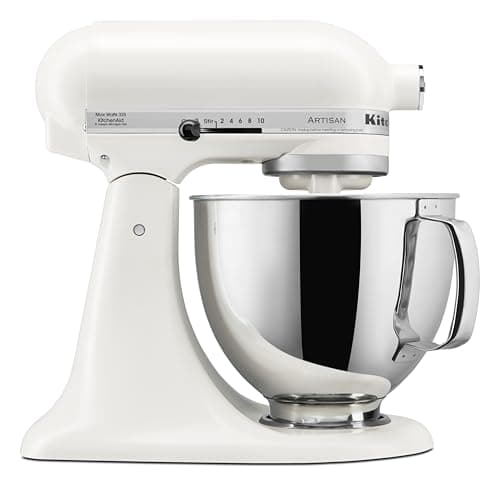
Plenty of people asking this question should buy neither. The KitchenAid Artisan is a 5-quart, 325 W rated tilt-head — smaller bowl and lower rated wattage than both machines above — and it is still the default recommendation for most home bakers because of what surrounds it: the PowerHub attachment ecosystem, the parts availability, and a resale market that means the mixer is worth something in ten years. If you want one machine that will grow with you and you are not kneading several loaves a week, that is the sensible buy. See our best stand mixers roundup for where each sits in the field.

The short answer

Quick picks

#ProductBest forScorePrice
01
Bosch Bosch Universal Plus Stand Mixer
Bosch Universal Plus Stand Mixer

The bread baker's mixer. A belt-driven motor at the base and a big open bowl let it knead far more dough than a KitchenAid without straining. Less elegant, less versatile for whipping small amounts — but for loaves it's the one.

High-volume bread dough
8.5
$499.00Amazon
02
Cuisinart Cuisinart Precision Master 5.5-Qt (SM-50)
Cuisinart Precision Master 5.5-Qt (SM-50)

The value tilt-head. A larger 5.5-qt bowl and a stronger rated motor than the Artisan, usually for less money. The trade is a thinner accessory ecosystem and slightly rougher fit and finish.

Best value tilt-head
8.3
$319.95Amazon
03
KitchenAid KitchenAid Artisan 5-Qt Tilt-Head (KSM150)
KitchenAid Artisan 5-Qt Tilt-Head (KSM150)

The default for a reason: 5-qt tilt-head, a mature attachment ecosystem, and enough motor for a couple of loaves a week. Not the mixer for daily heavy dough — but that's a small slice of home bakers.

Most home bakers
8.4
$489.00Amazon

#ad · Live prices from the Amazon Product API, as of October 17, 2026. Where we have no verified live price we show none — a gap beats a number that has rotted.

In detail

The picks, in full

01
Bosch Bosch Universal Plus Stand Mixer

High-volume bread dough

Bosch Universal Plus Stand Mixer

500 W rated6.5-qt bowlBottom-drive~5–6 lb doughDough hook + whisks
8.5/10

The bread baker's mixer. A belt-driven motor at the base and a big open bowl let it knead far more dough than a KitchenAid without straining. Less elegant, less versatile for whipping small amounts — but for loaves it's the one.

Motor / dough
9.5
Capacity
9.5
Build & durability
8
Ease of use
7.5
Value
8

Pros

  • Bottom-drive motor kneads large, stiff dough batches most tilt-heads can't finish
  • 6.5-qt bowl swallows 3–4 loaves' worth of dough at once
  • Lightweight for its capacity and easy to store

Cons

  • Not ideal for very small jobs — whipping one egg white gets lost in the big bowl
  • Plastic-forward build feels less premium than a cast KitchenAid
  • Smaller accessory ecosystem in the US

Don't buy this if…

…you mostly whip cream, beat butter and do single-batch baking — a tilt-head KitchenAid is friendlier for that work.

$499.00View on Amazon

Price as of October 17, 2026. Prices change — Amazon's at checkout is the one that counts.

#ad · we may earn a commission from this link to Bosch Universal Plus Stand Mixer

02
Cuisinart Cuisinart Precision Master 5.5-Qt (SM-50)

Best value tilt-head

Cuisinart Precision Master 5.5-Qt (SM-50)

500 W rated5.5-qt bowl12 speedsTilt-headSplash guard
8.3/10

The value tilt-head. A larger 5.5-qt bowl and a stronger rated motor than the Artisan, usually for less money. The trade is a thinner accessory ecosystem and slightly rougher fit and finish.

Motor / dough
8
Capacity
8.5
Build & durability
7.5
Ease of use
8.5
Value
9

Pros

  • Bigger bowl and higher rated wattage than the same-price KitchenAid
  • 12 speeds with a genuinely useful low start speed
  • Comes with dough hook, flat beater and whisk in the box

Cons

  • Far fewer first-party attachments than KitchenAid
  • Resale value and long-term parts support trail KitchenAid
  • Head latch feels less refined

Don't buy this if…

…you want to grow into pasta rollers, grinders and the wider attachment world — that's KitchenAid's home turf.

$319.95View on Amazon

Price as of October 17, 2026. Prices change — Amazon's at checkout is the one that counts.

#ad · we may earn a commission from this link to Cuisinart Precision Master 5.5-Qt (SM-50)

03
KitchenAid KitchenAid Artisan 5-Qt Tilt-Head (KSM150)

Most home bakers

KitchenAid Artisan 5-Qt Tilt-Head (KSM150)

325 W rated5-qt bowl10 speedsTilt-headPowerHub port
8.4/10

The default for a reason: 5-qt tilt-head, a mature attachment ecosystem, and enough motor for a couple of loaves a week. Not the mixer for daily heavy dough — but that's a small slice of home bakers.

Motor / dough
8
Capacity
8
Build & durability
8.5
Ease of use
9
Value
8.5

Pros

  • Huge attachment ecosystem (grinder, pasta, ice cream) via the front PowerHub
  • 5-qt bowl handles roughly a double batch of cookie dough or 2 loaves of bread dough
  • Holds resale value and parts availability better than any rival brand

Cons

  • Tilt-head flex shows on very stiff, low-hydration dough
  • 325 W rated motor is mid-pack — it will bog if you knead dense dough daily

Don't buy this if…

…you knead stiff bagel or heavy rye dough every day — a bowl-lift or a Bosch has the motor headroom you'll keep asking for.

$489.00View on Amazon

Price as of October 17, 2026. Prices change — Amazon's at checkout is the one that counts.

#ad · we may earn a commission from this link to KitchenAid Artisan 5-Qt Tilt-Head (KSM150)

How to decide in one question

Ask how many loaves of bread you expect to make at a time, honestly, over the next year. Three or more: Bosch. One, sometimes two, plus a lot of other baking: Cuisinart. One or two, and you want the machine to still be useful in a decade:KitchenAid Artisan. Everything else — colors, wattage claims, bowl material, speed count — is noise next to that.

Three things that look like differences but are not

Rated wattage. Both the Bosch and the Cuisinart are rated 500 W. That tells you about electrical draw, not about how much dough the machine can turn, which is a function of gearing, drive layout and structure. The Bosch kneads more dough than the Cuisinart on an identical rated wattage; that is the point.

Speed count.Twelve speeds sounds like four times the control of the Bosch's four. In practice you use two or three on any given recipe, and what matters is whether the lowest speed is slow enough to fold without flinging flour. The Cuisinart's is; the Bosch is a dough machine and does not really try.

Bowl size. A bigger bowl is only better if you fill it. A 6.5-quart bowl is a liability for small jobs, because a whisk cannot reach a quarter cup of cream spread across that diameter. What size stand mixer do I need works through the capacity arithmetic by batch.

What neither machine does well

Neither is a food processor and neither is a blender. Both will struggle with very small quantities — the Bosch badly, the Cuisinart mildly — and neither should be used to knead past its rated dough capacity, which is the single fastest way to kill a stand mixer of any brand. If your real problem is that you want hands-off bread rather than a mixer at all, a bread machine is cheaper than either: bread machine vs stand mixer lays that out.

If it is specifically Bosch versus KitchenAid you are weighing

That is the more common version of this question and it has its own page. KitchenAid vs Bosch covers the general case, and KitchenAid 7-quart vs Bosch Universal Plus is the head-to-head at the top of the range, where a bowl-lift KitchenAid finally has the structure to compete on dough. Our Bosch Universal Plus review is the full write-up of the machine, and tilt-head vs bowl-lift covers the same structural question inside the KitchenAid line.
How we picked

We don't run a testing lab

We read the manuals, compiled the published specifications, did the wattage-to-dough math and weighed aggregated owner reviews, then scored each product against a published rubric. The scores are judgments from documented research — they are not measurements we took, because we do not have a lab and we're not going to pretend we do. Every spec is the manufacturer's published figure, cited in Sources.

Questions

Frequently asked

Is the Bosch Universal Plus better than a Cuisinart stand mixer?
For bread dough, yes — clearly. The Bosch is a bottom-drive machine with a 6.5-quart bowl that Bosch rates for roughly 5 to 6 pounds of dough, and the load path runs down into the base rather than out along a tilting head. For everything else — cake batter, buttercream, small quantities, fine speed control — the Cuisinart Precision Master is the friendlier machine, and it is usually cheaper.
Do the Bosch and the Cuisinart have the same motor?
Both are rated at 500 W, but that is input wattage, not torque at the beater. Dough capacity comes from gearing and drive layout, which is where the two machines diverge completely: the Bosch drives the bowl from below and the Cuisinart from above. Identical rated watts, different jobs.
Can the Cuisinart Precision Master knead bread dough?
Yes, within reason. It ships with a dough hook and a 5.5-quart bowl, which is enough for a standard loaf or two. What it will not do is a stiff triple batch every week without complaint — that is the Bosch's territory. See the best stand mixers for bread dough for the ranked view.
Why does the Bosch look nothing like a normal stand mixer?
Because the motor is in the base rather than overhead. The bowl locks onto a drive spindle underneath and the tools are driven from below, so nothing overhangs the bowl. It is a deliberate design for dough: there is no hinged head to flex under load. Planetary vs bottom-drive explains the trade-offs.
Which has better attachments?
Neither, really — KitchenAid wins that fight. The Bosch's US accessory range is narrow, and Cuisinart's first-party range is thin next to KitchenAid's PowerHub ecosystem. If growing into pasta rollers, grinders and ice-cream bowls is part of the plan, the Artisan is the mixer to buy.

Keep reading

More in this category

More guides & comparisons

All guides & comparisons →

Receipts

Sources

We don't run a testing lab, and we don't pretend to. Specs are the manufacturer's published figures, cited above; scores are our judgments from that research. Where we couldn't verify something, we say so on the page rather than quietly leaving it out. Read our full method.