A cordless hand mixer solves a problem that is small but genuinely annoying: the cord. Not the power it carries — the physical cord, which drags through the flour on the counter, tugs the mixer off-axis when you lean over a bowl, limits you to the length of the lead from the nearest socket, and means you cannot carry a bowl of cream to the table and finish it there. If you have ever whipped cream one-handed while holding a bowl steady with the other and fighting a cord with your elbow, you already know whether you want one.
What a cordless mixer does not solve is power. This is the honest frame for the whole page: every mixer here trades motor headroom for freedom, and the field is small because the engineering is hard. So rather than pad this list with the dozens of unbranded cordless mixers that flood the search results — no published specifications, no support line, no replacement batteries in two years — we have ranked the four that come from companies that publish a spec sheet and answer the phone, and we are explicit about which reader should close this page and buy a corded mixer instead.
How we picked
Our scores are judgments made from documented research — published manufacturer specifications and aggregated owner reports — not lab measurements. We do not run a lab, and how we pick says so in those words. For cordless mixers, five criteria decided the list.
Run time per charge, because it is the one spec that can ruin a bake. A corded mixer runs until you stop. A cordless one has a budget, and it has to cover the longest continuous job in home baking: a Swiss or Italian meringue, or a batch of royal icing, either of which can want ten to fifteen unbroken minutes at speed. KitchenAid rates the Go at up to 60 minutes of continuous run time, Hamilton Beach rates its cordless at about an hour per charge, and Dash publishes about 37 minutes. All three clear a meringue comfortably; the gap matters if you bake in long sessions and forget to dock the thing.
Charging behavior, which is the real-world version of run time. What happens when you reach for the mixer and it is flat? Hamilton Beach publishes the most useful answer of the three: a 10-minute charge is enough for a batch of cookies. Dash recharges fully in about 2.5 hours on a USB-C stand. Whether the battery is removable also matters more than it sounds — a removable pack means a dead battery is a $40 part rather than a dead mixer, and KitchenAid's 12V MAX pack is shared across its whole Go range.
Low-speed control, and specifically soft start. This is the single biggest quality divider in hand mixers generally, and it does not change just because the cord is gone. A mixer that jumps straight to its selected speed launches dry flour and cocoa out of the bowl; one that ramps up does not. Only one mixer here has a named soft-start feature, and it is a real reason it wins. Hamilton Beach takes the other approach with infinite speed control — a squeeze trigger rather than steps — which gives genuinely fine low-end adjustment at the cost of being tiring to hold steady. Our hand mixer speeds explained guide covers what each speed is actually for.
What is in the box, because cordless mixers quietly ship light. Three of the four mixers here include beaters and no dough hooks. That is not a small omission: it means the mixer cannot attempt even a soft dough, and it is the main reason the cheapest pick on this page is also the most capable in one specific way. Check the accessory list before you buy; our attachments guide explains which ones you will actually use.
Then power, judged against honest expectations. None of these are cookie dough machines. Dash publishes 100 W and 11.1 V for its mixer, which is modest even by corded standards. We scored power against what a cordless mixer is realistically for — cream, egg whites, buttercream, cake and muffin batter — and we say plainly below where the ceiling is. Prices are linked live rather than quoted here, because small appliance discounts move weekly.
The picks, and who each is for
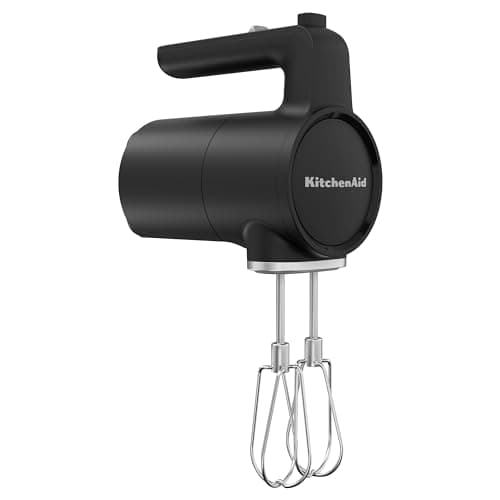
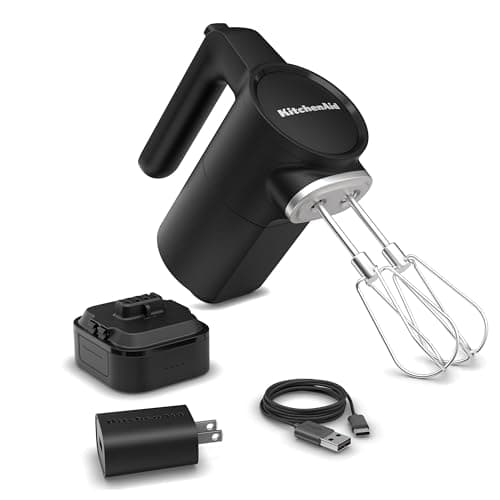
KitchenAid Go (KHMR762, battery included) — the one to buy. This is the only cordless hand mixer that feels like a tool rather than a gadget. Seven speeds plus a genuine Soft Start that brings the beaters up gradually so ingredients stay in the bowl. A removable 12V MAX battery rated for up to 60 minutes of continuous run time, with a USB-C cable and wall adapter in the box. The stainless Turbo Beater II accessories are the same ones KitchenAid ships on its corded mixers and they are dishwasher safe. At roughly 2.6 lb it is substantial but not heavy, and it stands upright on its own, which lifts the beaters out of the bowl and off your worktop — a small design win you notice every time. The honest cons: it ships with beaters only, so there are no dough hooks and stiff cookie dough is out of scope; it costs roughly three times a capable corded mixer that will never need charging; and the battery is a consumable, so eventually you are buying a replacement pack rather than a mixer. If you want one cordless mixer and you whip, cream and mix batter, this is it.
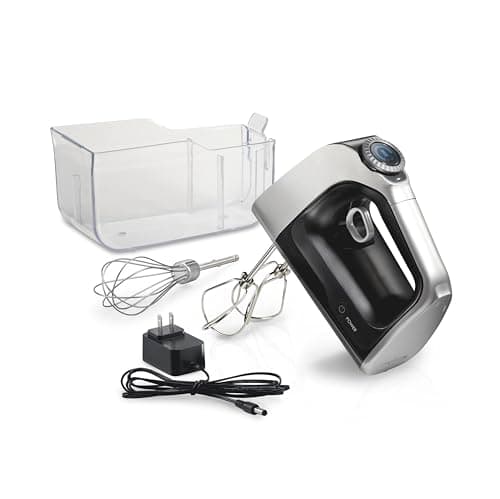
Hamilton Beach Professional Cordless (62673) — the value pick. Meaningfully cheaper than the KitchenAid and from a brand with a real support line. Its distinguishing feature is infinite speed control: instead of stepped speeds you squeeze a trigger further for more power, which gives finer adjustment at the very bottom of the range than a 5- or 7-step dial can. Hamilton Beach rates it at about an hour of mixing per charge and publishes the most practical charging claim on this page — a 10-minute top-up is enough for a batch of cookies, which removes most of the planning anxiety from owning a cordless appliance. Three attachments and a snap-on storage case come in the box, so the accessories stay with the mixer instead of migrating to the back of a drawer. The trade-offs: no dough hooks, same as the KitchenAid; a squeeze trigger is tiring to hold at a constant speed through a long meringue, and harder to return to exactly the same speed twice; and the battery is built in rather than a removable pack, so when it degrades the mixer goes with it.
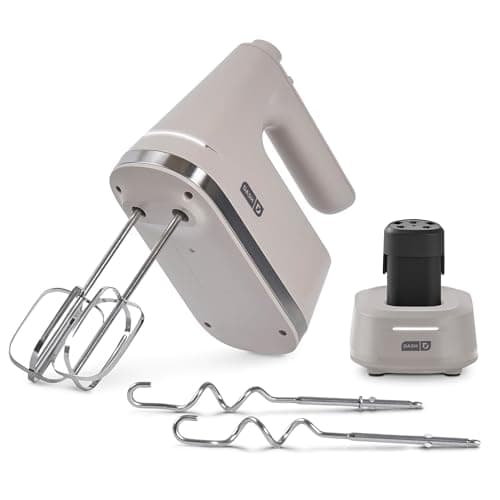
Dash Cordless Hand Mixer — the only one with dough hooks. The cheapest mixer here and, because of one accessory decision, the most capable in a way that matters. It is the only cordless pick that ships with two stainless beaters andtwo dough hooks, which means soft doughs are at least on the table rather than flatly impossible. Four speeds plus a Turbo button for a surge on thicker mixtures, 11.1 V and 100 W, about 37 minutes of run time, and a USB-C charging stand that recharges it in roughly 2.5 hours and gives it a tidy home on the counter. It is also the lightest and easiest to control one-handed. Be clear about the limits, though: 100 W is the least powerful figure on this page and stiff cookie dough will bog it down — dough hooks in the box are not the same as a motor that can drive them through a stiff dough. Run time is roughly 40% below the KitchenAid's rated hour. And four speeds is coarse, with no soft start, so a high-speed start still throws flour. For whipping, frosting and soft doughs at the lowest price here, it is the right call.
KitchenAid Go (KHMR700, battery sold separately) — for existing Go owners. The identical mixer to our winner with the 12V MAX battery left out of the box. Seven speeds, Soft Start, Turbo Beater II accessories, stands upright. If you already own a Go battery from the food chopper, the hand vacuum or one of the bundles, this is simply the cheaper way in, and sharing one pack across the range beats stockpiling chargers. If you do not own a battery, read the cons carefully: it will not turn on out of the box, and the street price gap between this and the battery-included KHMR762 is frequently smaller than a battery costs on its own, which makes this the more expensive route in disguise. Same no-dough-hooks limitation as the rest of the Go hand-mixer line. Check both prices before you add to cart.
Should you buy a cordless hand mixer at all?
We would rather talk you out of this than sell you the wrong tool, so start here. A cordless hand mixer is the right purchase for a specific person and the wrong one for several others.
Buy cordless if the cord is your actual complaint
Cordless is worth the premium if you regularly mix somewhere a cord is awkward: a kitchen island with no nearby socket, a bowl you want to hold and carry, a camper or a dorm, or if reduced grip or mobility makes managing a trailing lead genuinely difficult. It is also worth it if you mostly whip — cream, egg whites, mousse, buttercream — because those are low-load jobs where no cordless mixer is near its limit, and where one-handed freedom is most useful. Our best hand mixers for whipping cream page covers that job across corded and cordless.
Buy corded if you mix anything stiff
If cookie dough is a regular event in your kitchen, buy a corded mixer and stop reading. A corded hand mixer in the same price bracket has more motor, runs indefinitely, costs less, and will not degrade in three years because of a battery. There is no cordless mixer on the market today that we would recommend for stiff dough, and the one on this page that ships with dough hooks publishes 100 W, which is not enough for it. Our how many watts does a hand mixer need guide puts that number in context, and the best hand mixers for cookie doughroundup is the right page for that job. If dough is the whole reason you are shopping, the real answer may be further up the ladder entirely — see stand mixer vs hand mixer.
And be honest about whether you will dock it
A cordless appliance only works if it is charged, which means it needs a home. The mixers here that ship with a charging stand or a snap-on case solve this; the ones charged by a loose USB-C cable rely on you remembering. If you are the kind of cook who finds the hand vacuum flat every time you need it, that is real information about whether this purchase will make you happy. Our how to store a hand mixer guide is written for corded mixers but the counter-space logic is the same.
What to look for in a cordless hand mixer
Soft start matters more than speed count
Seven speeds are not better than four if the spacing is bad, and a mixer with ten speeds that all start with a jolt is worse than one with four that ramp. What you want is a slowest speed that is genuinely slow, and some mechanism — a named soft start, or a progressive trigger — that gets the beaters moving before they are at full tilt. That one feature is the difference between flour in the bowl and flour on your shirt, and it is the main thing separating the picks above.
Removable battery or sealed?
This is the question that decides how long the mixer lasts. Lithium-ion packs lose capacity with cycles; that is chemistry, not a defect. A mixer with a removable pack — the KitchenAid Go system — is repairable: in three years you buy a battery, not an appliance, and the same pack powers other tools in the range. A mixer with a sealed internal battery has a finite life, after which it is landfill. Neither is wrong, but a sealed battery should cost noticeably less, and if two mixers are close in price, the removable pack is the better buy.
Count the accessories before you compare prices
Cordless mixers ship light, and three of the four here include beaters only. If you need dough hooks, a whisk or a storage case, price those in — or pick the model that includes them, because most cordless mixers do not have a healthy aftermarket for attachments the way KitchenAid's corded line does. The stainless beaters on the KitchenAid are dishwasher safe, which is worth a little on its own; cheap coated beaters usually are not.
Weight and balance, since you are holding all of it
A cordless mixer carries its own battery, so it is heavier than the corded equivalent — you have traded a cord for mass. Around 2.5 lb is manageable one-handed for a few minutes and tiring over fifteen. Our KitchenAid Go cordless reviewtakes our winner apart model by model — the battery-included KHMR762 against the body-only KHMR700, and which is actually the cheaper route in. If you have wrist or grip problems, that trade can go either way, so weigh the relief of no cord against the extra weight in your hand rather than assuming cordless is automatically the accessible choice. A mixer that stands upright on its own helps here, because you can let go mid-recipe without finding somewhere to lay a pair of dripping beaters.
What we excluded, and why
Two deliberate omissions. First, we left out the large field of unbranded cordless mixers: they are often cheaper and occasionally fine, but they publish no specifications we can verify, offer no warranty path and no replacement batteries, and this site does not rank products we cannot stand behind. Second, we considered and dropped the Cuisinart EvolutionX cordless hand mixer, which looks like an obvious inclusion on specification — five speeds, a 7.4 V Samsung pack, an LED display. Cuisinart's own site now lists it as discontinued and Amazon stock has fallen to single units, and recommending a product you cannot reliably buy, or get parts for, is not useful. If that changes, we will revisit it.
Where a cordless mixer sits in a baking kitchen
Think of it as a second mixer rather than a first. If you own nothing, a good corded hand mixer is a better first purchase: more power, no battery, less money — start with the best hand mixers overall or, if you are unsure a hand mixer is enough at all, are hand mixers worth it. Cordless earns its place when you already know your jobs are whipping and light batter and your real complaint is the cord. And if you are kitting out a bread-focused kitchen, the money is better spent elsewhere entirely — our best Dutch ovens for bread roundup covers the upgrade that actually changes a loaf, and can a hand mixer knead dough explains why no hand mixer, corded or not, is the answer for bread.