Most home bakers don't need a stand mixer taking up permanent counter space. The everyday jobs — whipping cream to stiff peaks, creaming butter and sugar for a cake, beating a batch of cookie dough, mixing a quick buttercream — all belong to a good hand mixer that lives in a drawer and costs a fraction as much. The trick is buying one that's capable enough that you never think about it, without over-paying for power you'll rarely use. That's what this ranking is for: the all-rounders that do the widest range of real baking well, not the specialists.
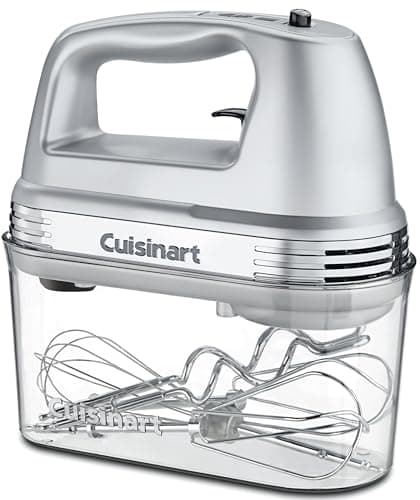
Our pick for most people is the Cuisinart Power Advantage Plus 9-Speed. It gets the balance right: a 220-watt-rated motor with genuine headroom, nine usefully spaced speeds for real control, and — the part that seals it — dough hooks, a whisk and a snap-in storage case in the box, at a price where most rivals hand you two beaters and nothing else. It leads on power and control for the money, which is exactly what "best overall" should mean for a home kitchen. Its one honest weakness is that speed one is a touch quicker than a true soft-start mixer's, so you have to be a little deliberate easing the beaters into a bowl of flour to avoid a cloud. That aside, most home bakers never out-grow it.
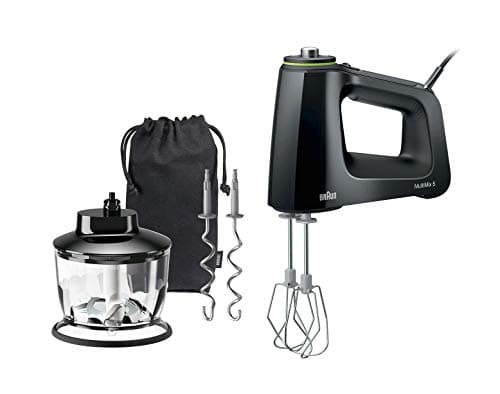
The Braun MultiMix 5 is the smooth, ergonomic step up. It carries the highest rated motor of this group at 350 watts and pairs it with a SmartMix ramp that eases the beaters up to speed instead of snapping them there, so it feels effortless through a stiff cookie dough or a thick batter. If your hand tires on long whipping sessions, or you mix on the heavier end, its comfort and headroom are worth the extra outlay. The honest catch is twofold: Braun lays out its speed selector and eject controls in a European style that takes a bake or two to become second nature, and its beaters are a single-piece design rather than the twin-wire look some bakers prefer. Neither is a dealbreaker, but both are worth knowing before the box arrives.
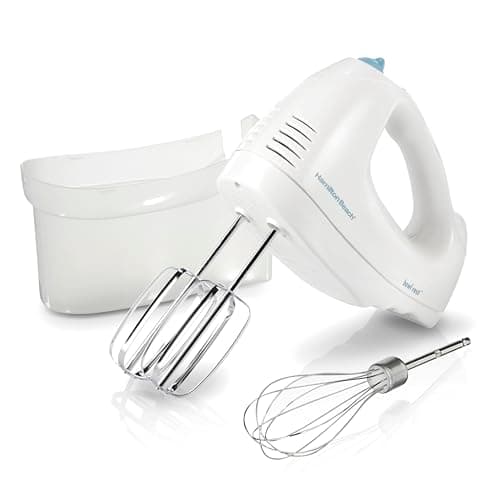
The Hamilton Beach 6-Speedis the reliable budget option — consistently one of the cheapest capable hand mixers you can buy, light in the hand, with a QuickBurst button for a momentary jolt of full power and an included whisk for meringue and whipped cream. For a kitchen that bakes now and then, it does the core jobs without complaint and asks for very little money. Be clear about its limits, though: its six speeds mean coarser steps and less fine control than the nine-speed picks above it, there's no true soft start so you have to start it down in the ingredients, and it ships without dough hooks, so it isn't a bread tool in any form. Within its lane — occasional, lighter baking — it is exactly enough mixer.
One model sits above this trio for a serious baker: the KitchenAid 9-Speed Digital (KHM926). Its genuine Soft Start is the smoothest in the category, its nine speeds are beautifully spaced, and it has the torque to handle stiff dough that makes cheaper mixers stall. We'd recommend it outright except for two things: it's frequently out of stock, and its dough hooks and whisk are sold separately rather than included, so the real cost runs higher than the sticker. If you can find it in stock and you bake often, read our full KitchenAid 9-Speed review— it is the premium pick. If you can't, the Cuisinart covers the same everyday ground for less, which is a big part of why it tops this list.
A quick word on how to read this ranking: it's ordered for the broadest set of home bakers, not for any single specialty. If your baking skews hard toward one job — stiff cookie dough by the double batch, delicate frosting, whipping cream by the quart — a specialist pick can edge out our overall order, and our best hand mixers for frostingguide and the rest of our category pages cover those cases. But for the person who wants to buy one hand mixer, use it for everything, and never think about it again, this is the order we'd shop in: the complete-in-the-box Cuisinart first, the smoother and stronger Braun if the budget and your hands want it, and the honest-value Hamilton Beach if you're spending as little as sensibly possible. None of them is a wrong answer; they're three points on the same short line between price and polish.
Whichever you choose, the honest boundary is the same for all of them. A hand mixer is the right tool for whipping, creaming, batter, frosting and cookie dough — and the wrong tool for kneading bread week in and week out. If bread is a regular event in your kitchen, spend the money on a stand mixer instead and keep a hand mixer for the light work; our look at whether a hand mixer can knead dough is straight about exactly where that line falls.
How to choose the best all-round hand mixer
A hand mixer is the appliance where spending more buys the least, so the goal is to pay for the few things that genuinely change daily use and skip the rest. A handful of things separate a mixer you never think about from one that quietly annoys you every bake.
Match the motor to the heaviest thing you actually mix
For whipped cream, cake batter and frosting, wattage is almost irrelevant — any competent hand mixer handles them without breaking a sweat. The rated motor only starts to matter on stiff, loaded jobs like a full batch of chocolate-chip cookie dough, where a stronger motor holds its speed instead of bogging down and warming in your hand. So buy for the hardest job you do regularly, not the average one. If your baking never gets heavier than batter, the value Cuisinart or the budget Hamilton Beach is plenty; if you mix stiff dough often, the Braun's 350-watt rating gives it the headroom to power through with the least strain. Treat the wattage figure as a rough proxy rather than a precise ranking — our guide to hand-mixer wattage explains why the number only tells part of the story.
Soft start and speed spacing matter more than the speed count
A high speed number sells mixers, but what actually improves everyday use is how gently the mixer starts and how well its speeds are spaced. A mixer that jumps straight to full speed fires flour and powdered sugar across the counter the instant you press the button — every experienced baker has that story. A gradual ramp removes it entirely: the KitchenAid's Soft Start is the benchmark, and the Braun's SmartMix ramp is close behind. Well-spaced speeds also give you a genuinely slow setting for folding and a controlled top end for whipping, rather than a cluster of near-identical fast settings. This is where the nine-speed Cuisinart and Braun pull ahead of the six-speed Hamilton Beach: not in the headline number, but in the useful gaps between the settings.
Count what's actually in the box
Two hand mixers at the same price aren't the same value if one includes a whisk and dough hooks and the other gives you bare beaters. The Cuisinart bundles dough hooks, a whisk and a storage case; the Braun adds a chopper attachment and a whisk; the Hamilton Beach includes a whisk and snap-on storage. If you know you'll want a whisk for meringue and whipped cream, or hooks for the occasional soft dough, factor those into the comparison — buying them separately for a bare mixer can erase the price gap entirely. This is a big reason the Cuisinart tops the ranking: it arrives complete.
Know where a hand mixer stops being enough
A hand mixer is the right tool for whipping, creaming, batter, frosting and cookie dough. It is not a stand-mixer replacement once you're kneading bread dough regularly — the motors here simply aren't geared for sustained, heavy kneading, and pushing one to do it just cooks the motor. If that's the question on your mind, our honest look at whether a hand mixer can knead dough and our stand mixer vs hand mixer comparison both walk through when it makes sense to step up. For everything short of a kneaded loaf, though, a good all-round hand mixer is the smarter, cheaper, drawer-friendly tool.
Weight and comfort matter on the long jobs
Spec sheets rarely mention it, but how a mixer feels in your hand decides whether a ten-minute buttercream or a big bowl of whipped cream is pleasant or a chore. Lighter mixers like the Hamilton Beach are easy to hold aloft through a long session; the more powerful models trade a little weight for their headroom, and you feel it after a few minutes. A swivel cord that stays out of the bowl, a grip that suits your hand, and a bowl-rest heel that lets you park the mixer mid-recipe all add up over a bake. If you have any wrist trouble, favor the lightest capable option and let the mixer's speed — not your arm — do the work. It's the kind of detail that never shows up in a side-by-side spec table but shapes how often you actually reach for the thing.