Skip to content
Plug & Prep

Hub 05 · Guides · Guides & Comparisons

Combo cooker vs Dutch oven for bread

Both bake the same loaf. The difference is how you get a proofed, sticky round of dough into a 450°F vessel without flattening it or burning your forearm.

By Stephen V.Updated How we pick
#ad

We earn a commission when you buy through our Amazon links, at no extra cost to you. It never changes our rankings, and we say so when the cheaper product is the better buy. How this works.

For bread specifically, the Lodge Cast Iron Combo Cooker is the better buy — and it is usually the cheaper one. Both vessels trap the dough's own steam, which is the entire mechanism behind a crackling home-oven crust, and a loaf baked in either comes out effectively the same. What differs is the loading step: with a combo cooker you set the proofed round onto a flat, shallow skillet at counter height and lower the deep pot over it as a lid. With a conventional Dutch oven you drop the dough into a deep, screaming-hot well and hope it lands centered. Buy the 6-quart enameled Lodge Dutch oven instead if the pot also has to braise, roast and go in the dishwasher-adjacent category of low-maintenance cookware— enamel needs no seasoning, and Lodge publishes a 500°F ceiling for it.

Why any lidded pot bakes better bread than a bare oven

A home oven cannot do what a bakery deck oven does: inject steam. Steam keeps the surface of the loaf pliable for the first part of the bake, so the dough can expand — oven spring — before the crust sets. Without it the crust hardens early and the loaf stays squat and pale.

A heavy lidded vessel solves this by accident of physics. The dough is roughly 75 percent water; sealed under a tight lid in a preheated pot, the water it gives off has nowhere to go, so the loaf bakes in a saturated pocket of its own steam. Take the lid off for the last stretch and the crust dries, browns and crackles. That is the mechanism, and it is identical in a combo cooker, an enameled Dutch oven, a bare cast-iron pot or a purpose-built bread pan. Our best Dutch ovens for bread roundup ranks the field; this page is about the two shapes.

The loading problem, which is the real difference

A conventional Dutch oven is a deep pot with a separate lid. To bake in it you preheat it empty to 450°F or above, take it out, remove the lid, and transfer a slack, sticky, fully proofed round of dough down into a vessel whose walls are hot enough to scorch skin on contact. People manage it — a parchment sling helps enormously — but the dough often lands off-center or deflates on the way, and a forearm against the rim is a genuine burn.

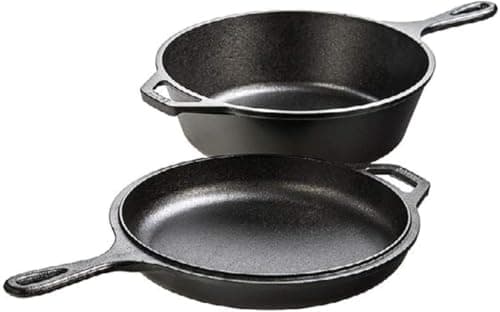
The Lodge Combo Cooker inverts the problem. It is a 3.2-quart deep pot plus a 10.25-inch shallow skillet, and either piece works as a lid for the other. For bread you use the skillet as the base: it is flat, shallow and open, so you tip the proofed loaf onto it the way you would onto a baking sheet, score it in the open, then lower the deep pot over the top as a dome. Nothing is lowered blind, nothing reaches down into a well, and the loaf keeps the shape you gave it.

Published specifications

Lodge Combo CookerLodge 6-qt EnameledChallenger Bread Pan
Shape of the baking surfaceFlat 10.25 in skilletDeep round wellFlat 15.5 x 10.5 in
Capacity3.2 qt pot6 qt15.5 x 10.5 x 5.5 in interior
SurfaceBare seasoned cast ironEnamel — no seasoningPre-seasoned bare cast iron
Published temperature guidanceBare iron — no enamel ceiling500°F500°F
Weight12.85 lbHeavy, no published figure20 lb
Loaf shapes it takesOne modest bouleBoule up to roughly 1 kgBoule, batard, baguettes, focaccia
Also useful forSearing, cornbread, braisingBraises, soup, stewBread only
CareHand wash, dry, oilWash normallyHand wash, dry, oil

Those are the manufacturers' published figures, cited in Sources, not measurements we took. Note the one spec that is easy to miss: the combo cooker is barecast iron, so it is not bounded by an enamel temperature rating the way the enameled pot is — which matters if your recipe preheats past 500°F.

Where the combo cooker gives something up

Three things. Capacity: at 3.2 quarts the deep pot is small, and a 1 kg loaf will touch the sides. If you bake big rounds, this is the wrong vessel and the 6-quart enameled pot is the right one. Maintenance: bare cast iron is a seasoned surface, and Lodge's own instruction is to hand wash, dry and oil it every time. Leave it wet and it rusts. Flavor carryover: if you also sear steak and braise in it, a bare seasoned surface will take on and give back strong flavors in a way enamel does not.

Those are real costs, and they are why plenty of weekly bakers own the enameled pot instead and simply use a parchment sling. Enameled vs bare cast iron for bread is the deeper version of that trade-off, and what size Dutch oven for bread covers why a pot that is too big gives you a flatter loaf.

And the third option, if bread is a weekly habit

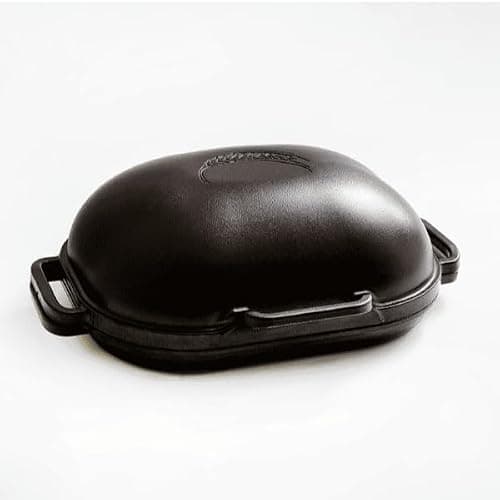
The Challenger Bread Pan solves the loading problem the same way the combo cooker does — flat base, lid that lifts away — but on a 15.5 by 10.5-inch rectangular footprint, so it takes a batard, baguettes or focaccia that no round pot will accept. It costs several times either Lodge and weighs 20 pounds. If you bake once a month, it is an indulgence. If you bake weekly and shape anything other than rounds, it is the one genuine upgrade here, and our Challenger Bread Pan review covers it properly.

The short answer

Quick picks

#ProductBest forScorePrice
01
Lodge Lodge Cast Iron Combo Cooker, 3.2 Quart
Lodge Cast Iron Combo Cooker, 3.2 Quart

The bread baker's cult pick, and for a real reason: the shallow skillet becomes the base and the deep pot inverts over it as a lid, so you load a proofed round onto a flat surface at counter height instead of dropping it blind into a deep, 450°F well. Bare cast iron, so there is no enamel to chip.

Loading dough without burning your knuckles
8.8
$59.90Amazon
02
Lodge Lodge Essential Enamel Cast Iron Dutch Oven, 6 Quart
Lodge Essential Enamel Cast Iron Dutch Oven, 6 Quart

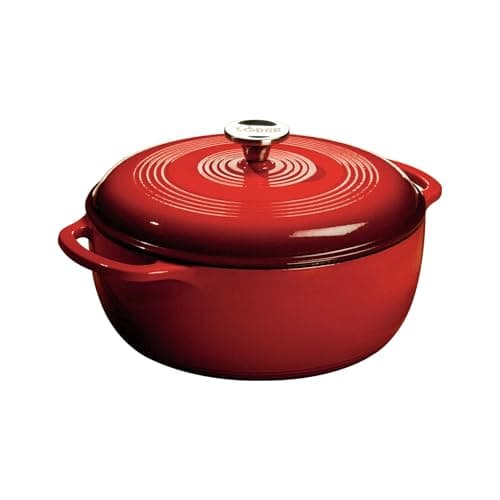
The sweet spot for bread. Six quarts is the volume a standard 500 g boule wants, the published 500°F ceiling clears the temperature most no-knead recipes ask for, and the enamel means you skip seasoning entirely. It costs a fraction of a French-made pot and bakes a functionally identical loaf.

Most sourdough and no-knead bakers
8.8
$89.90Amazon
03
Challenger Breadware Challenger Bread Pan
Challenger Bread Pan

The only vessel here designed for bread and nothing else. The 15.5 x 10.5-inch interior is rectangular, so a batard fits lengthwise instead of being coiled into a round, and the 11.3-lb lid lifts off sideways — you are never reaching down into a hot well. If you bake bread weekly and shape batards, it is the one real upgrade on this page.

Weekly bakers who shape batards and baguettes
8.3
$299.00Amazon

#ad · Live prices from the Amazon Product API, as of October 17, 2026. Where we have no verified live price we show none — a gap beats a number that has rotted.

In detail

The picks, in full

01
Lodge Lodge Cast Iron Combo Cooker, 3.2 Quart

Loading dough without burning your knuckles

Lodge Cast Iron Combo Cooker, 3.2 Quart

3.2-qt deep pot10.25 in skillet lidBare seasoned cast ironMade in USA12.85 lb
8.8/10

The bread baker's cult pick, and for a real reason: the shallow skillet becomes the base and the deep pot inverts over it as a lid, so you load a proofed round onto a flat surface at counter height instead of dropping it blind into a deep, 450°F well. Bare cast iron, so there is no enamel to chip.

Crust & steam
9
Build quality
9
Ease of use
9
Versatility
8
Value
9

Pros

  • Load the loaf onto the flat skillet, then cap it — far safer and more accurate than lowering dough into a deep pot
  • No enamel means nothing that can chip, and bare cast iron is not limited by an enamel temperature rating
  • Two pans in one: the skillet sears and bakes cornbread, the pot handles braises and soup

Cons

  • Needs seasoning maintenance — Lodge's own instruction is hand wash, dry, oil, every time
  • 3.2 qt suits one modest boule; a big 1 kg loaf will touch the sides
  • Bare cast iron will take on and give back strong flavors if you also braise in it

Don't buy this if…

…you want a zero-maintenance pot you can leave wet in the sink — this one rusts if you do, and enamel is the answer instead.

$59.90View on Amazon

Price as of October 17, 2026. Prices change — Amazon's at checkout is the one that counts.

#ad · we may earn a commission from this link to Lodge Cast Iron Combo Cooker, 3.2 Quart

02
Lodge Lodge Essential Enamel Cast Iron Dutch Oven, 6 Quart

Most sourdough and no-knead bakers

Lodge Essential Enamel Cast Iron Dutch Oven, 6 Quart

6-qt capacityEnameled cast iron500°F oven-safeStainless knobInduction ready
8.8/10

The sweet spot for bread. Six quarts is the volume a standard 500 g boule wants, the published 500°F ceiling clears the temperature most no-knead recipes ask for, and the enamel means you skip seasoning entirely. It costs a fraction of a French-made pot and bakes a functionally identical loaf.

Crust & steam
9
Build quality
8.5
Ease of use
8.5
Versatility
9
Value
9

Pros

  • 6-qt round shape gives a standard boule room to spring without spreading into a pancake
  • Published 500°F ceiling covers the preheat most no-knead and sourdough recipes specify
  • Enamel needs no seasoning and will not take on a garlic-and-stew flavor from other cooking

Cons

  • Enamel chips if you knock it or drop a lid on the rim, and a chipped interior cannot be repaired
  • No silicone grip — the loop handles get screaming hot and need two dry mitts
  • Heavier than it looks; lowering it into a low oven is awkward if you have weak wrists

Don't buy this if…

…your recipe preheats the vessel past 500°F — bare cast iron, not enamel, is the tool for a 550°F bake.

$89.90View on Amazon

Price as of October 17, 2026. Prices change — Amazon's at checkout is the one that counts.

#ad · we may earn a commission from this link to Lodge Essential Enamel Cast Iron Dutch Oven, 6 Quart

03
Challenger Breadware Challenger Bread Pan

Weekly bakers who shape batards and baguettes

Challenger Bread Pan

15.5 x 10.5 x 5.5 in interiorCast iron, 20 lb totalPre-seasoned500°F guidanceFlat base, lift-off lid
8.3/10

The only vessel here designed for bread and nothing else. The 15.5 x 10.5-inch interior is rectangular, so a batard fits lengthwise instead of being coiled into a round, and the 11.3-lb lid lifts off sideways — you are never reaching down into a hot well. If you bake bread weekly and shape batards, it is the one real upgrade on this page.

Crust & steam
9.5
Build quality
9.5
Ease of use
9
Versatility
7
Value
6.5

Pros

  • Rectangular 15.5 x 10.5-inch interior fits a batard, baguettes or focaccia that no round pot will take
  • Flat, open base loads at counter height with a lid that lifts away rather than a well you reach into
  • The 11.3-lb lid forms a tight seal, which is what traps steam for a blistered, well-scored crust

Cons

  • Costs several times any other pick here, and only pays off if bread is a weekly habit
  • 20 lb in total — heavy to lift, heavy to store, and it monopolizes a cupboard shelf
  • Pre-seasoned bare cast iron, so it needs the same hand-wash-and-oil routine as the Lodge combo

Don't buy this if…

…you bake a loaf a month or shape only rounds — a 6-qt enameled pot does that job for a fraction of the money.

$299.00View on Amazon

Price as of October 17, 2026. Prices change — Amazon's at checkout is the one that counts.

#ad · we may earn a commission from this link to Challenger Bread Pan

How to bake a loaf in a combo cooker, step by step

  1. Preheat both pieces togetherin the oven at your recipe's temperature — typically 450 to 475°F — for at least 30 minutes. The thermal mass is the point; a pot that is merely warm will not give you oven spring.
  2. Take the skillet out and set it on a trivet. Turn the proofed loaf out onto it, seam-side down, straight from the banneton. Because the surface is flat and open, you can see exactly where the loaf is landing.
  3. Score it in the open. This is the step a deep pot makes genuinely awkward, and it is where the combo cooker earns its reputation — see how to score sourdough bread.
  4. Invert the deep pot over the top as a dome and return the whole thing to the oven. Bake covered for roughly 20 minutes, then lift the dome off and bake another 20 to 25 minutes to color the crust.
  5. Cool on a rack, not in the pan. A loaf left in a hot vessel steams its own crust soft; see how to use a cooling rack.

If you buy the Dutch oven instead, use a parchment sling

Most of the combo cooker's advantage can be bought back for the price of a sheet of parchment. Proof the loaf on a parchment round with two long edges left as handles, and when the pot comes out of the oven you lift the loaf by the parchment and lower it in. It keeps your hands clear of the rim and lands the loaf centered. The paper stays in through the covered phase and comes out with the loaf.

That trick is the reason the 6-quart enameled Lodge remains our overall pick for most bakers: it is a better pot in general, it needs no seasoning routine, and a 20-cent piece of parchment cancels most of its only real bread-specific weakness.

Which one belongs in your kitchen

Buy the combo cooker if bread is the reason you are shopping, your loaves are modest in size, and you do not mind a seasoning routine. You also get a 10.25-inch skillet out of it, which is a useful pan in its own right.

Buy the 6-quart enameled Dutch oven if you want one pot that bakes bread well and also handles the braises, stews and soups the rest of the week, or if the idea of oiling a pan after every wash is a deal-breaker. It is the more generally useful object.

Buy the Challenger only if you bake weekly and shape batards. Otherwise its money is better spent on flour, a scale and a proofing basket.

What none of them fixes

A vessel cannot rescue an under-proofed or under-developed dough. If your loaves are dense or gummy, the problem is upstream of the pot — fermentation time, hydration, flour protein or shaping. How to proof bread dough covers the stage that actually decides how your loaf turns out, and bread flour vs all-purpose flour covers the ingredient that decides how much structure you have to work with.
How we picked

We don't run a testing lab

We read the manuals, compiled the published specifications, did the wattage-to-dough math and weighed aggregated owner reviews, then scored each product against a published rubric. The scores are judgments from documented research — they are not measurements we took, because we do not have a lab and we're not going to pretend we do. Every spec is the manufacturer's published figure, cited in Sources.

Questions

Frequently asked

Is a combo cooker better than a Dutch oven for sourdough?
For the act of baking, they are equivalent — both trap the loaf's own steam, which is what produces oven spring and a crackling crust. The combo cooker is better at the part people actually struggle with: you load the loaf onto a flat 10.25-inch skillet at counter height and cap it with the inverted pot, rather than lowering dough into a deep 450°F well. Its limits are capacity (3.2 qt) and the seasoning routine that bare cast iron needs.
What size loaf fits in a Lodge Combo Cooker?
One modest boule. Lodge publishes 3.2 quarts for the deep pot and 10.25 inches for the skillet, which comfortably takes a 500 g loaf. A big 1 kg round will spread to the walls, and at that size the 6-quart enameled pot is the better vessel.
Can you bake bread in an enameled Dutch oven, or does it need to be bare cast iron?
Enamel is fine and it is what most home bakers use. The one thing to check is the published temperature ceiling: Lodge rates its Essential Enamel line to 500°F, which covers nearly every no-knead and sourdough recipe. If a recipe asks you to preheat past that, bare cast iron has no such limit. Enameled vs bare cast iron goes further.
Do I need to preheat the pot?
Yes, and it is not optional. The crust and the oven spring both come from the dough hitting a vessel that is already at full temperature. Thirty minutes at the baking temperature is the usual guidance; a pot that has only been in for ten minutes is warm, not hot, and the loaf will be noticeably flatter.
Is the Challenger Bread Pan worth the money over a combo cooker?
Only if you bake often and shape more than rounds. Its 15.5 by 10.5-inch rectangular interior takes a batard, baguettes or focaccia that no round pot will fit, and the lid lifts off sideways rather than making you reach into a well. For a monthly boule, a combo cooker does the same job for a fraction of the money. See the full review.

Keep reading

More in this category

More guides & comparisons

All guides & comparisons →

Receipts

Sources

We don't run a testing lab, and we don't pretend to. Specs are the manufacturer's published figures, cited above; scores are our judgments from that research. Where we couldn't verify something, we say so on the page rather than quietly leaving it out. Read our full method.