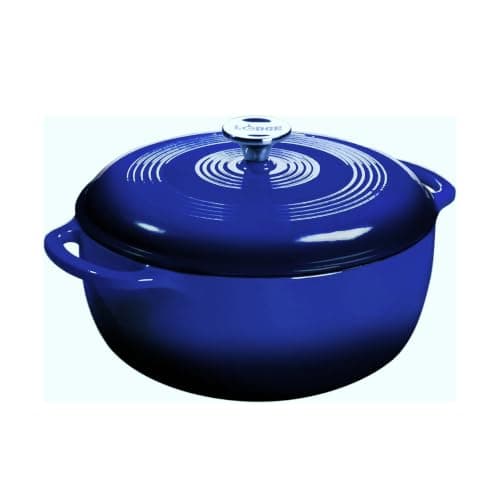
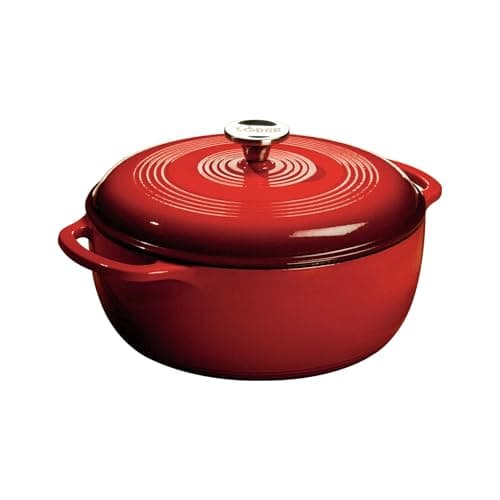
The Lodge Essential Enamel 6-quart is the Dutch oven we recommend to most bread bakers, and the reason is unglamorous: it does the one thing a bread vessel has to do as well as pots costing four or five times as much. It publishes a 500°F oven-safe ceiling, which clears the preheat almost every no-knead and sourdough recipe specifies. It has a stainless knob rather than a phenolic one, so there is no plastic part to unscrew before a hot bake. Six quarts is the size a standard boule actually wants. If you bake 900 g to 1 kg loaves, buy the 7.5-quartversion instead — same pot, same ceiling, another quart and a half of headroom.
This is a review rather than a recommendation to spend, so the frame matters: we are not arguing the Lodge is a better-made object than a French pot. It is not. The enamel is less finely finished, the handles are less well balanced for the weight, and it does not carry a limited lifetime warranty or a dishwasher-safe rating. We are arguing that none of those differences reach the loaf, which makes the Lodge the rational purchase for someone buying a pot to bake bread in.
What it is, specifically
Enameled cast iron, round, with a glass-fused interior and exterior and a stainless steel knob on the lid. Published oven-safe to 500°F. Induction ready, so it works on every hob type. Two loop handles, cast as part of the body. Available in 6 quarts and 7.5 quarts, which are the two sizes relevant to bread, and in a range of exterior colours that do not change the specification.
Enamel means there is no seasoning routine. You wash it, dry it and put it away, and it will not carry a flavour from a braise into a loaf — which is the practical advantage people under-weight when comparing it against bare cast iron. If the same pot is going to cook on weeknights and bake at weekends, that is a real reason to want enamel, and we lay out the full trade in enameled vs bare cast iron for bread.
How it performs as a bread vessel
A covered cast iron pot does two things for a loaf, and the Lodge does both. It traps the dough's own moisture for the first half of the bake, so the crust stays soft long enough for the loaf to spring instead of setting early. And the mass of preheated iron dumps heat into the base of the loaf in the first few minutes, which is what gives oven spring and an open crumb. King Arthur Baking's guidance on Dutch oven baking, cited below, describes this mechanism, and nothing in it is brand-specific.
Our scores for this pot are judgments from its published specifications and aggregated owner reports, not measurements — we do not run a lab and how we picksays so in those words. What we can state as fact is the comparison that matters: the 500°F published ceiling is the same figure Le Creuset publishes for the Signature, and a loaf baked covered in either is a loaf most bakers could not separate blind. If you want that argument in full, read Lodge vs Le Creuset.
Which size to buy
6 quarts — for the standard 500 g boule. This is the one to buy if you buy one. Six quarts puts the walls close enough that slack dough braces and climbs, with headroom for a confident spring. The majority of no-knead and sourdough recipes land in this band.
7.5 quarts — for 1 kg loaves, or double duty.Comfortably takes a big loaf without the dough touching the walls, and big enough to be the household's main braising pot, so it earns its shelf space twice. Do not buy it as insurance: a small boule in a pot this wide spreads sideways rather than springing upward, which costs you height you cannot recover. It is also noticeably heavier and takes longer to come up to temperature, so preheats stretch out. Our what size Dutch oven for bread guide walks the whole sizing question by dough weight.
The three cons, stated plainly
The enamel chips, and a chip cannot be repaired.Knock the rim, drop the lid on it, or stack something heavy on it and you can take a piece out of the interior. There is no fix for that, and unlike the premium pots there is no limited lifetime warranty behind it. This is the pot's real failure mode — not wear, impact — and careful handling extends its life far more than anything else you can do.
The handles get screaming hot and have no silicone grip.Two dry mitts, every time. A damp mitt on 450°F iron turns to steam against your hand, which is a genuine burn risk rather than a comfort complaint.
It is heavier than it looks.Lowering a loaded pot into a bottom-rack oven at arm's length is a wrist job, and it gets worse at 7.5 quarts. If that is a concern, the Lodge Combo Cooker is the lightest route to a covered bake and loads at counter height rather than down a hot well — see the best Dutch ovens for bread.
And the hard limit:if your recipe preheats the vessel past 500°F, this is not your pot. Bare cast iron, which has no enamel to blister, is the tool for a hotter bake, and we are not going to tell you to run a pot past its published rating.
Who should buy this pot
Buy it if this is your first Dutch oven
It is the right first pot for almost everyone: the correct size for a standard loaf, a ceiling that covers the recipes you will actually bake, and no seasoning routine to learn while you are also learning to shape dough. Spending four times as much on a first pot buys finish and a warranty, not better bread, and the money is better deployed on the two things that genuinely fix loaves — a scale and a thermometer.
Buy it if the pot will also cook
Enamel carries no flavours, so a pot that braises on Wednesday is a clean pot on Saturday. It is also fine with acidic ingredients in a way that bare iron is not. For a one-pot household, enamel is the correct material and this is the sensibly priced version of it.
Do not buy it if you preheat above 500°F
Covered above, and it is the one case where this is not a preference. Some artisan formulas specify 550°F; enamel is the wrong tool for those and bare cast iron is the right one.
Do not buy it if you shape batards
A round pot makes round loaves. If you shape oval loaves or baguettes, no amount of capacity helps — you want a rectangular vessel, and the Challenger Bread Pan is the purpose-built answer at several times the price.
Do not buy it if lifting it worries you
Be honest about this one rather than optimistic. If a loaded cast iron pot at arm's length into a low oven is beyond what your wrists want to do, the Combo Cooker loads at counter height and weighs less, and a loaf pan is lighter still — see the best loaf pans.
Living with it
Preheating
Most recipes have you preheat the empty covered pot with the oven, which is what produces the strongest oven spring. It is also what makes loading dangerous. Use parchment as a sling: lay the proofed loaf on a square of parchment, lift it by the corners, and lower it in without your hands going near the rim. This single habit removes most of the risk and costs nothing.
Covered, then uncovered
The standard method is roughly the first half of the bake with the lid on to trap steam, then the lid off to colour the crust. The lid is the whole mechanism; a pot baked uncovered throughout is just a heavy pot. Our scoring guide covers what the crust does with that second half.
Cleaning
Hand wash and dry. Let the pot cool before it meets water — thermal shock is hard on any enamel. Avoid metal utensils against the interior and do not scour it, not because the enamel wears like nonstick but because scratches and chips are what finish it. Stuck-on residue comes off with a soak rather than abrasion.
Storage
Store the lid slightly ajar or with a cloth between lid and rim. Lid-on-rim contact in a cupboard is one of the commonest ways people chip a pot they have been careful with everywhere else.
Alternatives worth considering
If you want the premium object: the Le Creuset Signature 5.5-qt is a better-finished pot, listed as dishwasher safe with a limited lifetime warranty. It bakes a loaf you could not pick out of a lineup against this one, and it is slightly tight for a 1 kg loaf. Read the head-to-head before spending the difference.
If loading a hot pot is the problem: the Lodge Combo Cooker is bare iron and inverts, so you load a flat skillet at counter height and cap it. Different material, same loaf, a far less frightening process.
If bread is a weekly habit and you shape batards: the Challenger Bread Pan, reviewed here, is the one upgrade on this page that is genuinely about bread rather than cookware.
If you are not sure you want a covered bake at all: read bread machine vs oven-baked bread first. A machine is a completely different proposition, and it is the right answer for some people.