Skip to content
Plug & Prep

Hub 01 · Stand Mixers · Stand Mixers

The best tilt-head stand mixers

The tilt-head is the design most home bakers should buy: the bowl locks to the base, the head hinges back, and you can see and scrape what you are mixing. Five ranked, from the default buy to the cheapest one worth owning.

By Stephen V.Updated How we pick
#ad

We earn a commission when you buy through our Amazon links, at no extra cost to you. It never changes our rankings, and we say so when the cheaper product is the better buy. How this works.

Buy the KitchenAid Artisan (KSM150). It is the tilt-head to get if you bake cookies, cakes and a couple of loaves of bread in a normal week: a 5-quart bowl, a 325 W rated motor, ten speeds and the front PowerHub port that every pasta roller, grinder and ice-cream bowl in the category is built for. If you want the most mixer for the least money, the Cuisinart Precision Master (SM-50) gives you a bigger 5.5-quart bowl and a higher published rated wattage for less. The KitchenAid Classic (K45SS) is the cheapest genuine KitchenAid and takes the same hub attachments. The SMEG SMF03 is the one you buy on looks and get a competent mixer with. And the budget pick is the Hamilton Beach 4-Quart — the cheapest tilt-head on this page that still creams butter and sugar properly, for an occasional baker who is not going to knead bread in it.

Why a tilt-head, and when it is the wrong choice

A stand mixer has to solve one mechanical problem: hold a bowl still while a beater sweeps every part of it. There are two ways to do that. A bowl-lift clamps the bowl into two arms and raises it to a fixed head, which makes the whole assembly rigid and is why commercial-pattern mixers use it. A tilt-head locks the bowl into a ring on the base and hinges the motor head backwards on a pin, which is less rigid and much more convenient.

The convenience is not a small thing, and it is why this is the design most home bakers should buy. Tilting the head back gives you a completely open bowl: you can scrape the beater with one hand, add flour without aiming past two support arms, swap a whisk for a paddle in two seconds, and see the texture of a batter while the machine is stopped. A bowl-lift makes all four of those jobs slightly more awkward, every single time.

The cost of the hinge is flex. On a stiff, low-hydration dough the head can rock a fraction on its pin, and you can feel it: the beater rides up, the dough climbs the hook, and the motor note changes. For a batter, a meringue, a frosting or a cookie dough, that flex never appears. For daily bagel, rye or very dry bread dough, it is the reason to buy a bowl-lift or a bottom-drive machine instead — see tilt-head vs bowl-lift for the mechanism in full, and the best stand mixers for bread dough if dough is most of what you make.

The criteria, in the order they decide a purchase

1. Rated wattage, read honestly.Three of the five mixers here publish a rated wattage and none of them publish a torque figure, which is the number that actually matters for dough. Wattage is still the only comparable published spec, so we use it — and we use it as a ceiling rather than a promise. The published spread on this page runs from 275 W to 800 W rated, and the useful reading is the ordering, not the absolute.

2. Bowl volume against your actual batch. A 4-quart bowl handles a single batch of cookies or one loaf comfortably. A 4.5-quart gets tight on a full double batch. Five to 5.5 quarts is the size that stops being a constraint for home baking. Bigger than that on a tilt-head is rare, because the head geometry limits how deep a bowl the beater can reach the bottom of.

3. The attachment hub, because it decides what the machine becomes.This is the single biggest difference between the KitchenAid pair and everything else here. Both KitchenAids carry the front PowerHub port, which accepts the pasta rollers, meat grinder, spiralizer, food grinder and ice-cream bowl that an enormous third-party market also makes. The Cuisinart and Hamilton Beach have no equivalent port; SMEG ships four of its own attachments, on its own fitting. If you expect to grow into pasta or grinding, the hub is worth paying for on its own — see stand mixer attachments.

4. Speed count, and specifically the lowest speed.Twelve speeds is not better than seven because of the top end; it is better because the gap between “stir” and “slow” is where a mixer either folds chocolate chips in or throws flour across the counter. A machine with a genuinely slow first speed is more useful than one with a faster fifth.

5. What ships in the box, and what you will have to buy.The Hamilton Beach and the Cuisinart both publish a splash guard, which is the accessory people buy first and the one that keeps flour in the bowl. SMEG publishes four attachments including a flex-edge beater. The KitchenAids ship the standard three tools and sell the flex edge separately — see our flex-edge beater review, because it is the cheapest upgrade either of them takes.

How the five compare on published specs

Every figure below is the manufacturer's published number, cited in Sources, and not publishedmeans exactly that — we do not borrow a wattage from a sibling model. Prices are deliberately absent from this table: they live in the Quick picks table above, which reads the live price layer and carries its own “as of” date, because a number typed into prose is a claim that rots.

MixerRated wattsBowlSpeedsAttachment hub
KitchenAid Artisan KSM150325 W5 qt10Yes — PowerHub port
Cuisinart Precision Master SM-50500 W5.5 qt12No
KitchenAid Classic K45SS275 W4.5 qt10Yes — PowerHub port
SMEG SMF03800 W~5 qt10SMEG's own fitting, 4 attachments
Hamilton Beach 4-QuartNot published4 qt7No

Two things in that table are worth saying out loud. First, the SMEG's 800 W rated figure is the highest here by a wide margin and it does not make the SMEG the best dough mixer on the page — rated input wattage is not delivered torque, and a tilt-head hinge is still a tilt-head hinge. Second, the Cuisinart out-specs the Artisan on wattage, bowl volume and speed count and still ranks second, because the PowerHub port is a capability the Cuisinart does not have at any price.

The short answer

Quick picks

#ProductBest forScorePrice
01
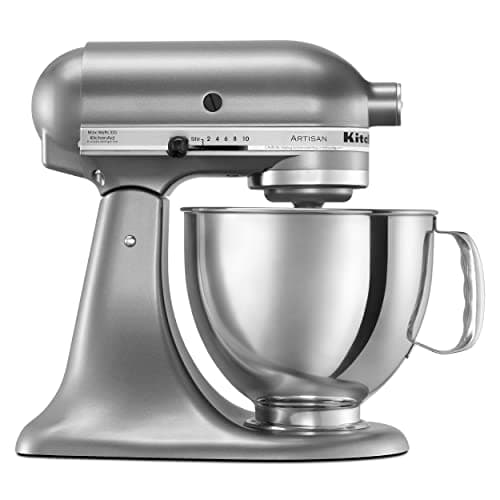
KitchenAid KitchenAid Artisan 5-Qt Tilt-Head (KSM150)
KitchenAid Artisan 5-Qt Tilt-Head (KSM150)

The default for a reason: 5-qt tilt-head, a mature attachment ecosystem, and enough motor for a couple of loaves a week. Not the mixer for daily heavy dough — but that's a small slice of home bakers.

Most home bakers
8.4
$499.00Amazon
02
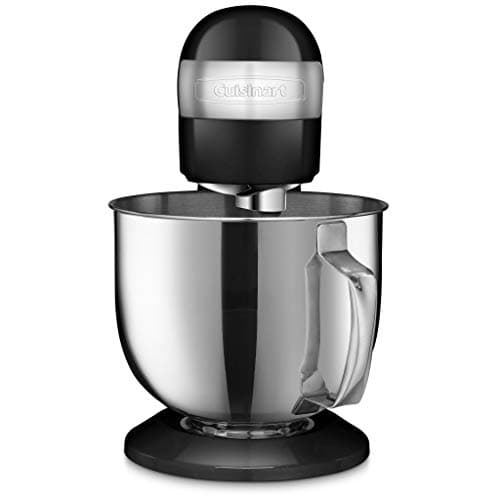
Cuisinart Cuisinart Precision Master 5.5-Qt (SM-50)
Cuisinart Precision Master 5.5-Qt (SM-50)

The value tilt-head. A larger 5.5-qt bowl and a stronger rated motor than the Artisan, usually for less money. The trade is a thinner accessory ecosystem and slightly rougher fit and finish.

Best value tilt-head
8.3
$199.99Amazon
03
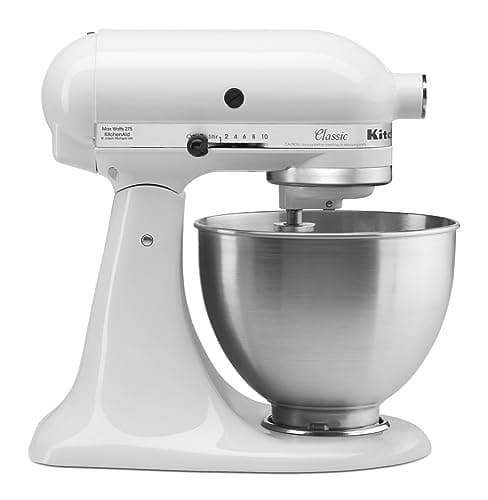
KitchenAid KitchenAid Classic 4.5-Qt Tilt-Head (K45SS)
KitchenAid Classic 4.5-Qt Tilt-Head (K45SS)

The cheapest way into the KitchenAid ecosystem. Slightly smaller bowl and a hair less power than the Artisan, but the same attachment hub and the same 10-speed planetary action. For occasional bakers this is the smart buy.

Budget / occasional bakers
8.0
$399.00Amazon
04
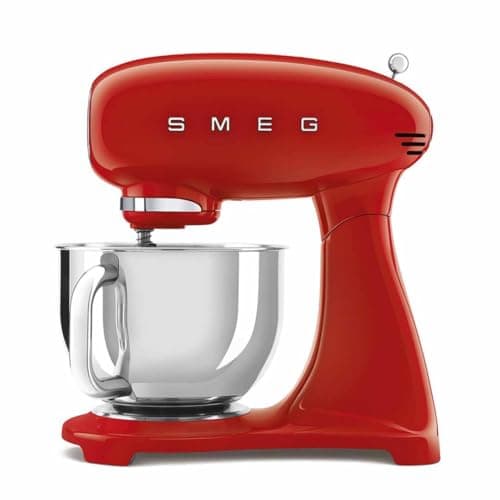
SMEG SMEG 50s-Style Stand Mixer (SMF03)
SMEG 50s-Style Stand Mixer (SMF03)

The design-first stand mixer. SMEG's die-cast body and retro colorways make it the best-looking mixer on most counters, and the build genuinely feels premium. On paper it has an 800-watt motor and a full attachment set — but reviewers consistently note it can lag a KitchenAid or Bosch on stiff, enriched dough, and you pay a steep premium for the styling.

Design-led kitchens
7.8
$570.79Amazon
05
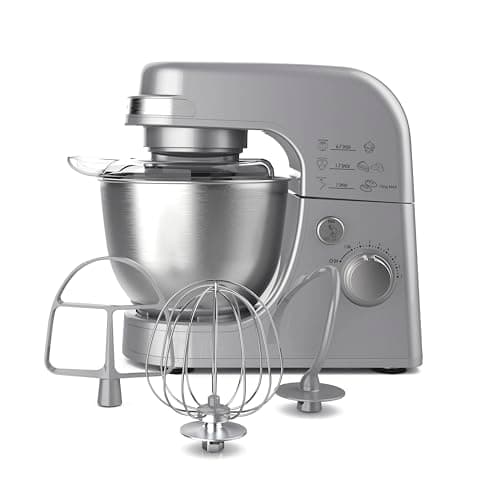
Hamilton Beach Hamilton Beach 4-Qt Electric Stand Mixer
Hamilton Beach 4-Qt Electric Stand Mixer

The cheapest way to get a real stand mixer on the counter. A 4-quart tilt-head with a dough hook, flat beater and whisk in the box for a fraction of a KitchenAid's price. It won't match the build or the motor, but for occasional baking it's a lot of mixer for the money.

Cheapest tilt-head stand mixer
7.4
$109.00Amazon

#ad · Live prices from the Amazon Product API, as of November 8, 2026. Where we have no verified live price we show none — a gap beats a number that has rotted.

In detail

The picks, in full

01
KitchenAid KitchenAid Artisan 5-Qt Tilt-Head (KSM150)

Most home bakers

KitchenAid Artisan 5-Qt Tilt-Head (KSM150)

325 W rated5-qt bowl10 speedsTilt-headPowerHub port
8.4/10

The default for a reason: 5-qt tilt-head, a mature attachment ecosystem, and enough motor for a couple of loaves a week. Not the mixer for daily heavy dough — but that's a small slice of home bakers.

Motor / dough
8
Capacity
8
Build & durability
8.5
Ease of use
9
Value
8.5

Pros

  • Huge attachment ecosystem (grinder, pasta, ice cream) via the front PowerHub
  • 5-qt bowl handles roughly a double batch of cookie dough or 2 loaves of bread dough
  • Holds resale value and parts availability better than any rival brand

Cons

  • Tilt-head flex shows on very stiff, low-hydration dough
  • 325 W rated motor is mid-pack — it will bog if you knead dense dough daily

Don't buy this if…

…you knead stiff bagel or heavy rye dough every day — a bowl-lift or a Bosch has the motor headroom you'll keep asking for.

$499.00View on Amazon

Price as of November 8, 2026. Prices change — Amazon's at checkout is the one that counts.

#ad · we may earn a commission from this link to KitchenAid Artisan 5-Qt Tilt-Head (KSM150)

02
Cuisinart Cuisinart Precision Master 5.5-Qt (SM-50)

Best value tilt-head

Cuisinart Precision Master 5.5-Qt (SM-50)

500 W rated5.5-qt bowl12 speedsTilt-headSplash guard
8.3/10

The value tilt-head. A larger 5.5-qt bowl and a stronger rated motor than the Artisan, usually for less money. The trade is a thinner accessory ecosystem and slightly rougher fit and finish.

Motor / dough
8
Capacity
8.5
Build & durability
7.5
Ease of use
8.5
Value
9

Pros

  • Bigger bowl and higher rated wattage than the same-price KitchenAid
  • 12 speeds with a genuinely useful low start speed
  • Comes with dough hook, flat beater and whisk in the box

Cons

  • Far fewer first-party attachments than KitchenAid
  • Resale value and long-term parts support trail KitchenAid
  • Head latch feels less refined

Don't buy this if…

…you want to grow into pasta rollers, grinders and the wider attachment world — that's KitchenAid's home turf.

$199.99View on Amazon

$319.9537% off

Price as of November 8, 2026. Prices change — Amazon's at checkout is the one that counts.

#ad · we may earn a commission from this link to Cuisinart Precision Master 5.5-Qt (SM-50)

03
KitchenAid KitchenAid Classic 4.5-Qt Tilt-Head (K45SS)

Budget / occasional bakers

KitchenAid Classic 4.5-Qt Tilt-Head (K45SS)

275 W rated4.5-qt bowl10 speedsTilt-headPowerHub port
8.0/10

The cheapest way into the KitchenAid ecosystem. Slightly smaller bowl and a hair less power than the Artisan, but the same attachment hub and the same 10-speed planetary action. For occasional bakers this is the smart buy.

Motor / dough
7
Capacity
7
Build & durability
8
Ease of use
9
Value
9

Pros

  • Usually the lowest price for a genuine KitchenAid planetary mixer
  • Takes the same front-hub attachments as the pricier models
  • 4.5-qt bowl is plenty for single batches

Cons

  • 275 W rated motor is the weakest in the line
  • 4.5-qt bowl gets tight on a full double batch
  • Fewer bowl/color options than the Artisan

Don't buy this if…

…you routinely bake double batches or bread — the extra half-quart and motor of the Artisan is worth the step up.

$399.00View on Amazon

Price as of November 8, 2026. Prices change — Amazon's at checkout is the one that counts.

#ad · we may earn a commission from this link to KitchenAid Classic 4.5-Qt Tilt-Head (K45SS)

04
SMEG SMEG 50s-Style Stand Mixer (SMF03)

Design-led kitchens

SMEG 50s-Style Stand Mixer (SMF03)

800 W rated~5-qt bowl10 speedsTilt-head4 attachments incl. flex edge
7.8/10

The design-first stand mixer. SMEG's die-cast body and retro colorways make it the best-looking mixer on most counters, and the build genuinely feels premium. On paper it has an 800-watt motor and a full attachment set — but reviewers consistently note it can lag a KitchenAid or Bosch on stiff, enriched dough, and you pay a steep premium for the styling.

Motor / dough
7.5
Capacity
8
Build & durability
9
Ease of use
8
Value
6.5

Pros

  • Die-cast aluminum body and zinc base feel more premium than most rivals
  • Comes with four attachments, including a flex-edge beater, plus a dishwasher-safe stainless bowl
  • Iconic 50s-retro styling in a wide range of colors, and runs relatively quietly

Cons

  • Reviewers report the 800 W motor can struggle on stiff, enriched dough and big meringues
  • Heavy (~20 lb) and priced well above better-performing mixers
  • Owners note frequent bowl-scraping and a fiddly pouring shield

Don't buy this if…

…you're buying on kneading power per dollar — a Bosch Universal Plus or a KitchenAid bowl-lift out-muscles it for less, and you're paying here largely for the look.

$570.79View on Amazon

Price as of November 8, 2026. Prices change — Amazon's at checkout is the one that counts.

#ad · we may earn a commission from this link to SMEG 50s-Style Stand Mixer (SMF03)

05
Hamilton Beach Hamilton Beach 4-Qt Electric Stand Mixer

Cheapest tilt-head stand mixer

Hamilton Beach 4-Qt Electric Stand Mixer

4-qt bowl7 speedsDough hook + whisk incl.Tilt-headSplash guard
7.4/10

The cheapest way to get a real stand mixer on the counter. A 4-quart tilt-head with a dough hook, flat beater and whisk in the box for a fraction of a KitchenAid's price. It won't match the build or the motor, but for occasional baking it's a lot of mixer for the money.

Motor / dough
6.5
Capacity
7
Build & durability
6.5
Ease of use
8
Value
9

Pros

  • One of the lowest prices for a genuine stand mixer, not a hand mixer
  • Ships with a dough hook, flat beater, whisk and splash guard
  • Light and easy to move on and off the counter

Cons

  • Plastic-forward build feels a long way from a cast KitchenAid
  • Smaller 4-qt bowl and a motor happier with batter than heavy dough
  • No attachment ecosystem to grow into

Don't buy this if…

…you bake bread often or want a machine that lasts a decade — a KitchenAid Classic or Cuisinart Precision Master is the sturdier buy.

$109.00View on Amazon

$126.9514% off

Price as of November 8, 2026. Prices change — Amazon's at checkout is the one that counts.

#ad · we may earn a commission from this link to Hamilton Beach 4-Qt Electric Stand Mixer

Buying notes, by situation

If you bake cookies, cakes and the occasional loaf

This is most people, and the Artisan is the answer. Five quarts is enough that bowl volume stops being a thought, the hub means the machine can grow, and parts and bowls for this model are the easiest to buy of anything in the category — which matters more at year eight than any spec does at year one.

If the budget is the constraint

Two honest paths. The Cuisinart Precision Master gives you the most capability per dollar and a bigger bowl than the Artisan; you are trading the attachment ecosystem for it. The Hamilton Beachis the budget pick and the right buy for someone who makes a few batches of cookies a year: it creams butter and sugar, whips cream, and will not thank you for bread dough. Do not buy the cheapest machine and then ask it to knead — that is how mixers die, and it is covered in why a stand mixer smokes.

If you want the KitchenAid ecosystem for the least money

The Classic K45SS. You give up half a quart of bowl and 50 W of published rated motor against the Artisan and you keep the hub port, the ten speeds and the planetary action. The full in-family comparison is at Artisan vs Classic.

If the mixer lives on the counter and you care how it looks

The SMEG SMF03 is a real mixer in a die-cast body, not an ornament, and it is priced as a design object. Buy it knowing that is the trade, and read SMEG vs KitchenAid first.

What we did not feature, and why

Bowl-lift mixersare excluded by definition — they are the other design, and they are ranked in best for large batches. Our KitchenAid 7-quart review covers the step up if you decide a tilt-head is not enough machine.

The Dash 3.5-quart tilt-head is in our registry and is not ranked here because it carried no verified live price when we published, and we do not put a pick on a ranked list that we cannot price. It has its own review and appears in best for small kitchens.

Unbranded high-wattage tilt-headsare the largest group in this category by listing count and are absent on purpose. They publish a wattage number and almost nothing else: no bowl material, no care instruction, no parts availability, frequently no consistent model identity between listings. Our rubric is built on published specifications and there is nothing to score — see how we pick.
How we picked

We don't run a testing lab

We read the manuals, compiled the published specifications, did the wattage-to-dough math and weighed aggregated owner reviews, then scored each product against a published rubric. The scores are judgments from documented research — they are not measurements we took, because we do not have a lab and we're not going to pretend we do. Every spec is the manufacturer's published figure, cited in Sources.

Questions

Frequently asked

What is a tilt-head stand mixer?
A mixer whose motor head hinges backwards on a pin, leaving the bowl locked into a ring on the base. The alternative is a bowl-lift, where the bowl clamps into two arms and is raised to a fixed head. The tilt-head is the more convenient design, because tilting the head back gives you a completely open bowl to scrape, add to and inspect; the bowl-lift is the more rigid design, which is why it handles stiff dough better. Most home bakers should buy a tilt-head.
Is a tilt-head stand mixer good for bread dough?
For occasional bread, yes. For daily or very stiff dough, no - and the reason is the hinge. The head can rock a fraction on its pin against a dry, low-hydration dough, which lets the hook ride up and makes the motor work harder than it should. A 5-quart tilt-head will handle one or two loaves of ordinary dough a week without complaint. If bread is most of what you make, buy a bowl-lift or a bottom-drive machine instead.
Which tilt-head stand mixer has the most power?
On published rated wattage, the SMEG SMF03 at 800 W, followed by the Cuisinart Precision Master at 500 W, the KitchenAid Artisan at 325 W and the KitchenAid Classic at 275 W. Hamilton Beach publishes no wattage for its 4-quart mixer, so we do not give it one. Read that ordering carefully rather than literally: rated input wattage is not delivered torque, no maker in this category publishes a torque figure, and a higher wattage on a tilt-head hinge does not convert into dough capacity the way it would on a bowl-lift. It is the only comparable published spec, which is why we use it, and it is not a promise.
Does a tilt-head mixer take KitchenAid attachments?
Only if it is a KitchenAid. Both KitchenAids on this page — the Artisan and the Classic — carry the front PowerHub port, which is where the pasta rollers, grinders, spiralizers and ice-cream bowls attach, and it is the same port on both, so an accessory bought for one fits the other. The Cuisinart and Hamilton Beach have no hub port. SMEG ships four of its own attachments on its own fitting, which is not interchangeable with KitchenAid's. Flat beaters and whisks are not cross-compatible between brands either, because the shaft and bowl geometry differ.
How big a bowl do I need on a tilt-head?
Four quarts covers a single batch of cookies or one loaf. Four and a half gets tight on a full double batch — this is the most common regret with the Classic. Five to 5.5 quarts is the point at which bowl volume stops being something you think about for home baking. Tilt-heads rarely go past that because the hinge geometry limits how deep a bowl the beater can reach the bottom of; if you need more, you are shopping for a bowl-lift. There is a fuller breakdown at bowl sizes explained.
What is the cheapest tilt-head stand mixer worth buying?
The Hamilton Beach 4-Quart is our budget pick: seven speeds, a 4-quart stainless bowl, a splash guard and a dough hook and whisk in the box, and it creams butter and sugar properly, which is the job most cheap mixers fail. It has no attachment hub port and it is not a dough machine. Below it the category becomes unbranded listings with a wattage number and no published specifications at all, which we will not rank. Live prices for all five picks, with the date they were fetched, are in the Quick picks table above.

Keep reading

More in this category

More stand mixers

All stand mixers →

Receipts

Sources

We don't run a testing lab, and we don't pretend to. Specs are the manufacturer's published figures, cited above; scores are our judgments from that research. Where we couldn't verify something, we say so on the page rather than quietly leaving it out. Read our full method.