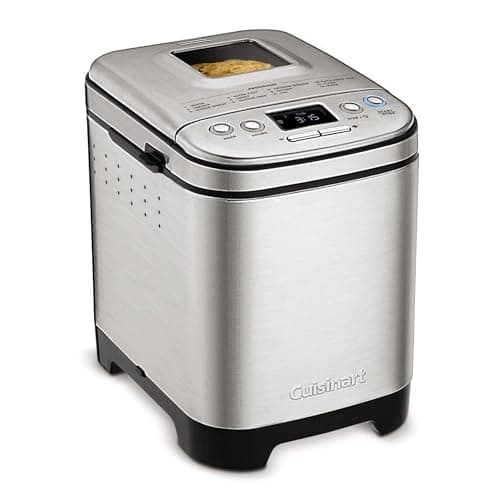
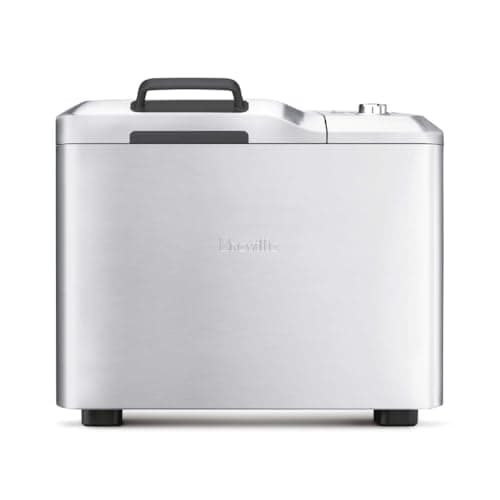
Both of these are "programmable" bread machines, but they aim at different bakers. The Breville Custom Loafis the machine for someone who wants to tinker — more loaf sizes, more settings, an automatic dispenser. The Cuisinart CBK-110 is the compact all-rounder that does the everyday jobs for a lot less money and shelf space. Deciding between them is mostly a question of how much fussing you actually want to do.
Loaf sizes are the clearest split. The Breville offers four sizes, from a 1-pound loaf up to 2.5 pounds, so you can bake a small loaf for two or a big one for a family from the same machine. The Cuisinart tops out at a 2-pound loaf across three sizes — plenty for most households, but without the Breville's range at either end. If you regularly want either a very small loaf or a larger-than-standard one, that flexibility is a real point for the Breville.
Programs and customization are where the Breville is built to shine. It carries thirteen settings, an automatic fruit-and-nut dispenser that drops mix-ins at the right moment so you don't have to hover, and a collapsible kneading paddle that folds down before the bake to leave a smaller hole in the finished loaf. That's the depth that earns it the most-customizablelabel — and it's also more than a casual baker will ever touch. The Cuisinartanswers with twelve programs covering gluten-free, sweet and low-carb, three crust shades and a 13-hour delay timer so you can wake to fresh bread. It's a simpler machine, and for a lot of people that's the point.
Loaf shape and footprint cut in different directions. The Cuisinart uses a single paddle and a compact vertical pan, which fits neatly under most cabinets but bakes a tall, square loaf rather than a standard horizontal shape, and its crust browning is a little less even than a machine with more heating sophistication. The Breville is the larger, more capable machine on the counter, and the collapsible paddle is a genuine advantage for a cleaner loaf base. Neither matches a dual-heater flagship for crust evenness — if that's your priority, our best-overall pickis the machine to read about — but between these two the difference is customization versus compactness.
Price tier is the last honest divider. The Breville sits in the premium tier, close to the most expensive home machines, and you're paying for the dispenser, the extra sizes and the settings depth. The Cuisinart is a compact mid-tier machine, a real step down in both price and shelf space. The rule: buy the Breville if you want to program and fuss, need four loaf sizes, or love the auto dispenser. Buy the Cuisinart if you want a capable, compact machine for standard loaves at a friendlier price.
Buy the Breville if… / buy the Cuisinart if…
Buy the Breville Custom Loaf if…
You want to tinker and you'll actually use the depth. Four loaf sizes from 1 to 2.5 pounds, thirteen settings, an automatic fruit-and-nut dispenser and a collapsible paddle add up to the most flexible home bread machine here. If you bake enriched loaves with mix-ins, switch between small and large loaves often, or just enjoy dialing a machine in, the premium buys something you'll touch every bake.
Who it's notfor: the set-it-and-forget-it baker who wants to press one button and walk away. The depth is wasted on you, and cheaper machines make a simple loaf just as well — you'd be paying premium money for settings you'll never open.
Buy the Cuisinart CBK-110 if…
You want a capable machine that fits a real kitchen for less money. The compact vertical build slides under most cabinets, twelve programs cover gluten-free, sweet and low-carb, and the 13-hour delay timer means fresh bread on waking. For a household that mostly bakes standard loaves and values counter space and price, it's the sensible middle.
Who it's notfor: anyone who wants four loaf sizes, an auto dispenser or the most even crust and a standard horizontal loaf shape. The single paddle bakes a tall, square loaf, and its browning is less even than pricier machines — if crust is the whole point, look at the best-overall tier instead.
How the programs map to results
Both machines run their loaves on programs that set knead time, rise time and bake — so the trick with either is matching the cycle to the flour. A basic white cycle assumes strong bread flour and standard hydration; whole-wheat and gluten-free cycles change the knead and rise timing to suit heavier or non-gluten flours. The Breville's extra settings give you more room to fine-tune those steps; the Cuisinart's twelve programs cover the common cases without the same granularity. Our loaf-sizes explainer covers how size selection changes the bake on both.
Footprint and the everyday reality
Counter space is a real tiebreaker that gets ignored in the spec race. The Cuisinart is a compact vertical machine designed to fit under most cabinets, which matters if you want to leave it out; the Breville is the larger, more capable machine on the counter, and its extra abilities come with extra size. Both are appliances you load, walk away from and come back to, so if the deciding factor is whether the machine fits your kitchen rather than what it can do, the compact Cuisinart has the edge — and if you want the range and have the room, the Breville earns its space. Be honest about the counter you actually have before you buy on features alone.
The deciding question
Ask how much you want to fuss. If the answer is "a lot — I'll use the sizes, the dispenser and the settings," the Breville is the machine and the premium is earned. If the answer is "as little as possible — I want good standard bread without babysitting," the Cuisinart does that for less money and less counter space, and you won't miss the depth you weren't going to use.