The most common reason a home loaf comes out gummy in the middle isn't a bad recipe — it's pulling it from the oven too early because the crust looked done. Crust color is a surface event; the inside of a loaf finishes cooking at a specific internal temperature, and the only reliable way to know you're there is to measure it. A thermometer isn't fussy overkill for bread; it's the single tool that turns "I think it's done" into "it's done."
The targets are simple. A lean, crusty loaf — a baguette, a sourdough, a rustic white — is baked through at an internal temperature of roughly 205–210°F. A softer, enriched loaf with butter, eggs or milk — brioche, a sandwich loaf, dinner rolls — is done a little lower, around 190–200°F, because pushing it hotter dries out the tender crumb. Learn those two ranges and you never have to guess from crust color or trust a recipe's bake time that assumes your oven and your loaf, which it doesn't know.
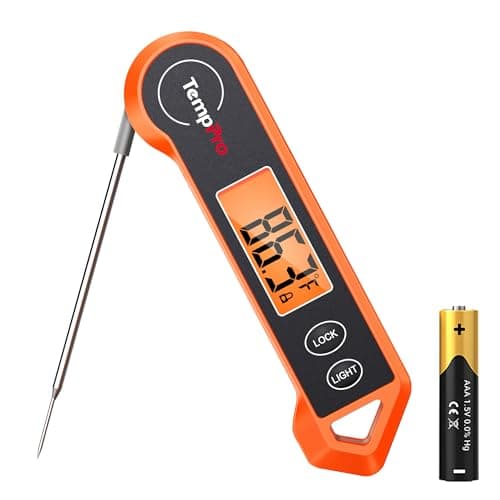
For this you want an instant-readthermometer, not a probe you leave in during baking — you check once, near the end. The pick below reads in about a second, so you open the oven, spear the loaf through the base or side into the center, read it, and close up before the oven loses much heat. It's cheap, it doubles for meat and candy, and it does more for your bread than most gadgets costing five times as much. If you're building a sourdough kit, it belongs in it.
The short answer
Quick picks
| # | Product | Best for | Score | Price |
|---|
| 01 | TempPro TP19H Instant-Read ThermometerThe cheapest way to stop guessing whether a loaf is baked through. Bread is done at an internal temperature, not a clock time, and a one-second instant-read takes the guesswork out — for about the price of a bag of good flour. | Checking bread doneness | | $14.99·Amazon |
#ad · Live prices from the Amazon Product API, as of Sep 19, 2026. Where we have no verified live price we show none — a gap beats a number that has rotted.
In detail
The picks, in full
Checking bread doneness
TempPro TP19H Instant-Read Thermometer
~1-sec readDigital instant-readFoldable probeAuto-offWide temp range
The cheapest way to stop guessing whether a loaf is baked through. Bread is done at an internal temperature, not a clock time, and a one-second instant-read takes the guesswork out — for about the price of a bag of good flour.
- Accuracy
- 8
- Build quality
- 7.5
- Ease of use
- 8.5
- Versatility
- 8.5
- Value
- 9
Pros
- +Reads in about a second, so you're not holding the oven open
- +An internal-temp check is the most reliable doneness test for bread
- +Doubles for meat, custards and candy
Cons
- −Budget brand, not a lab-grade instant-read
- −Battery, not rechargeable
- −Probe is splash-resistant, not fully submersible
Don't buy this if…
…you only bake in a bread machine — it bakes to its own program and you'll rarely probe a loaf.
How to use a thermometer on bread — and what to buy
Check once, near the end, from the bottom
Don't probe repeatedly — each open door drops the oven temperature. Wait until the loaf looks close, then insert the probe through the base or the side into the very center, angling to reach the thickest part. Reading from underneath keeps a clean top crust unmarked. If you're under temperature, give it a few more minutes and check again.
Know your two target ranges
Lean, crusty breads: 205–210°F. Enriched, soft breads: 190–200°F. Those two numbers cover almost everything a home baker makes. When in doubt on a new recipe, trust the temperature over the clock — oven calibration, pan color and dough temperature all shift the actual bake time from whatever the recipe printed.
What matters in the thermometer itself
You don't need a lab-grade instant-read for bread. Look for a genuinely fast read (a second or two, so the oven stays hot), a clear display, and a temperature range that comfortably spans baking. A foldaway probe and auto-off are nice for storage and battery life. A budget instant-read like the one here does all of this; a premium model is faster and tougher but not necessary for a home loaf.
When you can skip it
If you bake exclusively in a bread machine, you rarely need one — the machine bakes its own program in a sealed pan and you're not judging doneness by eye. The thermometer earns its place the moment you start baking loaves in your own oven, where the finish is up to you.
How we picked
We don't run a testing lab
We read the manuals, compiled the published specifications, did the wattage-to-dough math and weighed aggregated owner reviews, then scored each product against a published rubric. The scores are judgments from documented research — they are not measurements we took, because we do not have a lab and we're not going to pretend we do. Every spec is the manufacturer's published figure, cited in Sources.
Questions
Frequently asked
What temperature is bread done at?+
Lean, crusty loaves (baguettes, sourdough, rustic white) are baked through at roughly 205–210°F internal. Softer enriched loaves (brioche, sandwich bread, rolls) are done a little lower, around 190–200°F, so the tender crumb doesn't dry out.
Do I really need a thermometer to bake bread?+
You can bake without one, but it's the most reliable way to avoid a gummy, underbaked center — the most common home-baking miss. Crust color and bake times both lie; internal temperature doesn't. It's a cheap tool that removes the biggest source of doubt.
What kind of thermometer is best for bread?+
An instant-read, not a leave-in probe — you check once near the end. Look for a fast read so the oven stays hot, a clear display and a range that spans baking. A budget instant-read is plenty; see the pick in our
sourdough tools guide too.
Receipts
Sources
We don't run a testing lab, and we don't pretend to. Specs are the manufacturer's published figures, cited above; scores are our judgments from that research. Where we couldn't verify something, we say so on the page rather than quietly leaving it out. Read our full method.