A sheet pan warps because part of it gets hot faster than the rest of it. Metal expands when it heats. If the centre of a pan heats quickly while the rim is still cool — or the underside heats while the top is insulated by cold food — the hot part tries to get bigger than the cold part, the pan cannot resolve that, and it releases the stress by buckling. That is the bang you hear. It is physics, not a manufacturing defect, and the pan usually flattens out again as it cools evenly. Two habits cause most of it and one construction detail resists the rest: a heavy-gauge pan with an encapsulated steel wire in the rim is the pan that does not do this.
Here is the whole fix, in order of how much difference it makes.
1. Do not put a cold, wet, loaded pan into a hot oven
This is the biggest one and the easiest to change. A pan straight from the fridge, or a pan covered in cold raw vegetables, has a huge temperature gradient across it the moment it hits a 425°F oven: the exposed metal at the edges heats immediately while the metal under the cold food does not. Spread food evenly, leave the rim clear rather than crammed, and if the pan has been in the fridge give it a few minutes on the counter first. Same logic for a half-loaded pan — food on one end and nothing on the other is a gradient you created.
2. Do not run cold water on a hot pan
Thermal shock in the other direction, and it is harder on a pan than heating it is. Taking a 400°F sheet to the sink and hitting it with cold water cools one face of the metal almost instantly while the other is still hot. Let the pan cool on a rack first — it takes ten minutes and it is the difference between a pan that stays flat and one that does not. This is also, incidentally, the main way people destroy a bare aluminum pan's finish.
3. Do not broil a thin pan
A broiler is a single intense radiant element very close to the pan, which is the most uneven heating a sheet pan ever experiences. Thin pans warp under a broiler almost as a rule. If you broil, use your heaviest pan, and note that a coated pan under a broiler is a separate problem — coatings have published temperature ceilings and a broiler cheerfully exceeds them.
4. Buy the construction that resists it
Two features do the work here, and they are both visible on the pan.
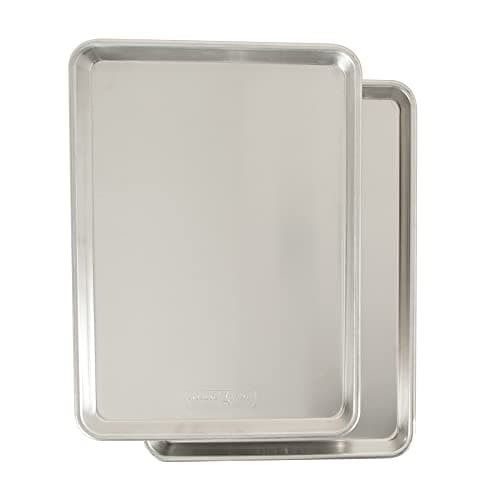
An encapsulated rim. Nordic Ware's Naturals line rolls a galvanized steel wire into the rim and encloses it; USA Pan reinforces its rims the same way. A steel wire has a different stiffness from the aluminum around it and it braces the edge of the pan against exactly the flex that buckling requires. This single detail is the most reliable predictor of whether a sheet pan will stay flat, and it is why every pan we rank first has one.
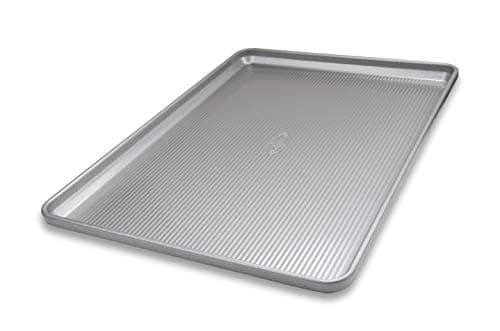
Gauge. A thicker pan has more mass, so it changes temperature more slowly and gradients across it are gentler. It is also simply stiffer. The USA Pan Heavy Duty is the thicker-gauge version of its standard half sheet and exists specifically for people whose pans keep buckling — the extra mass also evens out oven hot spots, so one tray of cookies bakes more uniformly as a bonus.
What does not help: a nonstick coating, which has no structural role whatsoever. If your pans warp, the coating was never the issue — see aluminum vs nonstick baking sheets for what a coating does and does not do.
Can you fix a pan that has already warped?
Sometimes, and it depends what kind of warp it is.
A pan that bows while hot and flattens when cool is behaving normally. That is reversible thermal expansion and the pan is fine. Annoying mid-bake, because butter and batter run to the low corner, but not damage.
A pan that is permanently dished or twisted has been stressed past its elastic limit, usually by thermal shock or by being dropped. You can occasionally improve a mild case by warming the pan gently and pressing it flat on a hard level surface, but the metal has yielded and it will never be as flat as it was — and on a coated pan, flexing it is a good way to crack the coating. For a pan you use for cookies and pastry, where a flat surface is the whole point, replacement is usually the honest answer.
Which pan to buy if yours keep buckling
- USA Pan Heavy Duty half sheet— the direct answer. Thicker gauge than the standard pan, reinforced rim, and the same PTFE-free Americoat surface. Published 450°F ceiling, so it is not the pan for broiling or hard roasting. It is sold as one pan for close to the price of a standard two-pack, which is the trade.
- Nordic Ware Naturals half sheet two-pack— the better buy for most people. The encapsulated galvanized steel rim is the specific anti-warp feature, bare aluminum has no coating to crack if the pan does flex, it carries a lifetime warranty, and you get two pans. Hand wash only.
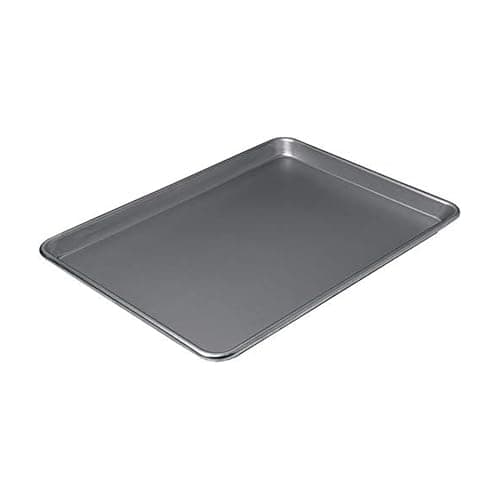
- Chicago Metallic Professional— named here as the counter-example as much as a pick. It is the lightest and cheapest pan we rank, which makes it the most likely to warp or flex, and we could not find a published oven ceiling for it at all. As a cheap extra pan for cookie rotations it is sensible; as your only pan, or for high-heat roasting, it is not the one.
Four habits that keep any pan flatter
- Load evenly, edge to edge. No bare half, no piled-up centre. An even load is an even heat-up.
- Cool on a rack, wash later. Never cold water on a hot pan. A wire rack lets air reach both faces so the pan cools evenly too — see how to use a cooling rack.
- Skip the dishwasher. Both Nordic Ware and USA Pan recommend hand washing. On bare aluminum the dishwasher also discolors the pan permanently.
- Store them flat and dry. Stacked flat, fully dry, and not wedged vertically between heavier pans. A pan stored under load for years takes a set, and a damp pan in a cupboard is how a bare pan starts to pit.
Where this fits with the rest of your bakeware
The same construction logic runs through everything flat you bake on. A loaf pan with a wire-rod reinforced rim stays square for the same reason a sheet pan does — see how to choose a loaf pan and the best loaf pans. Cast iron does not warp at all, which is part of why a Dutch oven is the vessel of choice for high-temperature bread baking; that trade is covered in the best Dutch ovens for bread. And if you are choosing sheet pans from scratch rather than replacing warped ones, start with the best baking sheets or, for cookies specifically, the best baking sheets for cookies.