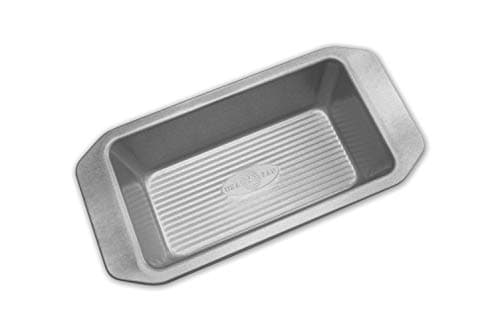
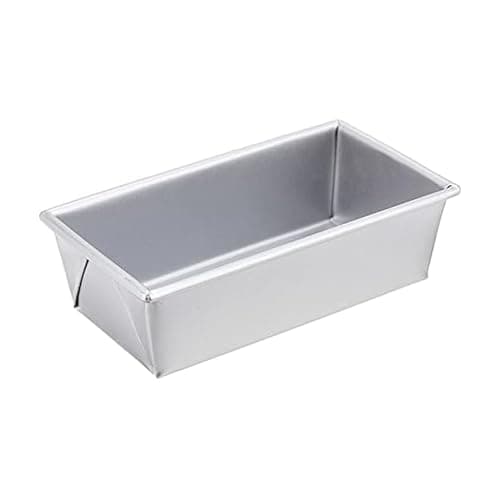
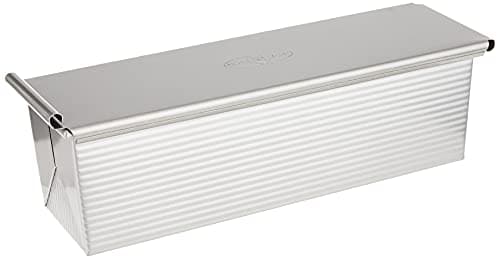
Buy a regular loaf pan first; buy a Pullman second, if square slices matter to you. The only meaningful difference between the two is the lid. A Pullman pan is taller and straighter-sided — the USA Pan is 13 x 4 x 4 inches — and it comes with a sliding lid that caps the rising dough. The dough hits the lid, has nowhere left to expand, and bakes into a rectangular block with a flat top and square corners. Every slice is the same shape from end to end, which is what pain de mie is and what makes a Pullman the pan for thin, even sandwich slices and for anyone who resents that the top third of a domed slice is crust. A regular loaf pan makes a domed loaf, costs less, and does more jobs.
What the lid actually does
A yeast loaf domes because the centre of the dough is the last part to set: the edges meet hot metal and firm up early, while the middle keeps rising, so it pushes up and over into a crown. That is normal and for most bread it is desirable. The Pullman lid intervenes by putting a ceiling on it. The dough rises, meets the lid, and the remaining expansion goes sideways into the corners instead of upwards, so the finished loaf is a true rectangular prism.
Three consequences follow, and they are not all upsides.
Uniform slices. The point of the exercise. Slice a Pullman loaf anywhere and you get the same square, and it stacks and toasts evenly. If you make sandwiches to pack, or you slice thin for canapés or melba toast, nothing else gets you this.
A softer, finer crumb and a thinner crust. The lid traps some of the dough's own steam for the first part of the bake and keeps the top from forming a thick crust at all. A classic pain de mie is deliberately tender and tight-crumbed. If you came to bread baking for a thick, blistered, chewy crust, the Pullman is working against you — that bread is a Dutch oven loaf and lives in the best Dutch ovens for bread.
You have to fill the pan properly. This is the detail people miss and the commonest Pullman disappointment. A 13 x 4 x 4 pan has considerably more volume than an 8.5 x 4.5 pan, so a standard three-cup-of-flour recipe put in a Pullman will not reach the lid — and a loaf that never meets the lid has no reason to be square. You will be scaling recipes up, typically to a 1.5 to 2-pound dough. Too much dough is the opposite failure: it forces the lid, bulges at the seams and can lift it off.
The two pans, side by side
| Pullman (USA Pan, lidded) | Regular loaf pan (8.5 x 4.5) |
|---|
| Published size | 13 x 4 x 4 in | 8.5 x 4.5 x 2.75 in |
| Loaf shape | Square block, flat top | Domed crown |
| Slice consistency | Identical end to end | Varies with height |
| Crust | Thin and soft | Fuller, browner on top |
| Dough needed | Roughly 1.5–2 lb | Roughly 1 lb (three cups flour) |
| Quick breads & banana bread | Wrong shape | Fine |
| Oven ceiling | 450°F | 450°F coated; uncoated not published |
| Price | Several times a basic pan | Lowest |
Dimensions and the 450°F figure are USA Pan's published specifications, cited in Sources; dough weights are the practical range these pan volumes call for rather than a manufacturer figure. We have not measured a loaf — see how we pick.
Should you buy one?
Yes, if any of these is true
- You slice thin. Melba toast, canapés, tea sandwiches, crustless sandwiches for children — all of these want a square loaf and are fiddly with a domed one.
- You pack sandwiches regularly. Uniform slices mean uniform sandwiches that sit flat in a box.
- You want pain de mie specifically. The soft, fine, tight-crumbed white sandwich bread is a style, and the lid is how it is made.
- You bake the same loaf every week. A specialist pan earns its keep through repetition. If one house loaf is your routine, the Pullman is a reasonable object to own.
No, if any of these is true
- This would be your only loaf pan. It is the wrong shape for banana bread, quick breads, pound cake and meatloaf. Buy a regular pan first, always.
- You want crust. The lid's whole job is to suppress the top crust. A crusty loaf comes from an uncovered bake, ideally in cast iron.
- You bake occasionally and vary what you make. You will scale a recipe up every time, and a half-filled Pullman makes a worse loaf than a well-filled regular pan.
- You bake above 450°F. USA Pan's published ceiling rules it out, and we do not recommend exceeding a published rating.
Which of the three to buy
USA Pan Pullman with lid— the lidded pan. Heavy corrugated aluminized steel, a PTFE-free Americoat surface, made in the USA, and the sturdiest loaf pan most bakers will own. Hand wash, 450°F, and it costs several times what a basic pan does. Our full review covers it alone.
USA Pan Classics 1-lb loaf pan— the regular pan to buy first, and the one most yeast recipes are actually written for at a true 8.5 x 4.5-inch interior. Same construction and coating as the Pullman, a fraction of the price, and it handles both sandwich loaves and quick breads passably.
Chicago Metallic Commercial II uncoated 1-lb— the same footprint with no coating at all. Nothing to scratch or wear out, a wire-rod reinforced rim, a lifetime warranty, usually the cheapest of the three. You grease it every bake, without exception.
Getting a square loaf without a Pullman
Two honest workarounds, since the pan is a real expense.
Cover a regular pan. A sheet pan or a flat baking tray weighted on top of a regular loaf pan will flatten the crown. It is imprecise — the pan has sloped sides so you still will not get square corners — but it gets you most of the way to flat slices for the cost of nothing.
Use a bread machine with a horizontal pan. A horizontal two-paddle machine bakes a wide, low, rectangular loaf rather than a tower, which is a different route to the same goal with no shaping at all. See the best bread machine for sandwich bread.
Where this fits
A Pullman is a second or third loaf pan, not a first. The first decision is size — 8.5 x 4.5 for yeast dough, 9 x 5 for quick breads — and that is how to choose a loaf pan. The ranked field is the best loaf pans and the sandwich cut is the best loaf pans for sandwich bread. The material questions sit alongside it in glass vs metal loaf pan and USA Pan vs Nordic Ware. And whichever pan you use, line it properly — how to grease and line a loaf pan is the five-minute read that prevents most stuck loaves.