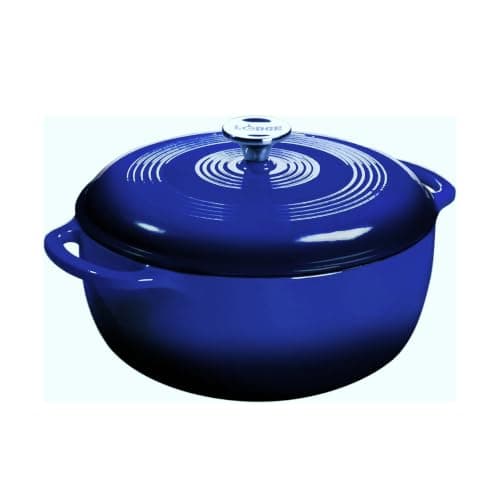
For the standard 500 g boule most no-knead and sourdough recipes make, you want 5.5 to 6 quarts— and our pick at that size is the Lodge Essential Enamel 6-quart, because six quarts gives the dough walls close enough to climb while leaving headroom for oven spring. Go up to 7.5 quarts only if you bake 900 g to 1 kg loaves. Go down to about 3.2 quarts if you bake one modest round and want the safest vessel to load. The one thing nobody tells you: a pot that is too big is a real mistake, not a harmless one.
Why a pot that is too large bakes a worse loaf
Most sizing advice only warns you about a pot being too small, which is the obvious failure — the dough touches the walls, the lid sits on the loaf, and you get a scorched flat top. The less obvious failure is the common one. A 500 g boule dropped into a wide 7.5-quart pot has nowhere to brace. Dough is slack when it goes in, and for the first few minutes before the crust sets it will take whichever path is easier: up, if there are walls nearby, or outward, if there are not. In a pot that is too wide it spreads sideways, and a loaf that spread sideways cannot un-spread. You get a pancake with a good crust.
A second, smaller penalty: more air inside the pot means more volume to heat and more volume for the dough's own moisture to fill before the atmosphere is genuinely steamy. The steam is the whole reason you are using a covered pot — King Arthur Baking's guidance on Dutch oven baking, cited below, describes the mechanism — and a cavernous pot dilutes it.
The sizing rule, by dough weight
Forget the pot for a moment and weigh your dough. This is the only input that matters, and if you do not currently weigh anything, our how to measure flour by weight guide is the five-minute fix that also improves the loaf itself.
Around 450-600 g of dough— the standard single boule, roughly three cups of flour. Target 5.5 to 6 quarts. This is the overwhelming majority of recipes and the size to buy if you buy only one pot.
Around 700-800 g— a generous loaf. Six quarts still works and 6.5 is comfortable. You are in the band where either pot is defensible.
Around 900 g-1 kg— a big loaf, or a recipe scaled up to use a full kilo of flour. Go to 7.5 quarts. At 5.5 quarts a loaf this size touches the walls, and touching the walls during spring means a deformed loaf and a crust that sticks.
One modest round and nothing bigger— 3.2 quarts is plenty, and at that size the Lodge Combo Cooker is the better-designed answer than a small pot, for reasons in the next section.
What to check before you buy any of them
Shape, not just volume.Round pots make round loaves. If you shape batards or baguettes, no round Dutch oven will take them and sizing by quarts is the wrong exercise entirely — you want a rectangular vessel, which is a different product with a different price. See the Challenger Bread Pan review for the purpose-built option.
The published temperature ceiling.Size is useless if the pot cannot take your preheat. The Lodge enamel pots here publish 500°F, which covers the 475-500°F most no-knead recipes specify. Cheaper enameled pots are frequently rated to 450°F, which does not, and we will not tell you to exceed a published rating. Our enameled vs bare cast iron guide covers what to do if your recipe goes hotter.
How you will get the dough in.A deep pot is a deep hot well, and lowering a slack proofed round into one at 450°F is the step that burns knuckles and deflates loaves. The larger the pot, the deeper the reach. Weigh that against capacity honestly.
Whether you can lift it loaded, into a low oven.Enameled cast iron is heavy and scales with size. A 7.5-quart pot plus a loaf, lifted at arm's length into a bottom-rack oven, is a genuine wrist job, and it also takes longer to preheat.
How to measure the Dutch oven you already own
Check the base first
Most cast iron pots have the capacity cast into the underside of the base, or stamped on the lid. Look there before you measure anything — it is faster and it is the manufacturer's own figure.
If there is no marking, fill it
Measure water into it a quart at a time until it reaches the brim. That is the number manufacturers quote, and it is why a pot never looks as big as its rating — you are not filling it to the brim with dough. A pot that takes six quarts of water to the rim is a 6-quart pot.
Then measure the diameter, because that is what the loaf feels
Volume is the number on the box, but width is what decides whether your loaf climbs or spreads. Measure the interior across the base. For a standard boule you want something in the region of 9 to 10 inches across the bottom; much wider and a 500 g loaf has room to run. Two pots of identical volume can behave differently if one is tall and narrow and the other is shallow and wide, and for bread the taller one is better.
The three picks, and who each is for
Lodge Essential Enamel 6-quart — for almost everyone
Who it is for: the standard 500 g boule, which is most bakers. Why this size:six quarts is the sweet spot — walls close enough to brace a slack dough, headroom enough for a confident spring. It publishes a 500°F ceiling, has a stainless knob rather than a phenolic one, and the enamel means no seasoning routine. The honest cons:enamel chips if you knock it or drop the lid on the rim, and a chipped interior cannot be repaired; the loop handles have no silicone grip and get screaming hot; and it is heavier than it looks when you are lowering it into a low oven. If your recipe preheats past 500°F, this is not your pot.
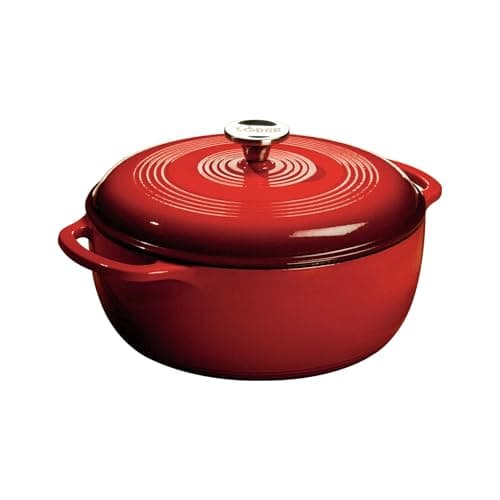
Lodge Essential Enamel 7.5-quart — for 1 kg loaves and braising duty
Who it is for: big loaves, or anyone who wants one pot that is also the household braiser. Why this size:7.5 quarts comfortably takes a 1 kg loaf without the dough touching the walls, with the same published 500°F ceiling and stainless knob as the 6-quart. Big enough to earn its shelf space twice. The honest cons:a small boule spreads sideways in a pot this wide instead of springing upward — which is the entire warning at the top of this page — it is noticeably heavier, and it takes longer to come up to temperature, so preheats stretch out. Do not buy this one “to be safe.” Buy it because you bake big.
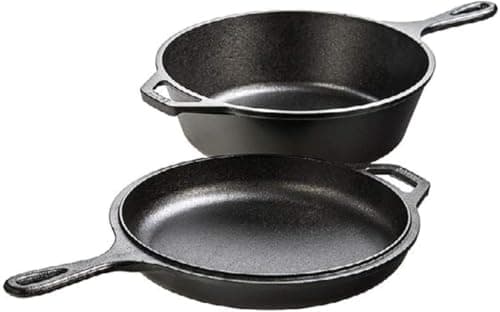
Lodge Cast Iron Combo Cooker — for one boule, loaded safely
Who it is for: one modest round at a time, and anyone who finds loading a hot pot genuinely frightening. Why this one: it inverts. The 10.25-inch shallow skillet is the base and the 3.2-quart deep pot caps it as a lid, so you set a proofed round onto a flat surface at counter height rather than lowering it blind into a deep well. It is bare seasoned cast iron, made in the USA, so there is no enamel to chip and no enamel temperature ceiling. It is also two pans: the skillet sears and bakes cornbread. The honest cons:Lodge's own instruction is hand wash, dry and oil every time; 3.2 quarts means a 1 kg loaf will touch the sides; and bare iron will carry strong flavours between a braise and a loaf.
Three sizing questions people ask that have surprising answers
“Can I just use a bigger pot and bake two loaves?”
No, and this is the most common version of the too-big mistake. Two loaves in one pot touch each other, fuse along the contact face and bake into one lumpy object with a pale seam. A covered bake is a one-loaf-at-a-time method. If you want two loaves at once, bake them in loaf pans instead — see the best loaf pans— or buy two pots.
“Does the lid need to be heavy?”
Yes, and it is worth understanding why: the lid's job is to seal well enough that the dough's own moisture stays inside. A light lid lifts slightly as steam builds and vents it, which is exactly what you do not want in the first half of the bake. Every cast iron lid here is heavy enough; this becomes a real problem only with thin stainless or glass lids, which is why we do not recommend a stockpot as a substitute.
“Do I need to preheat the pot, or can I load it cold?”
You can do either, and the size answer changes slightly if you load cold. Preheating the pot gives a stronger initial heat kick and better spring, and it is why most recipes specify it — it is also the step that makes loading dangerous and makes the Combo Cooker's design worth paying attention to. A cold start is gentler, more forgiving and produces a slightly less dramatic loaf. If you always load cold, a marginally wider pot hurts less, because the dough has longer to set before gravity wins.
Where this fits in your bread routine
Sizing the pot is one of three decisions that actually change a loaf, and the other two are cheaper. The first is weighing your ingredients instead of scooping them: a kitchen scalefixes more loaves than any pot upgrade. The second is baking to an internal temperature instead of a clock — see the bread thermometer guide. With those two in place, the right-sized pot is what turns a good loaf into one with real height and an open crumb. If you want the full ranked field of vessels, including the budget enameled pot and the rectangular Challenger, start at the best Dutch ovens for bread, and if you are weighing Lodge against the French pot, read Lodge vs Le Creuset. For what happens after the pot — shaping and scoring — see how to proof bread dough and how to score sourdough bread.