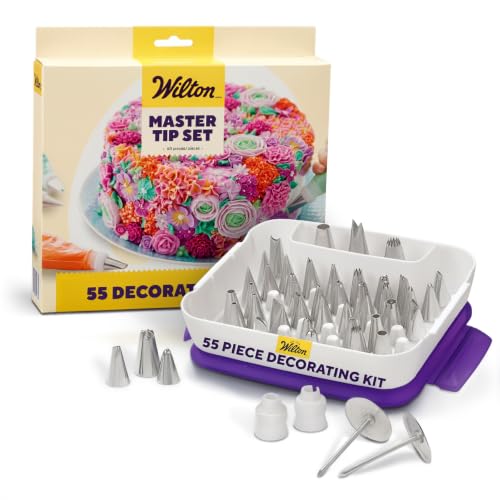
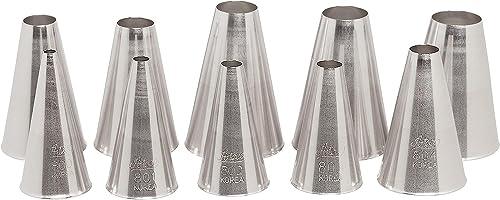
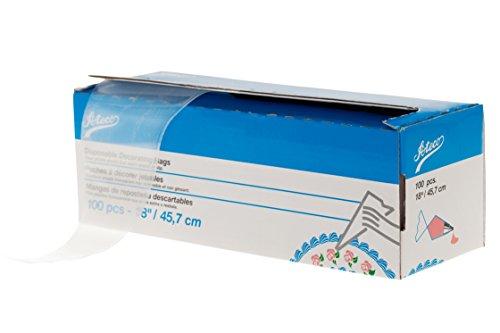
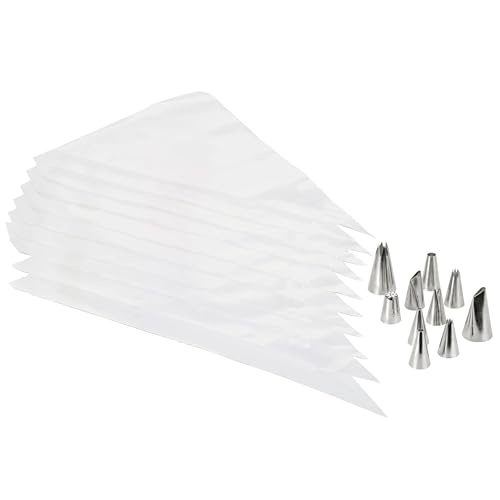
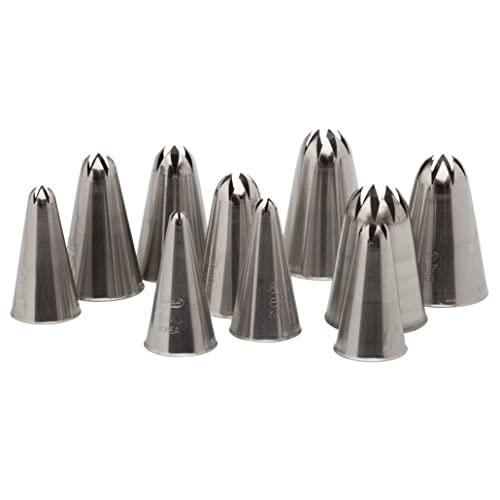
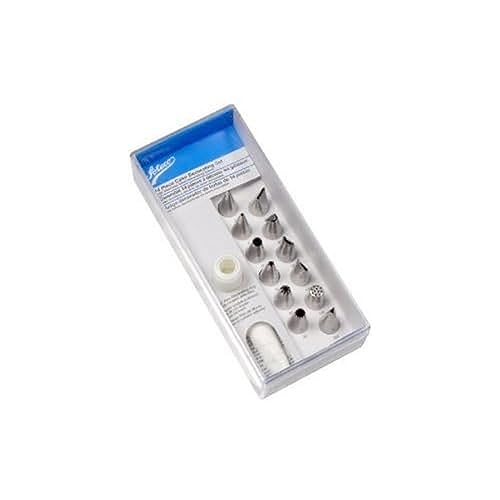
Buy the Ateco 14-Piece Cake Decorating Set.Twelve stainless tubes in a storage box covers the four families decorating actually uses, and — the real reason it wins — every tube in it is individually re-orderable by number for a couple of dollars. That is the difference between a tip system and a tip kit: when you crush a tube in a drawer, which you will, you replace that tube rather than that set. If you decorate often enough to want every tip that exists, the Wilton Master 55-piece is the stop-buying-tips purchase. If you mostly write, fill and pipe dots, the Ateco 810 plain setis the only pick here that publishes real opening dimensions — 5/32 inch to 11/16 inch across ten tubes. Standardize your bags on Ateco's 18-inch disposables, buy the Wilton Beginning Buttercream set if you own nothing at all and need couplers in the box, and take the Ateco 850 closed-star set if you want the family that makes the shapes people recognize for the least money on the page. Then read the compatibility section, because it is the part of this purchase that goes wrong.
The criteria: a tip has one spec, and it is a number
A piping tip is a cone of stainless with a shaped hole in the end. It has no mechanism, no motor and nothing to wear out. So the shopping question is not quality in the usual sense — it is which holes, in which sizes, in a language you can re-order against.
1. Which numbering system you are buying into. This is the spec. Ateco numbers its tubes in families: the plain rounds are #800 to #809, the closed stars are the 850 series, and within a family the last digit is the size, climbing in order. It is a system you can read. Wilton numbers its tips in a mostly historical sequence — #1 through the hundreds, plus letter codes like 1M and 2D — and the number tells you nothing about the family or the size until you learn the chart. Neither company publishes a cross-reference to the other. Pick one and stay in it, because the moment a tutorial says “use a 1M” and your box is Ateco, you are matching tip photographs rather than numbers.
2. Whether anyone publishes the opening size. Mostly they do not, which is why we rank the Ateco 810 set as highly as we do: it publishes 5/32 inch to 11/16 inch across its ten tubes, so you can choose the tube for the job before it arrives. Every other set on this page publishes a piece count and a list of effects. A count is not a specification. Where a set gives us only a number, the spec chips on that pick say so rather than borrowing a figure from a sibling product.
3. Stainless or plastic.Stainless tips can be pressed back into round after a drawer accident and survive hot water indefinitely. Plastic tips crack at the seam and go oval permanently. Every tip set on this page is stainless, which is not a coincidence — it is the filter we applied first.
4. Bag length, which is a capacity decision. Bags come in roughly 12, 14, 16 and 18 inch lengths, and the length sets how much frosting you can load and how much hand is left to twist. Twelve inches is a one-handed detail bag: writing on cookies, filling a few cupcakes. Eighteen inches is a two-handed batch bag: one fill does a layer cake instead of four. The usual mistake is buying the small bag because it is cheaper per bag, then refilling it all evening with sticky hands.
5. Disposable or reusable. Disposable bags are the professional default, and the reason is hygiene rather than laziness: buttercream is mostly fat, fat collects in a seam, and a reusable bag that was not scrubbed out immediately is a rancidity problem you cannot see. Reusable silicone bags are a legitimate choice if you pipe rarely and would rather wash one thing than store a hundred. We feature the disposables because the per-use cost is effectively nothing, and because a bag you are willing to throw away is a bag you are willing to use.
The compatibility spec nobody publishes
This is the honest part of the page, and it is the thing to read before you mix brands.
A coupleris the two-part plastic adapter that lets you change tips without emptying the bag: the threaded base goes inside the bag, the tip sits on the base, and a ring screws over the tip to hold it. Whether a given tip fits a given coupler comes down to one dimension — the base diameter of the tip, where it meets the coupler.
Ateco publishes that dimension for its hardware. Retailer listings for the Ateco 400 standard coupler state it works with standard tips having an 11/16 inch bottom diameter, and the Ateco 404 large coupler is listed as fitting 9/16 to 11/16 inch pastry tubes — two published ranges that overlap, which is itself confusing. Wilton publishes no comparable figure at all: its couplers are described as fitting “any standard Wilton tip,” with no diameter given.
The predictable result is that cross-brand fit is reported both ways by owners of the same products. Some report Ateco standard couplers fitting their Wilton standard tips with no trouble; others report the same couplers not seating Wilton's smallest #1 and #2 tips. We are not going to resolve that from here, and we are not going to assert a fit that no manufacturer publishes. The practical rule that follows from it:
Buy your tips and your couplers from the same brand. It costs nothing and removes the entire problem. If you already own a mixed drawer, measure the base of the tip against the coupler before you load a bag with frosting rather than after.
And one rule that holds across both systems: large tips— the cupcake-swirl sizes, 1M and 2D in Wilton numbering, the jumbo tubes in Ateco's — are too wide for a standard coupler. You drop them straight into the bag and cut the bag to fit around the tip, which means you cannot change tips mid-bag. That is not a defect; it is how the category works, and it is the single most common reason a new decorator thinks their coupler is broken.
How many tips do you actually need?
Fewer than any set on this page contains, which is worth saying on a page selling tip sets. Four tips cover almost all home decorating:
A medium roundfor writing, dots and pearl borders, and for filling anything — cupcakes, eclairs, macaron shells. An open star for classic piped stars and shell borders. A closed star for rosettes and the tall cupcake swirl, because the inward-curved points hold their ridges when the buttercream is a degree or two too warm. A leaf tip, because nothing else makes a leaf and a cake without leaves looks unfinished in a way people notice without knowing why.
The reason to buy a set rather than four tips is cost per tip and the box they live in, not coverage. The reason to buy a family ladder— ten rounds, or ten closed stars — is that a tip one size up or down is frequently the actual fix for a piping problem, and you cannot discover that with one of each.
Where these sit in the decorating kit
Piping is the last step of a sequence this site covers end to end, and tips are the cheapest part of it. A cake has to be baked level in a straight-sided pan — our cake pan roundupranks those — then crumb coated and smoothed, which is a offset spatula job on a turntable, and only then piped. If you are assembling the whole kit at once rather than one tool at a time, our cake decorating tools page ranks the combination instead of the individual pieces.
Two things worth knowing about what you are piping, because the tool cannot fix either. Buttercream that is too warm slumps out of every tip regardless of price, and the fix is twenty minutes in the fridge rather than a different tip. Buttercream with unmixed sugar or an unsoftened butter lump will block the small tubes specifically — the #800 end of the ladder — which is why the smallest tips get blamed for a mixing problem. Our guide to softening butter is upstream of most of those blockages.
How to choose and use piping bags and tips
Buy the tips from one brand, the bags in bulk, the couplers to match
Three purchases with three different logics. Tips are durable goods: buy one brand's system, in stainless, in the families you use, and expect them to outlive the kitchen. Bags are a consumable: buy a hundred at the length you actually need, which for most cake work is 18 inches. Couplers are hardware that must match your tips, so buy them from the same brand on the same order.
Fill the bag half full, never full
A bag filled to the top cannot be twisted closed, so the frosting comes out of the end you are holding. Half full is the working limit. Fold the top third of the bag down over your hand into a cuff, fill against the cuff, then unfold, twist the top and hold the twist in the crook of your thumb. Pressure comes from the palm of the hand squeezing the body of the bag — not from the fingers near the tip, which is the grip that makes a shaky line.
Stand the bag in a glass to load it
The simplest technique on this page. Put the empty bag, tip down, into a tall glass or a measuring jug and fold the cuff over the rim. Now you have two free hands to scrape the frosting in, and nothing is holding the bag closed while you do it. This is also how you park a loaded bag mid-decorating without it leaking onto the counter.
Cut a disposable bag smaller than you think
Cut the bag so the tip's threaded shoulder is just inside the opening and the shaped end is clear. Cut too far up the cone and the tip pushes out under pressure; cut too little and the shaped opening is partly covered, which changes the pattern. With a coupler, cut so the base's threads clear the plastic and the ring can screw on over the outside of the bag.
Wash tips immediately, and dry them before they go away
Buttercream sets hard inside a small tube and then has to be dug out with a brush, which is how small tips get deformed. Rinse under hot water the moment you are done, before the frosting cools. One caution on the dishwasher: retailers publish conflicting care instructions for the Ateco 810 plain set — several list it dishwasher safe and WebstaurantStore lists it Hand Wash Only — and we could not reach a care instruction from Ateco itself. A rinse and a soak in hot soapy water takes less time than the disagreement is worth. Dry fully before storing: a damp stainless tip in a closed box is the one way these ever corrode.
Store them in their seats, not loose in a drawer
The way a tip dies is being crushed by something heavier. Every set on this page except the Ateco 850 publishes a box or case, and the case is doing real work — a tip pressed out of round pipes a lopsided shape forever, because you cannot restore a star's geometry by hand. If your set has no case, a small rigid container is a better investment than another tip.
What we did not feature, and why
The 100-plus-piece unbranded kits that dominate search results for this category. They look like tremendous value and several of them are genuinely usable, but they fail the one criterion this page is built on: no numbering system you can re-order against, no published opening dimensions, and no brand continuity, so a crushed tip means buying another whole kit. Several also mix plastic couplers of non-standard diameter, which puts you outside both numbering systems at once.
Reusable silicone and polyurethane bags. We checked several and they are cheap and widely available. We did not rank one because the hygiene argument above is real and because none of the ones we looked at published a seam or thickness specification to rank on. If you want one, buy it as a second bag for small jobs rather than as your main bag.
Tip brushes and bag ties. Useful, a dollar or two, and not worth a ranked slot. A dedicated narrow brush does make cleaning small rounds faster.