Skip to content
Plug & Prep

Hub 01 · Stand Mixers · Stand Mixers

KitchenAid Classic (K45SS) review

The cheapest way into the KitchenAid ecosystem — same attachment hub, same planetary action, a little less bowl and motor. Here's when that trade is the smart one.

By Stephen V.Updated How we pick
#ad

We earn a commission when you buy through our Amazon links, at no extra cost to you. It never changes our rankings, and we say so when the cheaper product is the better buy. How this works.

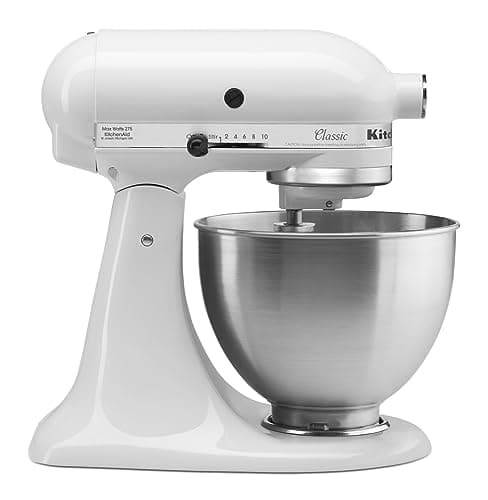
The KitchenAid Classic is the least expensive genuine KitchenAid stand mixer, and for the right baker that's the whole story. It shares the two things that make a KitchenAid a KitchenAid — the 10-speed planetary mixing action and the front PowerHub that every attachment clips into — while trimming the bowl and motor to hit a lower price.

The specifics: a 4.5-quart stainless bowl (half a quart smaller than the Artisan) and a rated 275-watt motor (the weakest in the line). In practice that means it's completely at home with single batches — a batch of cookies, a cake, whipped cream, a single loaf of soft dough — and it gets tight or works harder as you push toward double batches and stiff bread dough. For an occasional baker, none of those limits ever show up. For a weekly bread baker, they will.

What you are not giving up is the ecosystem. The Classic takes the same pasta rollers, grinders and other PowerHub attachments as the Artisan, and it holds the same reputation for parts availability and long service life. That's the case for buying the cheapest KitchenAid rather than a cheaper off-brand: you're buying into a platform, not just a mixer.

The short answer

Quick picks

#ProductBest forScorePrice
01
KitchenAid KitchenAid Classic 4.5-Qt Tilt-Head (K45SS)
KitchenAid Classic 4.5-Qt Tilt-Head (K45SS)

The cheapest way into the KitchenAid ecosystem. Slightly smaller bowl and a hair less power than the Artisan, but the same attachment hub and the same 10-speed planetary action. For occasional bakers this is the smart buy.

Budget / occasional bakers
8.0
$399.00Amazon

#ad · Live prices from the Amazon Product API, as of Aug 5, 2026. Where we have no verified live price we show none — a gap beats a number that has rotted.

In detail

The picks, in full

01
KitchenAid KitchenAid Classic 4.5-Qt Tilt-Head (K45SS)

Budget / occasional bakers

KitchenAid Classic 4.5-Qt Tilt-Head (K45SS)

275 W rated4.5-qt bowl10 speedsTilt-headPowerHub port
8.0/10

The cheapest way into the KitchenAid ecosystem. Slightly smaller bowl and a hair less power than the Artisan, but the same attachment hub and the same 10-speed planetary action. For occasional bakers this is the smart buy.

Motor / dough
7
Capacity
7
Build & durability
8
Ease of use
9
Value
9

Pros

  • Usually the lowest price for a genuine KitchenAid planetary mixer
  • Takes the same front-hub attachments as the pricier models
  • 4.5-qt bowl is plenty for single batches

Cons

  • 275 W rated motor is the weakest in the line
  • 4.5-qt bowl gets tight on a full double batch
  • Fewer bowl/color options than the Artisan

Don't buy this if…

you routinely bake double batches or bread — the extra half-quart and motor of the Artisan is worth the step up.

$399.00View on Amazon

Price as of Aug 5, 2026. Prices change — Amazon's at checkout is the one that counts.

#ad · we may earn a commission from this link to KitchenAid Classic 4.5-Qt Tilt-Head (K45SS)

Who should buy the Classic — and who should step up

Buy the Classic if…

You bake occasionally and in single batches, you want a real KitchenAid rather than a budget alternative, and you'd rather put the saved money elsewhere. It does everything a light-to-medium home baker asks, and the shared attachment hub means it can grow into pasta or grinding later without a second machine.

Step up to the Artisan if…

You bake often, make double batches, or knead bread more than occasionally. The Artisan'sextra half-quart of bowl and slightly stronger motor are exactly the headroom you'll keep reaching for, and buying it up front costs less than upgrading twice. Our Artisan vs Classic comparison lays the two side by side.

Consider a Cuisinart if attachments don't matter

If you'll never buy a pasta roller or grinder, the Cuisinart Precision Master gives you a bigger bowl and a higher rated motor for similar money — you're trading the KitchenAid ecosystem and resale value for more raw mixing capacity per dollar.

The bottom line

The Classic isn't a compromised KitchenAid — it's a right-sized one. For a baker whose hardest job is a single batch of cookie dough, paying more for motor and bowl you'll rarely use is the actual mistake.

How we picked

We don't run a testing lab

We read the manuals, compiled the published specifications, did the wattage-to-dough math and weighed aggregated owner reviews, then scored each product against a published rubric. The scores are judgments from documented research — they are notmeasurements we took, because we do not have a lab and we're not going to pretend we do. Every spec is the manufacturer's published figure, cited in Sources.

Questions

Frequently asked

What's the difference between the KitchenAid Classic and Artisan?
The Artisan has a larger 5-quart bowl (vs 4.5), a slightly stronger rated motor and more color and bowl options. Both share the same 10-speed planetary action and the same PowerHub attachment hub, so accessories fit either.
Can the KitchenAid Classic knead bread dough?
A single loaf of standard dough, yes. Its 275-watt rated motor and 4.5-quart bowl handle occasional bread comfortably, but double batches and stiff, low-hydration doughs make it work harder — for frequent bread, see the best-for-bread-dough roundup.
Is the KitchenAid Classic worth it over a cheaper off-brand mixer?
For most people, yes. You get the same attachment ecosystem, parts availability and long service life as pricier KitchenAids. A no-name mixer that costs less but has no parts support or resale value is often the false economy.

Keep reading

Receipts

Sources

We don't run a testing lab, and we don't pretend to. Specs are the manufacturer's published figures, cited above; scores are our judgments from that research. Where we couldn't verify something, we say so on the page rather than quietly leaving it out. Read our full method.