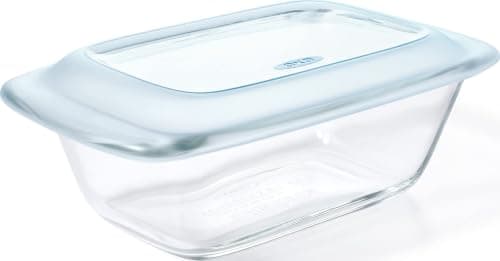
Buy the OXO Good Grips glass loaf pan if the thing you bake most is something you then cover and refrigerate. Banana bread, zucchini bread, meatloaf, a baked pâté, a bread pudding: in all of those the bake and the leftovers are the same dish, and this pan's slosh-proof lid means no transferring anything into a container. It is borosilicate glass, which is built for temperature swings, so it goes from freezer or fridge straight into the oven; it is dishwasher-, microwave- and freezer-safe; and it has actual handles, which a plain glass dish does not. It is the wrong pan for crusty yeast bread— glass browns the sides more gently than metal and leaves you a paler, softer crust, and that is physics rather than a flaw.
What you are actually buying
| Capacity | 1.6 qt |
| Material | Borosilicate glass |
| Lid | Included, slosh-proof |
| Dishwasher | Yes |
| Freezer to oven | Yes |
| Microwave | Yes |
| Broiler | No — OXO says not to |
| Who it is for | Quick breads, meatloaf, anything you cover and refrigerate |
Those are OXO's published figures, cited in Sources. The material claim is the one worth understanding, because it is the reason this pan costs more than a plain glass dish.
Borosilicate, and why it matters here
Glass bakeware comes in two broad types. Tempered soda-lime glass is the common supermarket material: strong, cheap, and vulnerable to thermal shock — a sudden temperature change across the body of the dish can shatter it, which is why those pans carry warnings about not putting a hot dish on a wet counter or adding cold liquid to a hot pan.
Borosilicate has a much lower coefficient of thermal expansion, which in plain terms means it tolerates sudden temperature changes far better. That is exactly the property this pan's whole purpose depends on: if the point is to take a covered loaf out of the fridge or freezer and put it in a hot oven, the glass has to survive that. OXO lists it as freezer-to-oven safe for that reason.
It does not make the pan indestructible. It is heavy for its size and a hard knock against a tap or a tiled floor will end it, which is true of all glass. And OXO specifically says not to use it under a broiler — direct radiant heat on one surface is a different stress from an evenly heating oven.
How glass changes the bake
Glass heats more slowly than metal and then holds that heat. Two consequences follow.
Drop the oven temperature by about 25°Fcompared with a metal-pan recipe. King Arthur's standing advice for glass is exactly that, and the reason is that glass continues to transfer heat into the edges of the bake after the metal equivalent would have stopped — so a recipe baked at its stated temperature in glass tends to over-brown the sides while the center lags. Lowering the oven and extending the time slightly fixes it.
You can see what is happening. This is a genuine advantage that gets undersold. Through the side of the pan you can watch the base crust color and judge doneness by sight rather than by skewer. For a banana bread that always seems to come out pale underneath, that visibility is the difference between guessing and knowing.
What glass will not give you is a crisp, well-browned crust on a yeasted sandwich loaf. For that, a metal pan's faster, more aggressive side-browning is what you want — glass vs metal loaf pan is the full comparison, and the best loaf pans for sandwich bread has the metal picks.
The lid is the feature
It is easy to dismiss and it is the reason to buy this pan over a steel one. A loaf pan with a sealing lid is a storage container that happens to bake. Make a meatloaf, bake it, lid it, refrigerate it, reheat it, all in one dish and with one thing to wash. Make a banana bread on Sunday, cap it and it keeps on the counter without foil. Prep a cold batter the night before, lid it in the fridge, bake it in the morning.
OXO calls the lid slosh-proof, which is a claim about carrying something wet rather than about an airtight seal — useful for taking a dish to someone else's house. Combined with the handles, which give you something to actually hold with a mitt, this is a pan designed around the whole life of the food rather than just the twenty minutes in the oven.
Who should buy it
Quick-bread bakers.Banana bread, zucchini bread, lemon loaf, pumpkin bread — sugary batters that bake long and gently are exactly what glass suits, and they are also the bakes most likely to be covered and kept.
Anyone who batch-cooks. If dinner gets made in advance and refrigerated, a bakeable container with a lid removes a step and a washing-up item every single time.
People who want one dish for savory and sweet.Glass does not take on or hold flavors, so last week's meatloaf does not haunt this week's banana bread. Bare metal is less obliging about that.
People who hate hand washing.It is dishwasher safe, which most of the good metal loaf pans are not — USA Pan and Nordic Ware both recommend hand washing.
Who should not
Yeast-bread bakers. If your loaf pan's job is sandwich bread with a proper crust, buy aluminized steel. Best loaf pans ranks those, and how to choose a loaf pan covers sizing.
Anyone who wants a 9 x 5 pan. This is a 1.6-quart dish; check the capacity against the recipes you bake, because quick-bread recipes are commonly written for either 8.5 x 4.5 or 9 x 5 metal pans and the volume is what matters. Loaf sizes explained works through the conversions.
Anyone with a crowded cupboard and clumsy hands. It is heavier than steel for the same capacity and it is glass. A steel pan survives being dropped.
Getting the best out of it
- Reduce the oven by 25°F from a metal-pan recipe and expect to add a few minutes. Start checking at the original time anyway.
- Still grease it, and consider a parchment sling. Glass is not a release surface, and a sling is how you get a loaf out of a straight-sided dish without levering at it. The method is here.
- Watch the base through the side. Use the one thing metal cannot do. A pale base means more time; a dark one means it is done regardless of what the skewer says.
- No broiler, and no empty preheating. OXO rules out the broiler, and there is no reason to preheat an empty glass dish.
- Cool before lidding. Capping a warm loaf traps steam and softens the crust you just baked. Ten minutes in the pan, out onto a rack, then lid it once cool.
The honest verdict
This is a specialist pan that happens to look like a general one. Judged as a loaf pan for bread it is mid-pack and would not make our top picks. Judged as what it actually is — a lidded, dishwasher-safe, freezer-to-oven baking dish in loaf shape — it has almost no competition, and for a kitchen whose loaf pan mostly produces banana bread and meatloaf it is the most convenient thing on the shelf. Buy it for the lid and the dishwasher, not for the crust.
If you are deciding between this and a metal pan, the two pages to read are glass vs metal loaf pan and silicone vs metal loaf pans. If you have already decided on metal, USA Pan vs Nordic Ware is the head-to-head that usually settles it.