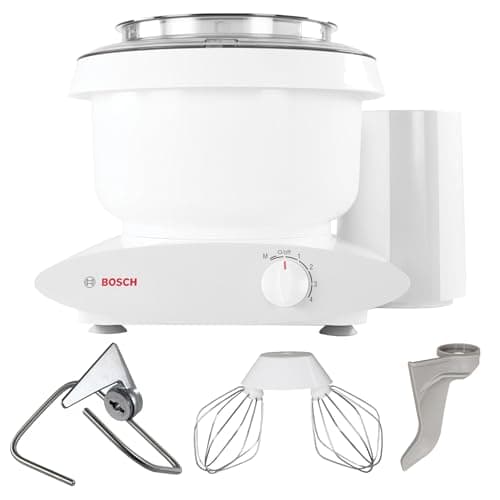
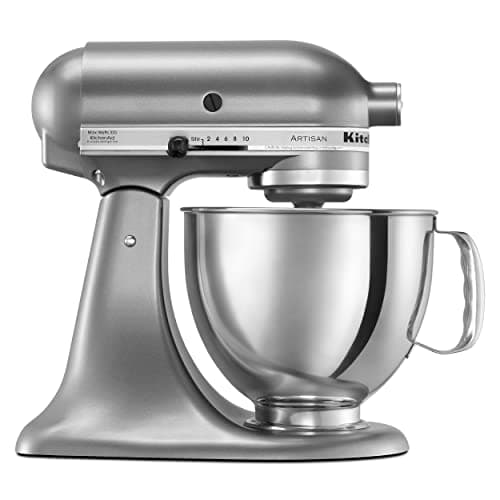
People often collapse two different stand-mixer questions into one. Tilt-head versus bowl-lift is about the geometry of the head. Planetary versus bottom-drive is about where the motor drives the tool from— and that's the one that most changes what a machine is actually good at. This is the mechanism, explained, using the two clearest examples: the planetary KitchenAid Artisan and the bottom-drive Bosch Universal Plus.
In a planetarymixer, the motor sits in the head, above the bowl, and turns a single tool — beater, whisk or dough hook — that does two things at once: it spins on its own axis while also orbiting the inside of a fixed bowl, the way a planet spins while circling the sun. That orbit is the whole trick. One tool sweeps the entire bowl, reaching the walls and the center on every pass, which is why planetary machines are so good at creaming butter evenly, whipping cream and folding batter. The KitchenAid Artisan's rated 325-watt motor and 5-quart bowl are a textbook example of the design.
In a bottom-drivemixer like the Bosch, the motor lives in the base and drives the tools from underneath a big, open bowl. Instead of one tool orbiting a still bowl, the drive spins from the bottom and the dough is worked against the bowl and the fixed hooks. That layout is built for one job above all: kneading large, stiff batches without straining. The Bosch's rated 500-watt motor and 6.5-quart bowl are quoted by the manufacturer to handle roughly 5 to 6 pounds of dough — three or four loaves' worth — in a single go, which is more than most planetary tilt-heads will finish comfortably. Read the full Bosch review and the full Artisan review for how each plays out in a real kitchen.
The trade-offs fall out of the mechanism directly, and they run in both directions. A planetary orbit covers a small quantity beautifully — a couple of egg whites, a half cup of cream, a small bowl of buttercream all get whipped because the tool physically sweeps them against the wall. A bottom-drive machine's big open bowl needs a certain volume of ingredient to work well; a single egg white can get lost down in it. Flip it around for dough: the planetary head can flex on very stiff, low-hydration dough pushed hard, and the motor works harder for it, while the bottom-drive just keeps folding heavy dough because that's what its geometry and gearing are built to do.
The rule:a planetary mixer is the versatile default — best coverage on small and medium jobs, a deep attachment ecosystem, and enough dough capacity for a loaf or two a week. A bottom-drive mixer is the specialist — the most dough capacity for the money, at the cost of finesse on small jobs, some build polish and a narrower accessory range. Match the design to what's in your bowl most weeks.
The short answer
Quick picks
| # | Product | Best for | Score | Price |
|---|
| 01 | KitchenAid Artisan 5-Qt Tilt-Head (KSM150)The default for a reason: 5-qt tilt-head, a mature attachment ecosystem, and enough motor for a couple of loaves a week. Not the mixer for daily heavy dough — but that's a small slice of home bakers. | Most home bakers | | $449.00·Amazon |
| 02 | Bosch Universal Plus Stand MixerThe bread baker's mixer. A belt-driven motor at the base and a big open bowl let it knead far more dough than a KitchenAid without straining. Less elegant, less versatile for whipping small amounts — but for loaves it's the one. | High-volume bread dough | | $499.00·Amazon |
#ad · Live prices from the Amazon Product API, as of Sep 19, 2026. Where we have no verified live price we show none — a gap beats a number that has rotted.
In detail
The picks, in full
Most home bakers
KitchenAid Artisan 5-Qt Tilt-Head (KSM150)
325 W rated5-qt bowl10 speedsTilt-headPowerHub port
The default for a reason: 5-qt tilt-head, a mature attachment ecosystem, and enough motor for a couple of loaves a week. Not the mixer for daily heavy dough — but that's a small slice of home bakers.
- Motor / dough
- 8
- Capacity
- 8
- Build & durability
- 8.5
- Ease of use
- 9
- Value
- 8.5
Pros
- +Huge attachment ecosystem (grinder, pasta, ice cream) via the front PowerHub
- +5-qt bowl handles roughly a double batch of cookie dough or 2 loaves of bread dough
- +Holds resale value and parts availability better than any rival brand
Cons
- −Tilt-head flex shows on very stiff, low-hydration dough
- −325 W rated motor is mid-pack — it will bog if you knead dense dough daily
Don't buy this if…
…you knead stiff bagel or heavy rye dough every day — a bowl-lift or a Bosch has the motor headroom you'll keep asking for.
High-volume bread dough
Bosch Universal Plus Stand Mixer
500 W rated6.5-qt bowlBottom-drive~5–6 lb doughDough hook + whisks
The bread baker's mixer. A belt-driven motor at the base and a big open bowl let it knead far more dough than a KitchenAid without straining. Less elegant, less versatile for whipping small amounts — but for loaves it's the one.
- Motor / dough
- 9.5
- Capacity
- 9.5
- Build & durability
- 8
- Ease of use
- 7.5
- Value
- 8
Pros
- +Bottom-drive motor kneads large, stiff dough batches most tilt-heads can't finish
- +6.5-qt bowl swallows 3–4 loaves' worth of dough at once
- +Lightweight for its capacity and easy to store
Cons
- −Not ideal for very small jobs — whipping one egg white gets lost in the big bowl
- −Plastic-forward build feels less premium than a cast KitchenAid
- −Smaller accessory ecosystem in the US
Don't buy this if…
…you mostly whip cream, beat butter and do single-batch baking — a tilt-head KitchenAid is friendlier for that work.
Which drive design fits your baking?
How this differs from tilt-head vs bowl-lift
Worth being precise, because it's the most common mix-up. Both the tilt-head Artisan and KitchenAid's bowl-lift machines are planetary— the tilt-head/bowl-lift choice is only about whether the head tips back or the bowl cranks up to meet it. Planetary versus bottom-drive is a separate axis: it's about whether the motor drives from the head or the base. You can read the head-geometry question on its own in our tilt-head vs bowl-lift guide; this page is the layer underneath it.
Choose a planetary mixer if…
Your baking is varied and mostly small-to-medium: cakes, cookies, whipped cream, frostings, the occasional loaf. The orbiting tool gives the best coverage on modest quantities, the attachment ecosystem (pasta, grinder, spiralizer) is far deeper, and the machine feels more refined on the counter. For the large majority of home bakers, a planetary tilt-head like the Artisan has all the capacity and versatility they'll ever use, and it does the light jobs a big open bowl fumbles.
Who it's notfor: the volume bread baker. Push a planetary head into daily heavy or low-hydration dough and it flexes and heats up — it'll do it, but it's working at its limit, and a machine run at its limit every week wears out faster.
Choose a bottom-drive mixer if…
Bread is the reason you're buying a mixer, especially in volume or with stiff, low-hydration dough. The base-driven motor and big open bowl knead three to four loaves' worth at once without the strain a planetary head shows, and it typically costs less than a premium KitchenAid while doing it — real value if dough capacity is the priority. Our best-for-bread-dough roundup ranks it against the planetary options directly.
Who it's notfor: someone who mostly whips cream, beats butter and does single-batch baking. Small amounts get lost in the big bowl, the build is more plastic-forward than a cast KitchenAid, and the US accessory range is thinner. It's a specialist, and it's honest about it.
Where footprint tips the call
Counter space cuts in a surprising direction. The planetary KitchenAid's cast body reads as the more premium appliance but is a fixed lump you leave out. The bottom-drive Bosch is lighter for its capacity and its open bowl detaches, so some bakers store it away and get a bigger working capacity without a permanently larger footprint sitting on the counter. If you want big-batch dough capacity but can't give up the counter to a heavy machine, that's a point for the bottom-drive design. Our KitchenAid vs Bosch comparison weighs the two specific machines side by side, and the wattage guide explains why the Bosch out-kneads on dough regardless of the watt figures.
How we picked
We don't run a testing lab
We read the manuals, compiled the published specifications, did the wattage-to-dough math and weighed aggregated owner reviews, then scored each product against a published rubric. The scores are judgments from documented research — they are not measurements we took, because we do not have a lab and we're not going to pretend we do. Every spec is the manufacturer's published figure, cited in Sources.
Questions
Frequently asked
What is the difference between a planetary and a bottom-drive stand mixer?+
In a planetary mixer the motor sits in the head and turns one tool that spins while orbiting a fixed bowl, sweeping the whole bowl. In a bottom-drive mixer the motor is in the base and drives the tools from under a big open bowl. Planetary designs cover small jobs better; bottom-drive designs knead large, stiff dough better.
Is a bottom-drive mixer better than a planetary one?+
Only for its specialty. A bottom-drive Bosch kneads far more dough at once without straining, which makes it better for high-volume or stiff bread. A planetary KitchenAid covers small and medium jobs better, has a deeper attachment ecosystem and a more refined build. Match the design to what you make most.
Is planetary vs bottom-drive the same as tilt-head vs bowl-lift?+
No — they're different questions. Both KitchenAid tilt-head and bowl-lift mixers are planetary; tilt-head versus bowl-lift is only about the head geometry. Planetary versus bottom-drive is about where the motor drives from. See our
tilt-head vs bowl-lift guide for the geometry question on its own.
Receipts
Sources
We don't run a testing lab, and we don't pretend to. Specs are the manufacturer's published figures, cited above; scores are our judgments from that research. Where we couldn't verify something, we say so on the page rather than quietly leaving it out. Read our full method.