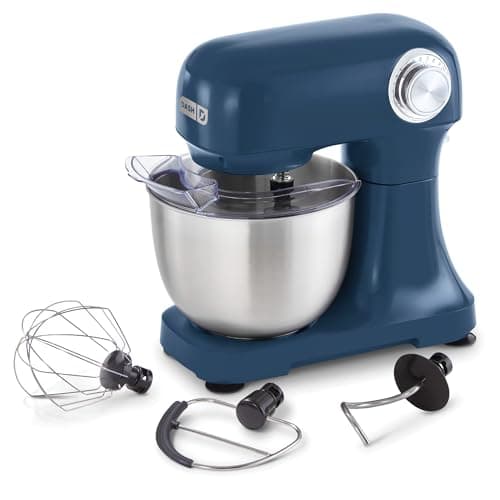
The Dash 3.5-Qt Tilt-Head Stand Mixer exists to answer one question: what is the least you can spend and still get a real stand mixer, not a hand mixer on a stick? The answer turns out to be surprisingly little. This is a genuine tilt-head planetary mixer with a paddle, a dough hook, a whisk and a splash guard in the box, for well under a hundred dollars. It is light-duty and small — and if you understand that going in, it is a lot of mixer for a small kitchen or a first-time baker.
The appeal is size and price together. At roughly six pounds and a compact footprint, it tucks into a cupboard or sits on a crowded counter without dominating it — the opposite of a thirty-pound bowl-lift. The 3.5-quart stainless bowl is right-sized for a single batch of cookies, a cake, whipped cream or a small loaf's worth of dough, and the twelve speeds plus tilt-head bowl access make it genuinely easy to use. The included dough hook, paddle, whisk and splash guard are all dishwasher-safe, which is more than some pricier mixers can say. For a student kitchen, a small apartment, or a beginner testing whether they will bake enough to justify a KitchenAid, this is a low-risk way in.
The limits are exactly what the price implies, and being honest about them is the whole point of this review. The 3.5-quart bowl and the light-duty motor are built for small batches, not heavy or high-volume work — try to knead a big, stiff bread dough and you are asking more of it than it is built for. The body is plastic-forward and does not have the cast-metal heft that lets a KitchenAid shrug off years of use; treat this as a machine for occasional-to-regular light baking, not a decade-long workhorse. And the warranty is short — one year, or two only if you register the product.
It is worth being clear about where the Dash sits against the next step up. Our Hamilton Beach 4-qt review covers the cheapest full-size stand mixer — a bigger bowl and a bit more motor for a modest step up in price and footprint. The Dash undercuts it on both price and size, which makes it the better pick specifically when space is the constraint and batches are small; the Hamilton Beach is the better pick when you want more capacity and a machine that reaches a little further into real baking. Neither is a KitchenAid, and neither pretends to be.
So the buyer is specific and real: someone with a small kitchen, a small budget, or a small amount of baking, who wants hands-free mixing without committing to a big, expensive machine. For them, the Dash does the job. Anyone who bakes bread, doubles batches, or wants a mixer to keep for a decade should read our best stand mixers for small kitchens roundup, where the Dash is weighed against slightly larger compact options, and how we pick for the standard behind these calls.
Is a mini stand mixer like the Dash right for you?
A sub-$100 mini mixer is a genuinely good buy for some kitchens and a false economy for others. Here is how to tell which you are.
Buy it if space and budget lead the decision
If your kitchen has no room for a full-size mixer, or you are not ready to spend on one, the Dash gives you real hands-free mixing in a footprint you can store. For single batches of cookies, cakes, frosting and whipped cream it does everything a beginner needs, and its low price makes it a sensible way to find out how much you will actually bake before spending more.
Match the batch to the bowl
The 3.5-quart bowl and light-duty motor set the ceiling. Stick to single batches and softer mixes and it works happily; push it with big, stiff bread dough or back-to-back heavy batches and you are working it past its design. If bread is a regular plan, skip the mini class entirely — a machine sized for dough, like the ones in our bread-dough roundup, will save you frustration.
Know it's a starter, not an heirloom
The plastic-forward build and short warranty mean this is best thought of as a first mixer or a small-kitchen mixer, not the last one you will buy. Many owners use it happily for years of light baking; few would ask it to be a lifetime workhorse. If you already know you will bake a lot, spending once on a KitchenAid Classic often works out better than replacing a budget machine later.