Scoop a cup of flour four different ways — spoon and level, dip and sweep, packed straight from the bag — and you can end up with noticeably different weights from the same measuring cup. That variation, not your recipe, is usually why the same cookies come out a little different every time you bake them. Switching to a scale removes the variable entirely: a gram of flour is a gram of flour no matter how it got into the bowl.
This matters more in baking than almost anywhere else in the kitchen, because baking is chemistry with narrow margins. A soup or a stir-fry tolerates a loose cup of vegetables without consequence. A cake batter or a bread dough is far less forgiving of extra flour packed into a cup, because that shifts the ratio of flour to fat, sugar and liquid the recipe depends on. Recipe developers write and test recipes by weight; measuring by volume is really an approximation of the weight they meant, filtered through however firmly you happen to pack a cup that day.
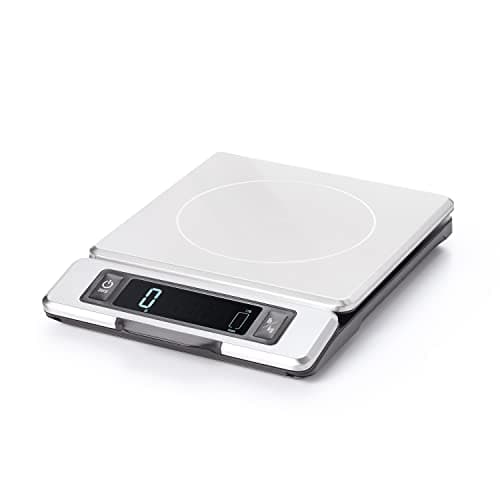
The upgrade itself is inexpensive and nearly invisible once it's part of your routine: set the bowl on the scale, hit tare, add the ingredient, watch the number. It's faster than digging out a set of measuring cups, and it rinses down to one bowl and one tool instead of a pile of cups and spoons. The OXO Good Grips 11-lb Food Scale below is the one we point people toward — a pull-out display that stays readable under a wide mixing bowl, and resolution fine enough for baking, not just rough kitchen portioning.
What actually matters in a kitchen scale
Most digital kitchen scales look similar on a shelf, but a few specs decide whether one earns a permanent spot on your counter or ends up in a drawer after a month.
Tare (zero-out) is non-negotiable
Tare lets you zero the scale with a bowl already on it, then add ingredient after ingredient and read each new weight from zero. Baking recipes routinely call for flour, then sugar, then butter, all in the same bowl — without tare you're doing subtraction in your head after every addition, which defeats the point of weighing in the first place.
Resolution: aim for 1-gram steps
A scale that only reads in 5- or 10-gram increments is fine for produce but too coarse for ingredients like yeast, salt or leavening, where a few grams changes a recipe noticeably. Look for 1-gram (or 0.1-ounce) resolution so small quantities read accurately, not just large ones.
Capacity and a readable display
Check the maximum capacity against your biggest mixing bowl of flour and liquid combined — a scale that maxes out mid-recipe is a bigger annoyance than it sounds. And make sure the display is actually visible once a bowl is sitting on the platform; a lot of scales hide their own number behind whatever you just put on them. A pull-out or angled display solves that without needing a taller, clunkier scale body.
If you bake regularly and haven't made this switch yet, it's worth pairing with the other small upgrades on this site — see our stand-mixer attachment guide for the mixer side of the same idea, or start with whether a stand mixer is worth itat all if you're building out a baking setup from scratch.